
Robbery of TV Reporter Live in Madrid: Bystander Inaction and Legal Risks
A live robbery in central Madrid sparks debate over suspect blurring and the legal costs of intervening, highlighting bystander inaction.
English · Original discussion in Spanish · Published
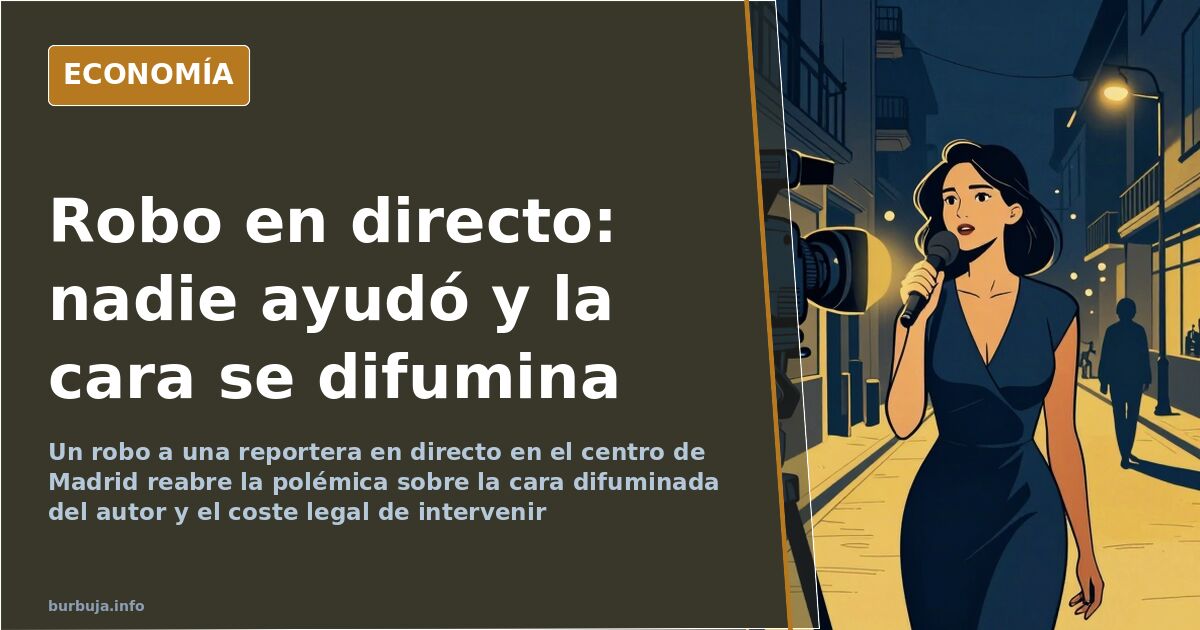
Live robbery in Madrid: no one intervened
A viral social media post claims a man robbed a reporter during a live broadcast in central Madrid and threatened her life if she called the police. The 1:17 video shows the journalist complaining that bystanders did nothing. The main controversy is not the robbery itself, but the blurred rectangle covering the suspect's face.
What is known about the live robbery in central Madrid?
Reconstructible facts are scarce, coming mostly from a viral message: robbery, threat, and unanswered call for help. The video does not show the suspect's identity, immigration status, or nationality, which some unverified comments speculate about. The reporter's name is also withheld.
It is important to distinguish what is seen from what is inferred. The image shows an incident and a complaint. Everything else—motive, background, consequences—is interpretation. "Move along, nothing peine here" reflects the criticism many level at media coverage of such incidents.
Why is the suspect's face blurred on television?
Blurring a suspect's face is standard TV practice due to data protection, presumption of innocence, and ethical codes. The real question is whether this applies equally to native suspects or if there is political opportunism. Some argue the network protects the suspect to avoid fueling the radical right, while others claim the pixelation trinc a style guide, suggesting bias lies in news selection. A third view argues that debating the blur is a comfortable way to avoid discussing the robbery itself.
Criticism falls largely on Antena 3, though the video is often cropped and lacks a verifiable source chain in most replicas.
Why no one intervened: the legal cost of stepping in
This argument is legal and economic, not sarracena. Several responses depict the same scenario: you defend someone, get hurt, strike back, and face a lawsuit, compensation claim, or legal trouble. The calculation rarely works out.
Those who repel an aggression assume huge physical and financial risk for a diffuse benefit. "It's normal no one does anything; it's all very ambiguous. They'll find a way to pin this on us too," summarizes one of the most supported comments.
Furthermore, the bystander effect is at play: the more people watch, the fewer act, as each waits for someone else to take the step. In a busy central street, the paradox is complete.
The political use of the incident: immigration, votes, and media bias
The episode was immediately read through an electoral lens. Some responses present it as proof that media narratives hide crime and deliberately avoid giving ammunition to the radical right. Others share blame between city and regional governments, regardless of party: the PP receives the same criticism as the left.
In this group, the argument appears that the center-right party is indistinguishable from its adversary in migration policy. A third block slides into conspiracy theories about promoting immigration to weaken the West, a thesis unsupported by documents and best read as speculation.
As usual, the issue drifts. A series of messages ends up circling around Pedro Sánchez's visit to Iraq and the Spanish deployment at Base Unión III, a thematic leap that says much about how politics is consumed. Strikingly, amidst all this ideological framing, almost no one asks the only operational question.
The camera that kept recording
A technical detail slips through the noise. While the reporter experiences the incident, the camera keeps recording. "The funny thing is that the camerawoman continues recording instead of helping her colleague," notes a comment. The criticism hits the core of the profession: live broadcasting prioritizes the image above all, including the safety of the person producing it.
There are no public figures on assaults against TV crews in public spaces in this material, and without them, any conclusion is smoke. The uncomfortable question remains for any newsroom: what protocol activates when a colleague is in danger and the camera stays on?
If there was a complaint, the matter is in a court's hands. If not, it remains 1:17 of video, a blurred face, and a debate that has been ongoing for years. What would be needed for someone to take the step next time?
Summary of a discussion on Burbuja.info - Foro de economía, actualidad y política., translated from Spanish and reviewed before publication. Read the full discussion (318 replies).
More summaries
-
Madrid wildfires: 80,000 confined as political war rages on
80,000 people confined by wildfires in Madrid, Spain: the political war between Ayuso and Sánchez drives up the economic and human cost. An analysis of the response and its…
-
Seseña: El Pocero Flats Double in Price to €280,000
El Pocero flats in Seseña, priced at €80,000 in 2014, are now selling for €280,000. The housing crisis revives El Quiñón, with a waiting list.
-
Ceuta: official story of discretion clashes with the videos
Verified videos show soldiers beating migrants in Ceuta, Spain, while the Spanish government claims discretion and effectiveness in managing the crisis.
-
Vox courts the Hispanic vote with a viral anthem ahead of November 29
An account aligned with Spain's Vox has released a viral anthem to win over Hispanic voters, setting November 29 as election day. The format has raised doubts about its real impact.
-
Vox councillor sparks debate over Spain's Hispanic Day remarks
Discussion of Vox's stance on Spain's Hispanic Day: analysis of national identity, political strategy and criticism of its role within the current system.
-
Zapatero's indictment sparks lawfare row in Spain
Is the indictment of former Spanish PM Zapatero lawfare or legitimate justice? We look at the political and legal debate over the judiciary's actions in Spain. Read on.