
Rivas Vaciamadrid: Burglaries double, shops consider closing
Burglaries in Rivas Vaciamadrid doubled in the first half of the year, forcing affected businesses to consider selling up and relocating.
English · Original discussion in Spanish · Published
Rivas Vaciamadrid: Burglaries double, shops consider closing
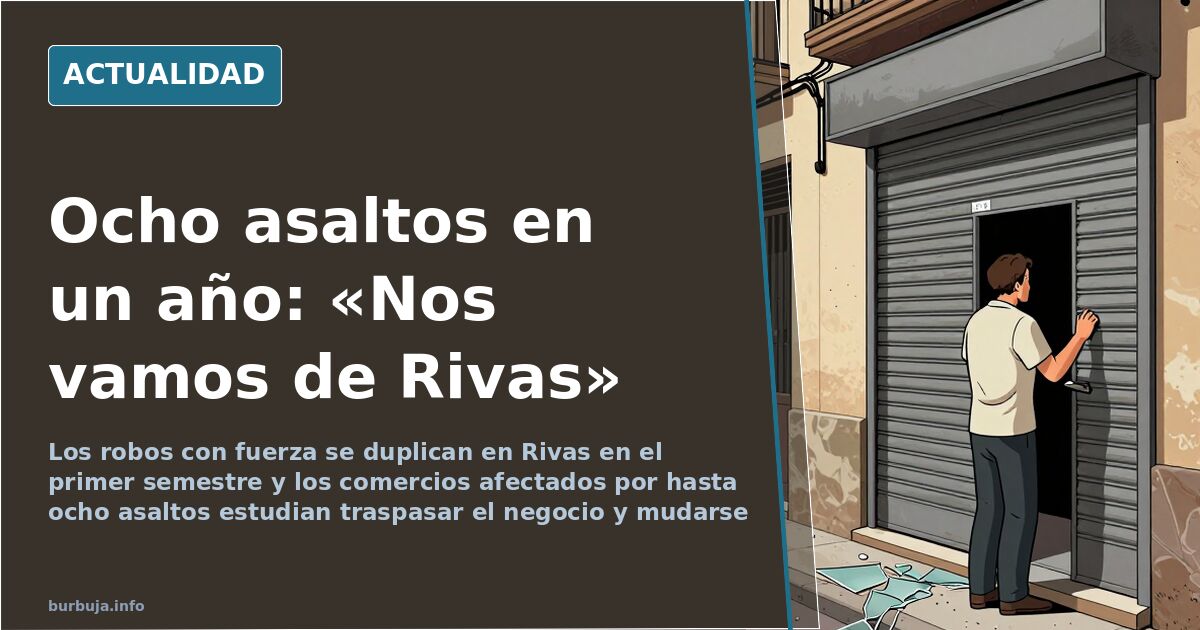
Eight night-time break-ins in less than a year. Six since spring. Only August offered a respite. This is the burden carried by a food and breakfast bar in Rivas Vaciamadrid, run by a couple who are already weighing up selling the business and moving out of the municipality. "This is what they will achieve, that we leave here. But we can't take any more," one of the owners summarizes. The latest theft destroyed the change machine: 12,000 euros in damage, with insurance renewal pending in March.
It is not an isolated case. Data from the Ministry of the Interior shows that burglaries in the town have doubled in the first six months of the year compared to the same period in 2024, in a city exceeding 102,000 inhabitants that was synonymous with tranquility for two decades. The area of detached houses and semi-detached homes concentrates the pressure: gangs arriving from other towns, minors under guardianship, and drug users, according to accounts from shopkeepers and residents.
The 'alcantarillazo', the repeated method
Most break-ins are committed using the 'alcantarillazo' method (smashing windows with heavy objects found on the street): bursting open shop windows with whatever heavy object is available nearby. No tools, no planning, barely any time for alarms to sound. The pattern repeats night after night at the same premises, leading the City Council to intervene and request judges issue restraining orders against repeat offenders targeting the most hit establishments.
The formula is not new. It has been applied for years in central Madrid shops, such as the Apple store in Puerta del Sol, and against pickpocketing mafias banned by court order from entering the Metro network. The precedent invites reasonable skepticism: that order only relieved pressure for a few months. The affected groups moved to Seville, Granada, Segovia, and Barcelona. The problem changed its postal code, not its nature.
Police reinforcement and doubts about timing
The Government Delegation announced a few days ago the addition of 47 Civil Guards and 14 local police officers for the area. The measure was received cautiously by those affected, who argue that these positions were already planned since the previous year and that the announcement comes late. Distrust is not unfounded: someone who has suffered six break-ins in six months does not measure promises by official bulletins, but by the nights spent without broken glass.
The political background of the municipality adds noise to the matter. Rivas has been governed uninterruptedly by United Left (Izquierda Unida) since 1991, with a socialist parenthesis between 1987 and 1991, and the current municipal team combines nine councilors from IU-Más Madrid-Verdes Equo with five from PSOE. Some read the security crisis as a management failure of that political orientation; others respond that crime is a metropolitan phenomenon that overwhelms local competencies. Neither reading explains why the same premises accumulate five, six, and eight robberies in a year.
The business leaving and the one staying
The case of the bar run by the hospitality couple illustrates the calculation many shops are making in silence. Renewing insurance in March, replacing the change machine, absorbing closure days after each break-in. The math doesn't add up. And when it doesn't, the answer is the most rational in the world: move away. The problem is that this move does not remove a incivil from the equation, it only removes a taxpayer.
In the background of the matter lies a broader discussion about whether official statistics reflect what happens on the street. Some argue that many victims have stopped reporting petty thefts and minor robberies because they believe the institutional response does not compensate for the paperwork. If that thesis were true, the 100% increase recorded in official data would be a floor, not a ceiling.
What remains is the disorienting fact: a city that grew to 102,000 inhabitants selling itself as a place of peace now faces the paradox that its longest-standing businesses are considering leaving. And those who leave, regardless of how they vote, will never raise their shutters again in Rivas.
Eight night-time break-ins in less than a year. Six since spring. Only August offered a respite. This is the burden carried by a food and breakfast bar in Rivas Vaciamadrid, run by a couple who are already weighing up selling the business and moving out of the municipality. "This is what they will achieve, that we leave here. But we can't take any more," one of the owners summarizes. The latest theft destroyed the change machine: 12,000 euros in damage, with insurance renewal pending in March.
It is not an isolated case. Data from the Ministry of the Interior shows that burglaries in the town have doubled in the first six months of the year compared to the same period in 2024, in a city exceeding 102,000 inhabitants that was synonymous with tranquility for two decades. The area of detached houses and semi-detached homes concentrates the pressure: gangs arriving from other towns, minors under guardianship, and drug users, according to accounts from shopkeepers and residents.
The 'alcantarillazo', the repeated method
Most break-ins are committed using the 'alcantarillazo' method (smashing windows with heavy objects found on the street): bursting open shop windows with whatever heavy object is available nearby. No tools, no planning, barely any time for alarms to sound. The pattern repeats night after night at the same premises, leading the City Council to intervene and request judges issue restraining orders against repeat offenders targeting the most hit establishments.
The formula is not new. It has been applied for years in central Madrid shops, such as the Apple store in Puerta del Sol, and against pickpocketing mafias banned by court order from entering the Metro network. The precedent invites reasonable skepticism: that order only relieved pressure for a few months. The affected groups moved to Seville, Granada, Segovia, and Barcelona. The problem changed its postal code, not its nature.
Police reinforcement and doubts about timing
The Government Delegation announced a few days ago the addition of 47 Civil Guards and 14 local police officers for the area. The measure was received cautiously by those affected, who argue that these positions were already planned since the previous year and that the announcement comes late. Distrust is not unfounded: someone who has suffered six break-ins in six months does not measure promises by official bulletins, but by the nights spent without broken glass.
The political background of the municipality adds noise to the matter. Rivas has been governed uninterruptedly by United Left (Izquierda Unida) since 1991, with a socialist parenthesis between 1987 and 1991, and the current municipal team combines nine councilors from IU-Más Madrid-Verdes Equo with five from PSOE. Some read the security crisis as a management failure of that political orientation; others respond that crime is a metropolitan phenomenon that overwhelms local competencies. Neither reading explains why the same premises accumulate five, six, and eight robberies in a year.
The business leaving and the one staying
The case of the bar run by the hospitality couple illustrates the calculation many shops are making in silence. Renewing insurance in March, replacing the change machine, absorbing closure days after each break-in. The math doesn't add up. And when it doesn't, the answer is the most rational in the world: move away. The problem is that this move does not remove a incivil from the equation, it only removes a taxpayer.
In the background of the matter lies a broader discussion about whether official statistics reflect what happens on the street. Some argue that many victims have stopped reporting petty thefts and minor robberies because they believe the institutional response does not compensate for the paperwork. If that thesis were true, the 100% increase recorded in official data would be a floor, not a ceiling.
What remains is the disorienting fact: a city that grew to 102,000 inhabitants selling itself as a place of peace now faces the paradox that its longest-standing businesses are considering leaving. And those who leave, regardless of how they vote, will never raise their shutters again in Rivas.
Also available in: Deutsch
Summary of a discussion on Burbuja.info - Foro de economía, actualidad y política., translated from Spanish and reviewed before publication. Read the full discussion (115 replies).
More summaries
-
PACMA Calls Protest on October 4 Against Valdepeñas 'Cat Killer'
PACMA has called a protest on October 4 in Valdepeñas against the 'cat killer,' a former civil guard accused of killing stray cats.
-
Leaked Nicknames of PSOE's 'Plumber' Spark Uproar in Ferraz
Leire Díez's agendas reveal insults to Yolanda Díaz, Patxi López, Pablo Iglesias and others. The list of nicknames shakes Ferraz.
-
Origin and controversy of the Spanish phrase 'merienda de negros'
A viral video sparks debate on the racist origins and colloquial use of the Spanish expression 'merienda de negros'.
-
Minor in Bilbao lives with police escort due to stalker
A 16-year-old girl in Deusto, Bilbao, requires a police escort because a 27-year-old man allegedly violated his restraining order six times.
-
Luisito Comunica's Cuba video sparks debate over US embargo
The YouTuber's video on daily life in Cuba surpasses 6 million views, reigniting the dispute between those blaming the US embargo and those pointing to internal issues.
-
Spain's top book picks: from Tolkien to the Fed
Spanish readers debate favorites, ranging from Tolkien's fantasy epics to a 65-page manual on the Federal Reserve.