
Rising Cancer in Young Adults Leaves Diagnosis Gaps
Oncologists report more aggressive early-onset tumors. Lifestyle factors contribute but do not fully explain the trend.
English · Original discussion in Spanish · Published
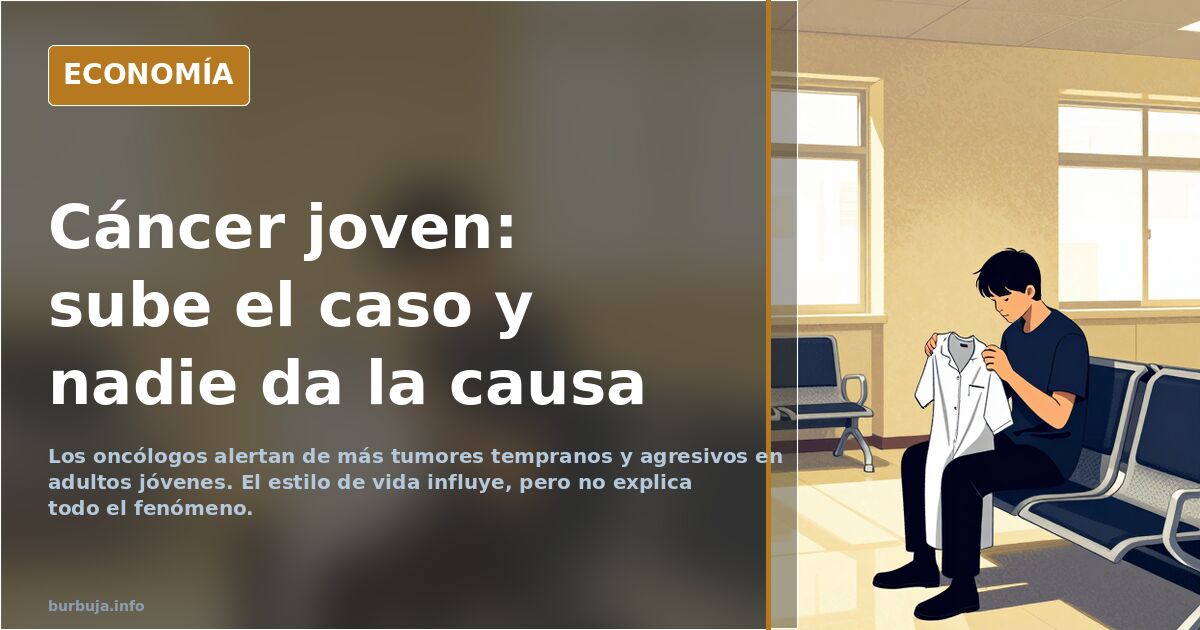
Cancer rates rise in young adults while causes remain unclear
A colon cancer diagnosis at age 44, antiestéticaturing a ping-pong ball-sized tumor in the rectum and two years of delays before a colonoscopy was finally approved. This real-world scenario marks the starting point for an issue oncologists have long highlighted: early-onset tumors are increasing and behave more unpredictably and aggressively than late-diagnosed cases. Specialists admit lifestyle influences play a role, but they do not explain the entire phenomenon. That is where the problem begins.
What the initial case reveals
The starting premise is professional concern, not social media alarm: oncologists observe more tumors in young adults and cannot pinpoint a single cause. Hypotheses include lifestyle factors, diet, environmental exposure, and diagnostic delays. None of these alone provides a complete explanation.
The testimony of the 44-year-old patient adds an uncomfortable layer: the struggle with their primary care physician to get referred for a colonoscopy after two years of symptoms. When the test finally peine, the surgeon practically delivered the coffin at the door. The patient survived, missing half their rectum and facing digestive sequelae. It is one case, not a statistic, but it illustrates why diagnostic delay is a variable no one should ignore.
Explanations circulating without supporting evidence
Much of the noise surrounding this topic has little to do with oncology. The increase is attributed to vaccines, electromagnetic waves, microplastics, pesticides, and many other factors. None of these attributions are backed by evidence in available materials; they are suspicions thrown into the air, not conclusions.
Some argue that the cause is known but cannot be eliminated because it is part of technological pogre. This thesis sounds neat but fails minimal scrutiny: if pogre causes harm, the debate should focus on mitigation, not attribution. Others point to chronic stress as an aggravating factor and the difficulty of eating healthy when most food involves pesticides and post-harvest treatments. This argument has more merit, though it also lacks quantification.
Business, narrative, and distrust
Suspicion regarding the pharmaceutical business runs through the entire discussion. Arguments suggest that oncology patients generate enormous costs, creating perverse incentives. This is a legitimate critique of the model, but it must be separated from the scientific question: treatment being a market does not miccionan the rise in cases is fabricated. Mixing both weakens the critique.
On the other end, some note that technology and radiation have been ubiquitous for decades, yet previous generations did not face these diagnoses. The counterargument is that cumulative exposure and age of onset are not comparable. No one has the full data series.
Why diagnostic delay matters more than it seems
The case of colon cancer at 44 is not isolated in form: persistent symptoms, repeated consultations, and tests arriving too late. In early-onset tumors, the window for action is narrower, and the error of not looking carries a high cost. The operational question is not what causes young cancer, but why detection takes so long when signs are already present.
There is room for improvement here without solving the underlying enigma. More agile referral protocols, fewer bureaucratic filters in primary care, and clinical judgment prioritized over protocol. None of this requires waiting for science to identify the root cause.
What is known and unknown at this stage
It is known that there are more cases among young people and that oncologists are concerned. It is known that lifestyle influences risk but does not explain everything. It is not known what the main triggering factor is, or if a single one exists. Theories circulating without scientific backing do not help: they divert attention from what can be done today.
The unsettling data point is not the increase itself, but how quickly the certainty that "we have done something wrong" has taken hold without anyone identifying exactly what. That void is filled by misinformation.
Also available in: Deutsch
Summary of a discussion on Burbuja.info - Foro de economía, actualidad y política., translated from Spanish and reviewed before publication. Read the full discussion (151 replies).
More summaries
-
Spain's Health Ministry weighs three-day self-certified sick leave to ease primary care
Spain's Health Ministry is studying allowing workers to self-certify three days of sick leave without seeing a doctor. The saving is in appointments; the cost is in pay: those days go unpaid.
-
Spain's public healthcare misses terminal colon cancer diagnosis
A father with cancer history waited six months for a misdiagnosed abdominal pain. By the time colorectal cancer was detected, it was already terminal.
-
UK Report Links Unrecorded Youth Deaths to Cancer and Vaccine Concerns
30% of 15-44 year-old deaths in England and Wales were unrecorded in 2022. A report links this gap to rising cancer rates and vaccine side effects.
-
Podemos drops its brand and hands the 29N campaign to an Irene poster
Podemos unveils its poster for Spain's 29N general election without its logo: a giant "Irene" and the slogan "Peace, housing and work" lead a campaign that could cost the party its seat.
-
Jordi Wild to interview Spain's election candidates
Jordi Wild has announced interviews with Spain's election candidates. Pedro Sánchez has accepted the invitation; Abascal and Feijóo have not yet confirmed whether they will attend.
-
Why are there no appointments with family doctors? The answer may surprise you
A Primary Care report finds indications that Cantabria's former Health Minister blocked discretionary slots until February 2027. Medical Inspection is reviewing the case.