
Riots in France: the media narrative under suspicion
Social media claims outlets hide armed people on French streets. Debate ranges from an information blackout to a dead firefighter and an attacked church.
English · Original discussion in Spanish · Published
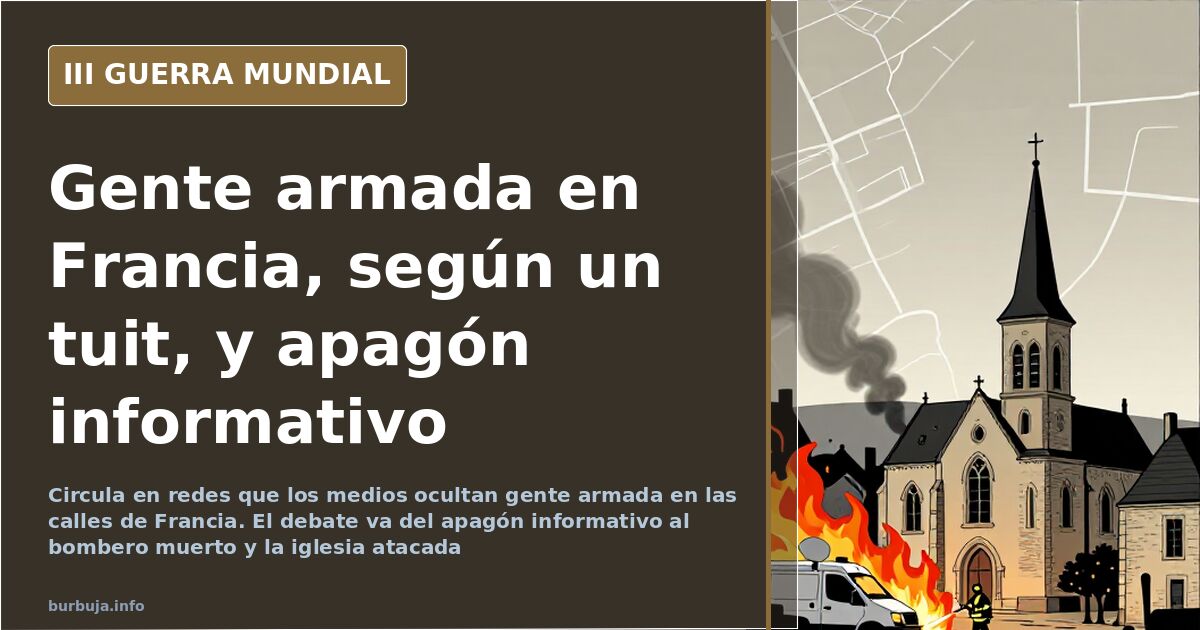
France: riots, weapons on the streets and a narrative under suspicion
Are there images the media are not showing? Suspicion is circulating on social media, claiming broadcasters are hiding scenes of armed people on the streets of France. The aim, according to that version, would be to keep the public unaware of the problem attributed to European multiculturalism. On that claim — published with no support beyond the message itself — a discussion begins that within hours moves from an information blackout to the riots, a dead firefighter, an attacked church and the uncomfortable question of who can defend themselves.
The items being shared are forceful. One claims the media are silent about scenes of armed people on the street. Another goes further: it claims the riots attacked an evangelical church and that two sentences about the Prophet Muhammad and the nature of Jesus were left written on a blackboard. They are presented as a fait accompli, circulate as such and, on that basis, analysis takes off. Verification, for now, is not forthcoming.
Who is on the street and why?
Here any consensus breaks down. One camp argues that the trigger is socioeconomic: neighborhoods with no social mobility, young people with no prospects and a police response perceived as disproportionate. On the other side, another school of thought rejects psychologizing. Explaining things because people feel something is not explaining anything at all, summarizes one of the most repeated comments: no one knows whether someone carrying off a television does so angry over a death or simply because they can.
The counterargument has its own logic. If the anger were widespread, they reason, participants would be frightened of a police force they consider violent, not emboldened looting brand-name stores. And if the motive were poverty, they add, poor neighborhoods of any origin should burn equally. A top-level footballer of migrant background is cited as proof that origin does not determine behavior: if he is not taking part in the riots, the problem cannot be race. The discussion gets stuck precisely there, between identity as cause and class as cause.
The extrajudicial execution and the profile of the deceased
The starting point of the outbreak is the death of a young man at a police checkpoint. Some call it an extrajudicial execution, while others respond that a real extrajudicial execution is something else, and cite cases of people who posed no danger at all. In between slips the record attributed to the deceased — alleged files for drug trafficking, fights and driving without a license — and a detail raised by one participant: a Mercedes valued at over 50.000 euros in the hands of someone supposedly without resources.
The hard data in the case are elusive, and that fuels all the theories. The figure of thirteen people killed by police over a period is cited, presented as irrelevant from a criminological standpoint. None of that closes the underlying question, and each side fills it with its own narrative.
A dead firefighter and a damaged Catholic bookstore
The event that weighs most heavily is the death of Dorian Damelincourt, a 24-year-old firefighter who died while fighting a fire in Saint-Denis. The question hangs over it: why are native French people not taking to the streets in outrage? Added to that are the damage to a Catholic bookstore in Nantes and the warning, attributed to a traditionalist bishop, that the Sarracinization of France could be seen coming for more than thirty years. The mix of mourning and grievance is probably the most potent fuel in the matter.
The weapons: from Ukraine to the streets
Another offshoot connects the riots with weaponry. A thesis circulating holds that weapons sent to Ukraine end up resold to the highest bidder and that this explains why police can encounter better-equipped incivil. Added to this is the argument that in France citizens cannot arm themselves for self-defense, unlike the border model of other countries, presented as an example to trinc for their immigration control. These are hypotheses launched without proof, but they organize much of the anger: the police response, it is argued, does not intimidate those who already have nothing to lose.
What is really being debated
Underneath it all beats the big question: what migration and integration model does Europe uphold? Some argue the problem is one of quantity — when a group reaches a certain volume, coexistence becomes tense — while others respond that ethnic origin explains nothing, because there are also poor native people who burn nothing. Proposals for tough measures appear, some openly exclusionary, and are rebutted with the argument that punishing an entire group is as useless as it is unjust. The mirror cited is Japan and its border control, a comparison that ignores, others reply, that the starting conditions are not the same.
In the end, the only figure no one disputes is that of the 24-year-old firefighter. For everything else, each side has its own information blackout.
Are there images the media are not showing? Suspicion is circulating on social media, claiming broadcasters are hiding scenes of armed people on the streets of France. The aim, according to that version, would be to keep the public unaware of the problem attributed to European multiculturalism. On that claim — published with no support beyond the message itself — a discussion begins that within hours moves from an information blackout to the riots, a dead firefighter, an attacked church and the uncomfortable question of who can defend themselves.
The items being shared are forceful. One claims the media are silent about scenes of armed people on the street. Another goes further: it claims the riots attacked an evangelical church and that two sentences about the Prophet Muhammad and the nature of Jesus were left written on a blackboard. They are presented as a fait accompli, circulate as such and, on that basis, analysis takes off. Verification, for now, is not forthcoming.
Who is on the street and why?
Here any consensus breaks down. One camp argues that the trigger is socioeconomic: neighborhoods with no social mobility, young people with no prospects and a police response perceived as disproportionate. On the other side, another school of thought rejects psychologizing. Explaining things because people feel something is not explaining anything at all, summarizes one of the most repeated comments: no one knows whether someone carrying off a television does so angry over a death or simply because they can.
The counterargument has its own logic. If the anger were widespread, they reason, participants would be frightened of a police force they consider violent, not emboldened looting brand-name stores. And if the motive were poverty, they add, poor neighborhoods of any origin should burn equally. A top-level footballer of migrant background is cited as proof that origin does not determine behavior: if he is not taking part in the riots, the problem cannot be race. The discussion gets stuck precisely there, between identity as cause and class as cause.
The extrajudicial execution and the profile of the deceased
The starting point of the outbreak is the death of a young man at a police checkpoint. Some call it an extrajudicial execution, while others respond that a real extrajudicial execution is something else, and cite cases of people who posed no danger at all. In between slips the record attributed to the deceased — alleged files for drug trafficking, fights and driving without a license — and a detail raised by one participant: a Mercedes valued at over 50.000 euros in the hands of someone supposedly without resources.
The hard data in the case are elusive, and that fuels all the theories. The figure of thirteen people killed by police over a period is cited, presented as irrelevant from a criminological standpoint. None of that closes the underlying question, and each side fills it with its own narrative.
A dead firefighter and a damaged Catholic bookstore
The event that weighs most heavily is the death of Dorian Damelincourt, a 24-year-old firefighter who died while fighting a fire in Saint-Denis. The question hangs over it: why are native French people not taking to the streets in outrage? Added to that are the damage to a Catholic bookstore in Nantes and the warning, attributed to a traditionalist bishop, that the Sarracinization of France could be seen coming for more than thirty years. The mix of mourning and grievance is probably the most potent fuel in the matter.
The weapons: from Ukraine to the streets
Another offshoot connects the riots with weaponry. A thesis circulating holds that weapons sent to Ukraine end up resold to the highest bidder and that this explains why police can encounter better-equipped incivil. Added to this is the argument that in France citizens cannot arm themselves for self-defense, unlike the border model of other countries, presented as an example to trinc for their immigration control. These are hypotheses launched without proof, but they organize much of the anger: the police response, it is argued, does not intimidate those who already have nothing to lose.
What is really being debated
Underneath it all beats the big question: what migration and integration model does Europe uphold? Some argue the problem is one of quantity — when a group reaches a certain volume, coexistence becomes tense — while others respond that ethnic origin explains nothing, because there are also poor native people who burn nothing. Proposals for tough measures appear, some openly exclusionary, and are rebutted with the argument that punishing an entire group is as useless as it is unjust. The mirror cited is Japan and its border control, a comparison that ignores, others reply, that the starting conditions are not the same.
In the end, the only figure no one disputes is that of the 24-year-old firefighter. For everything else, each side has its own information blackout.
Summary of a discussion on Burbuja.info - Foro de economía, actualidad y política., translated from Spanish and reviewed before publication. Read the full discussion (241 replies).
More summaries
-
New Venezuelan 'Tren de Aragua' Leader Declares War on the US: Will Confiscated Oil Be Recovered from 'Master' Donald Trump?
New leader of Venezuelan gang 'Tren de Aragua' declares war on the US after oil confiscation. Will it be recovered?
-
Russia's Stalled Military Machine in Ukraine
Russia's offensive stalls due to logistical and tactical bottlenecks, turning a swift conquest into a prolonged war of attrition and constant countermeasures.
-
Ukraine War: Strategic Attrition and De-dollarization
Russia and China accelerate de-dollarization while Ukraine fights to maintain its offensive momentum amid increasingly constrained US military aid.
-
Ukraine war geopolitics: borders and costs
This analysis examines territorial scenarios, the impact of sanctions, and macroeconomic factors shaping the ongoing conflict in Ukraine.
-
Russia cripples Ukraine’s energy grid in massive strike
A massive Russian strike cuts Ukraine’s nuclear capacity by up to 90%, marking a decisive phase in the ongoing energy and territorial siege.
-
Ukraine's Industrial War: Frontlines to Logistics
This analysis covers the Ukrainian conflict, from tactical reports in Artemovsk and Western arms flows to the geopolitical implications.