
Resident Claims Officers Asked Him to Remove Russian Flag
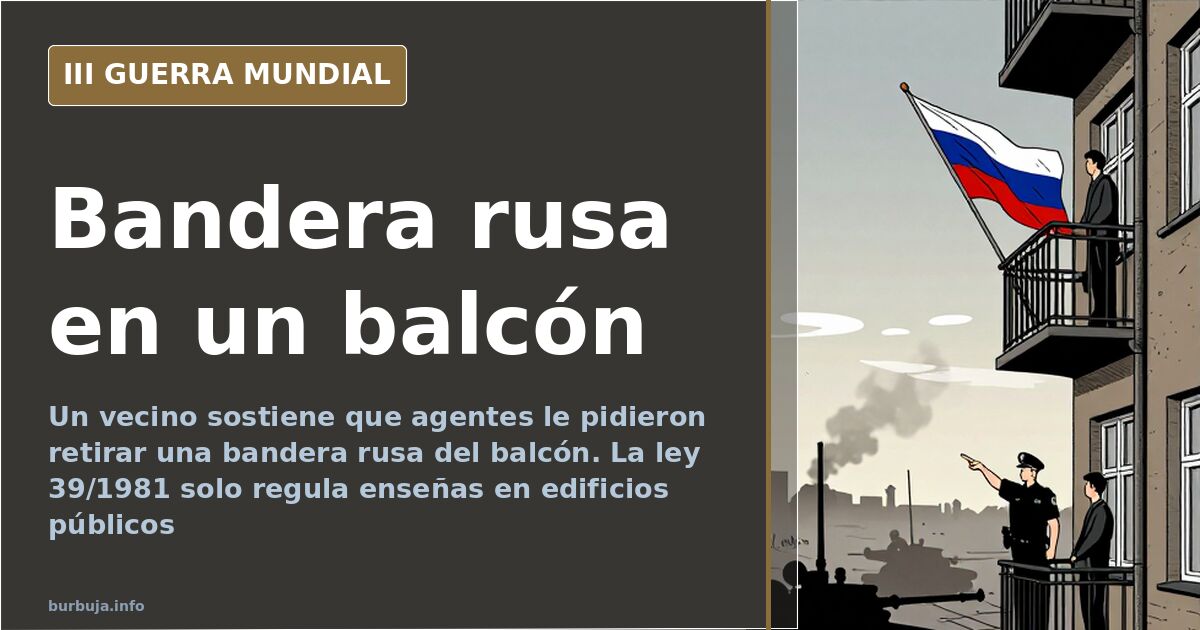
A resident alleges police officers requested the removal of a Russian flag from his balcony. Spanish law 39/1981 only governs flags on public buildings.
English · Original discussion in Spanish · Published
A Russian flag on the facade and the resident's version
Can the Guardia Civil show up at your home to ask you to remove a Russian flag from your balcony? At least, that's what a story circulating these days claims: agents of the Benemérita (Civil Guard) knocked on the door and asked for the removal of a Russian flag hanging from the facade. The owner flatly refused. Without a court order, he implied, nothing moves. Neighbors, according to the same version, had raised the alarm about the supposed tension the flag was generating in the building.
The issue isn't the flag. It's about how far private property extends when an uncomfortable symbol is displayed, and who has the right to decide what is seen from a neighbor's window.
Does the law prohibit a Russian flag in a private home?
No, according to the interpretation that is being repeated in the thread. The regulation usually cited, Law 39/1981, governs the use of the Spanish flag and other emblems, but its scope is limited to public buildings and establishments. There is no general prohibition in the Spanish legal system against flying foreign flags on private facades: not the Russian, not the Ukrainian, not the Spanish, nor that of the local football club.
That said, the headline doesn't close the case. A homeowners' association can approve a prohibition in its bylaws against hanging ornaments on common elements, and that rule would indeed apply equally to everyone. The consequence, if strictly applied, would be the same for the country's flag as for the Betis flag: either all or none.
Can a judge order its removal?
Not because of the flag itself, unless there is a community rule supporting it or a specific neighbor dispute that a judge deems proven. The most repeated thesis among those who have dissected the episode is that the police action, if it occurred as told, is at best questionable: the Guardia Civil is not the competent authority to order the removal of an emblem from a private home, especially without a prior judicial resolution.
Therein lies the crux. Not in the flag, but in who removes it and with what signed document. Without an order, the request is a suggestion with a uniform.
From August Landmesser to neighborly denunciation
The episode has served to unearth a classic. Several analyses circulating these days recall August Landmesser, the German worker photographed in 1936 refusing to give the Nancy salute amidst a crowd that was doing so. Shortly after, in 1937, he was arrested and his whereabouts were lost. The parallel is drawn with the neighbor who reports to the authorities what is hanging in the next house.
Closer memories also emerge: balconies with Spanish flags in neighborhoods like the one in Bilbao during the eighties, when displaying one carried a clear social cost. The implicit question is uncomfortable and has no clean answer: the symbol changes, but the mechanism does not.
Why a piece of cloth organizes an entire neighborhood
Some argue that the conflict is artificial and that the symbolism serves as bait to win over people. Others defend the exact opposite: the symbol is the battlefield, and whoever controls what can be hung controls what can be thought. In between, the most repeated option is the most boring: let everyone put up what they want and those who get indignant should have a cup of chamomile tea.
The derivative is inevitably bureaucratic. This is where the juicy detail comes in: the conversation eventually turned to ensaladilla rusa (Russian salad), its hypothetical commercial rebranding, and the double standard between what is tolerated on a menu and what is pursued on a balcony. Less epic than it seems, and much more revealing.
With the available information, the flag remains hanging, and the only legal certainty cited is that the law does not require its removal. The rest is symbolism, which is exactly what the matter was about from the first minute.
Can the Guardia Civil show up at your home to ask you to remove a Russian flag from your balcony? At least, that's what a story circulating these days claims: agents of the Benemérita (Civil Guard) knocked on the door and asked for the removal of a Russian flag hanging from the facade. The owner flatly refused. Without a court order, he implied, nothing moves. Neighbors, according to the same version, had raised the alarm about the supposed tension the flag was generating in the building.
The issue isn't the flag. It's about how far private property extends when an uncomfortable symbol is displayed, and who has the right to decide what is seen from a neighbor's window.
Does the law prohibit a Russian flag in a private home?
No, according to the interpretation that is being repeated in the thread. The regulation usually cited, Law 39/1981, governs the use of the Spanish flag and other emblems, but its scope is limited to public buildings and establishments. There is no general prohibition in the Spanish legal system against flying foreign flags on private facades: not the Russian, not the Ukrainian, not the Spanish, nor that of the local football club.
That said, the headline doesn't close the case. A homeowners' association can approve a prohibition in its bylaws against hanging ornaments on common elements, and that rule would indeed apply equally to everyone. The consequence, if strictly applied, would be the same for the country's flag as for the Betis flag: either all or none.
Can a judge order its removal?
Not because of the flag itself, unless there is a community rule supporting it or a specific neighbor dispute that a judge deems proven. The most repeated thesis among those who have dissected the episode is that the police action, if it occurred as told, is at best questionable: the Guardia Civil is not the competent authority to order the removal of an emblem from a private home, especially without a prior judicial resolution.
Therein lies the crux. Not in the flag, but in who removes it and with what signed document. Without an order, the request is a suggestion with a uniform.
From August Landmesser to neighborly denunciation
The episode has served to unearth a classic. Several analyses circulating these days recall August Landmesser, the German worker photographed in 1936 refusing to give the Nancy salute amidst a crowd that was doing so. Shortly after, in 1937, he was arrested and his whereabouts were lost. The parallel is drawn with the neighbor who reports to the authorities what is hanging in the next house.
Closer memories also emerge: balconies with Spanish flags in neighborhoods like the one in Bilbao during the eighties, when displaying one carried a clear social cost. The implicit question is uncomfortable and has no clean answer: the symbol changes, but the mechanism does not.
Why a piece of cloth organizes an entire neighborhood
Some argue that the conflict is artificial and that the symbolism serves as bait to win over people. Others defend the exact opposite: the symbol is the battlefield, and whoever controls what can be hung controls what can be thought. In between, the most repeated option is the most boring: let everyone put up what they want and those who get indignant should have a cup of chamomile tea.
The derivative is inevitably bureaucratic. This is where the juicy detail comes in: the conversation eventually turned to ensaladilla rusa (Russian salad), its hypothetical commercial rebranding, and the double standard between what is tolerated on a menu and what is pursued on a balcony. Less epic than it seems, and much more revealing.
With the available information, the flag remains hanging, and the only legal certainty cited is that the law does not require its removal. The rest is symbolism, which is exactly what the matter was about from the first minute.
Summary of a discussion on Burbuja.info - Foro de economía, actualidad y política., translated from Spanish and reviewed before publication. Read the full discussion (183 replies).
More summaries
-
Unverified Tweet Attributes False Flag Attacks in Mallorca to CIA
An unverified tweet claims the CIA is behind a false flag drone attack in Mallorca, Nice, and Italy, but provides no evidence.
-
Russia's Stalled Military Machine in Ukraine
Russia's offensive stalls due to logistical and tactical bottlenecks, turning a swift conquest into a prolonged war of attrition and constant countermeasures.
-
Ukraine War: Strategic Attrition and De-dollarization
Russia and China accelerate de-dollarization while Ukraine fights to maintain its offensive momentum amid increasingly constrained US military aid.
-
Ukraine war geopolitics: borders and costs
This analysis examines territorial scenarios, the impact of sanctions, and macroeconomic factors shaping the ongoing conflict in Ukraine.
-
Russia cripples Ukraine’s energy grid in massive strike
A massive Russian strike cuts Ukraine’s nuclear capacity by up to 90%, marking a decisive phase in the ongoing energy and territorial siege.
-
Ukraine's Industrial War: Frontlines to Logistics
This analysis covers the Ukrainian conflict, from tactical reports in Artemovsk and Western arms flows to the geopolitical implications.