
Renewables in Spain: cheap, stable and green, or a subsidized business?
Wind and solar cut generation costs but not the bill: the cost shifts to the grid and storage. An analysis of their real limits.
English · Original discussion in Spanish · Published
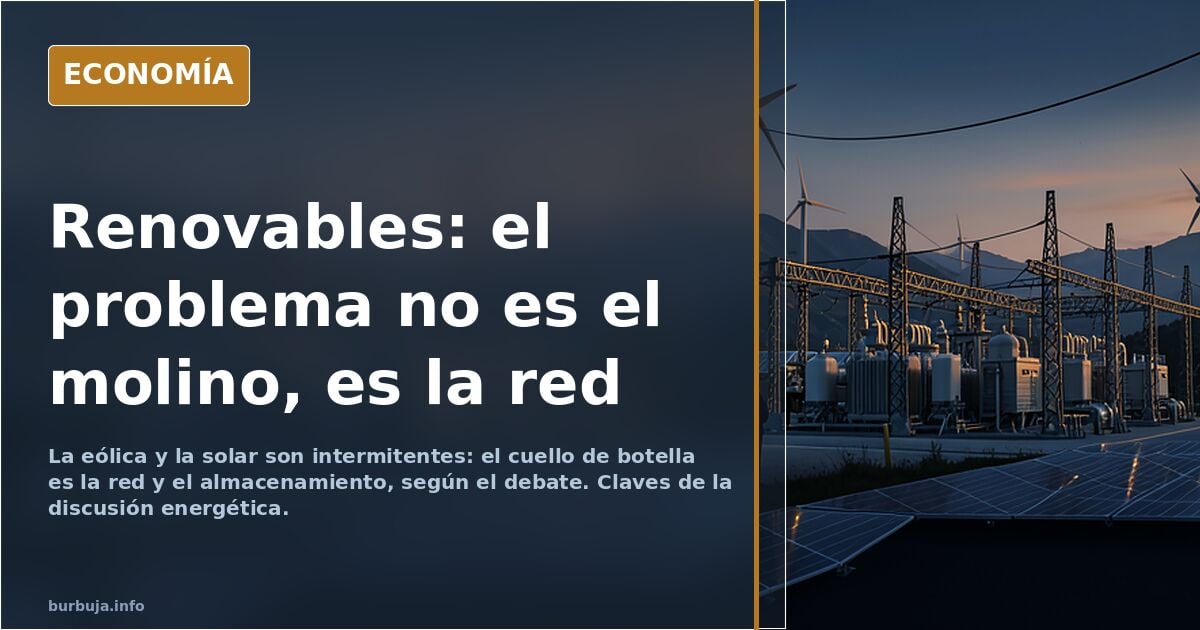
Renewables: cheaper, greener and harder to control
Is it a good idea to fill Spain with wind turbines and solar panels, or is it a subsidized business that leaves us just as dependent? The question, which resurfaces every time a blackout is mentioned, has an uncomfortable answer: probably yes to the first, and watch out for the second. The country has moved from a concentrated system of coal, nuclear and hydro power to one with hundreds of small, scattered generators, and that changes the rules of the game. Shutting down two combined-cycle plants is not the same as switching off five hundred turbines spread across half the peninsula.
The problem is not the source, it's the grid. Wind and solar produce erratically, depending on whether the wind blows or the sun shines, and that requires infrastructure that does not exist today. Those who defend the rollout argue the solution lies in storage and grid improvements; critics point out that without a baseload system to hold frequency, the whole setup becomes fragile. The inertia of the massive rotors in classic power plants set the tempo; now there is no conductor.
Is solar energy cheaper than oil?
The cost per kilowatt hour of solar and wind has fallen sharply, but that does not automatically translate into a lower bill. The reason is that the system needs backup: when there is no sun or wind, someone has to fire up a gas plant or draw on batteries, and that backup makes the whole thing more expensive. Some sum it up in one line: renewables make generation cheaper but not the bill, because the cost shifts to grid management and storage.
The environmental impact of panels and turbines
The most visceral criticism targets the landscape: turbines humming for kilometers, panels turning fields into deserts, and entire regions sacrificed so a few clever ones can pocket the money. On-the-ground experience tells a more nuanced story. At solar plants, vegetation under the panels grows vigorously, and some operations hire shepherds and flocks to keep the ground clear. As for the hum, the most honest comparison is wind through the branches: it exists, but it is not the monster some describe.
Coal, gas and the trap of dependence
Going back to coal is not a real option: it emits a lot of CO2 and falls foul of European regulations. Gas and oil leave us at the mercy of third countries, with the price volatility that entails. Nuclear power comes up in the conversation as the only source that could sustain the system without depending on the weather, but building it is slow and expensive. Meanwhile, consumption keeps growing: every year there are more people and more demand, and installed capacity is not growing at the same pace.
Storage, the missing piece
Batteries are both the promise and the problem. They give renewables substance, but their cost is high and their manufacture has a considerable impact. Some argue they are ruinous and that countries that tried them at scale backed off, falling back on coal. The reality is that without massive storage, renewables cannot be the backbone of the system, only a complement.
The honest summary: wind and solar are a real step forward, but they are not the complete solution. Without grid, without storage and without backup, the system becomes unstable. And no government or subsidy can fix that. Engineering can. Or not.
Also available in: Deutsch
Summary of a discussion on Burbuja.info - Foro de economía, actualidad y política., translated from Spanish and reviewed before publication. Read the full discussion (35 replies).
More summaries
-
Spain's solar mirage and Elon Musk's export dream
The idea of Spain exporting solar power to all of Europe runs into the loss of fertile farmland, a lack of storage capacity and insufficient grid interconnections.
-
Australia deploys giant batteries to shore up its power grid
Australia is rolling out giant batteries to prevent blackouts. Octopus is leading energy storage while doubts grow over recycling and the alternative.
-
PSOE ministers hold 30+ properties while attacking landlords
Spanish ministers declared over 30 properties, including seven for Isabel Rodríguez, contradicting the PSOE's anti-landlord rhetoric.
-
The 90-day payment terms nobody factored into the price
A client accepts the quote on a Thursday and work starts on Monday, but the invoice is paid at 90 days. The collection period is also part of the price.
-
Mortgage life insurance in Spain: when the bank can require it and when it's optional
Spain's Law 5/2019 bans banks from making a mortgage conditional on taking out their insurance. They can discount the rate, but it pays to compare the real cost.
-
Medical cannabis arrives in Spanish hospitals
Curaleaf will supply CAN-1 and CAN-2 to around 50 clinics this week. Four approved indications and a specialist prescription are required to access the treatment.