
Quit Smoking: One Year On, 3,240 Euros Saved and the Cravings Persist
A forum user calculates that quitting 30 cigarettes daily saves 3,240 euros annually. After one year, cravings remain, highlighting the ongoing battle with nicotine addiction.
English · Original discussion in Spanish · Published
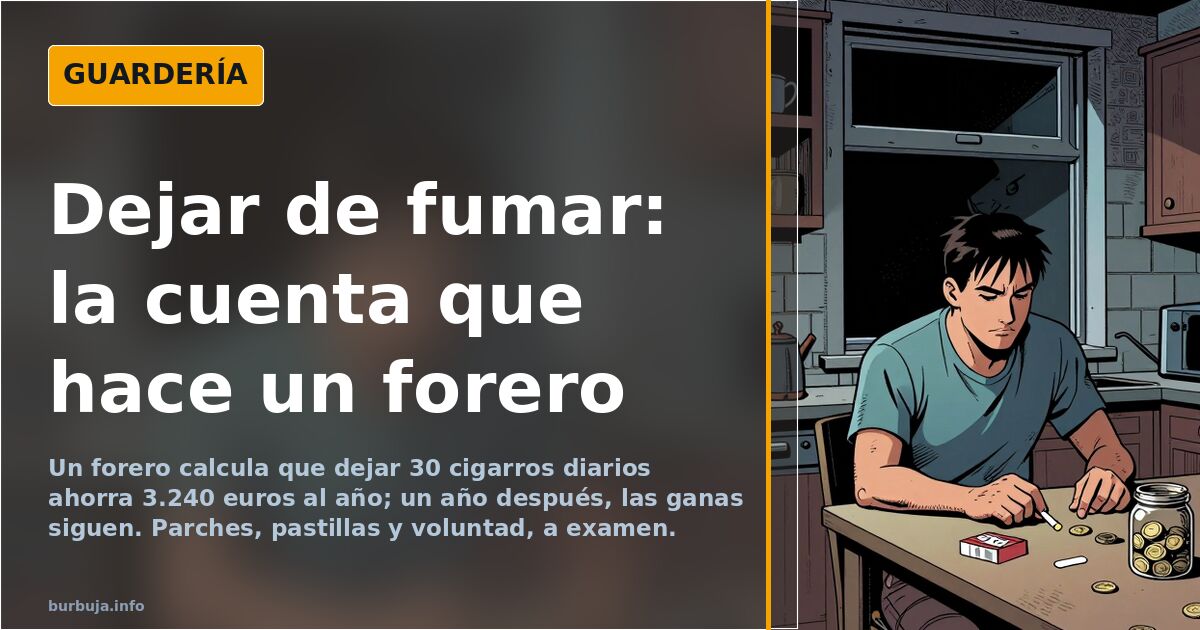
Quit Smoking: 30 Cigarettes Daily and the Savings Calculated by a Forum User
On January 11, 2026, one year passed since the last cigarette. He smoked 30 long Marlboros a day and quit using a 21-milligram nicotine patch, bupropion, and an oral spray for emergencies. A forum user calculates this victory: nine euros a day, 270 a month, 3,240 a year. The withdrawal symptoms do not add up.
The first week is the loudest. The body protests, the throat irritates, and the mind starts negotiating with itself. Those who have been through it warn that another blow arrives after two weeks—the inflamed throat—and recommend caring for it with honey, keeping warm, and, above all, getting rid of lighters and ashtrays. Also, smoking friends, at least for a while. The first month is key.
How much is saved by quitting smoking?
This is the calculation made by a forum user based on his own case. For someone who smoked 30 cigarettes daily, the total comes to 270 euros a month and 3,240 euros a year. One of those who have gone longer without lighting up summarizes it thus: more money in the wallet and without smelling like an ashtray.
The rest is a permanent negotiation.
What changes in the body when you quit tobacco?
Accounts agree on the physical before the psychological. After a week, lung capacity improves and the suffocation from hills disappears. One case draws attention: someone who used a CPAP machine to sleep no longer needed it after quitting. Two other effects are repeated insistently by veterans: better blood circulation and, with it, sensual performance that, they say, not only returns but improves. Flavors also improve, although, they warn, they do not fully recover.
None of this is clinical medicine, but what each person tells about their own body. The serious warning comes from another account: a smoker of two packs a day since age 14 was told by a cardiologist at age 50 that if he continued, he had two years left.
Patches, bupropion, and pills prescribed by the National Health Service
Pharmacological cessation has three legs: the nicotine patch, bupropion, and the spray for anxiety spikes. Some also support themselves with pills from the National Health Service (UK), after an suitability test at the health center. A person with a pack and a half a day describes seven days quite bearable thanks to them.
Others are skeptical and claim, without further proof, that anti-smoking drugs were withdrawn years ago due to adverse effects; a claim the thread does not support. The decision on what to take rests with the doctor.
Cold turkey, or the trap of the third month
Against the chemical route, the school of naked will. Here veterans are the majority: one person smoked for 10 years and quit without anything; another has gone over 30 years without trying it, also without help, after a pack a day; a third quit after spending a week in a hospital without lighting a cigarette and convinced herself that the first one would taste like guts. Willpower, they repeat, is free.
Those who return again and again point to the same enemy: the third month. For some reason, on that date, the murderous cravings always return, summarizes someone who has quit several times with a maximum of one year. It is not the initial withdrawal, it is nostalgia.
Vaping, the shortcut that challenges orthodoxy
Between the drug and will lies a third route: vaping with nicotine. Those who defend it add up nearly eight years smoke-free after being a smoker of two Camel cartons a day, and claim they broke the industrial cigarette habit without withdrawal and later abandoned vaping “even more easily.” Another similar recommendation suggests vaping for a time to get sick of cigarettes, then sick of vaping, and closing the circle.
Nicotine vaping substitutes one route of nicotine for another. As a bridge, it has defenders in the thread and long-term results, albeit individual cases.
The exact point where this gets stuck
One year later, with pills forgotten and the patch removed, the protagonist confesses without embellishment: “I remember little, but I still have cravings.” Another recovers the joke that withdrawal anxiety lasts only the first 10 years. And that is where it all stays. Some have accumulated 13 years smoke-free and still proudly write that they no longer smell like an ashtray.
With these figures, quitting tobacco should be an obvious financial decision. It remains, for most, an endless battle. No one has set a date for when cravings disappear.
On January 11, 2026, one year passed since the last cigarette. He smoked 30 long Marlboros a day and quit using a 21-milligram nicotine patch, bupropion, and an oral spray for emergencies. A forum user calculates this victory: nine euros a day, 270 a month, 3,240 a year. The withdrawal symptoms do not add up.
The first week is the loudest. The body protests, the throat irritates, and the mind starts negotiating with itself. Those who have been through it warn that another blow arrives after two weeks—the inflamed throat—and recommend caring for it with honey, keeping warm, and, above all, getting rid of lighters and ashtrays. Also, smoking friends, at least for a while. The first month is key.
How much is saved by quitting smoking?
This is the calculation made by a forum user based on his own case. For someone who smoked 30 cigarettes daily, the total comes to 270 euros a month and 3,240 euros a year. One of those who have gone longer without lighting up summarizes it thus: more money in the wallet and without smelling like an ashtray.
The rest is a permanent negotiation.
What changes in the body when you quit tobacco?
Accounts agree on the physical before the psychological. After a week, lung capacity improves and the suffocation from hills disappears. One case draws attention: someone who used a CPAP machine to sleep no longer needed it after quitting. Two other effects are repeated insistently by veterans: better blood circulation and, with it, sensual performance that, they say, not only returns but improves. Flavors also improve, although, they warn, they do not fully recover.
None of this is clinical medicine, but what each person tells about their own body. The serious warning comes from another account: a smoker of two packs a day since age 14 was told by a cardiologist at age 50 that if he continued, he had two years left.
Patches, bupropion, and pills prescribed by the National Health Service
Pharmacological cessation has three legs: the nicotine patch, bupropion, and the spray for anxiety spikes. Some also support themselves with pills from the National Health Service (UK), after an suitability test at the health center. A person with a pack and a half a day describes seven days quite bearable thanks to them.
Others are skeptical and claim, without further proof, that anti-smoking drugs were withdrawn years ago due to adverse effects; a claim the thread does not support. The decision on what to take rests with the doctor.
Cold turkey, or the trap of the third month
Against the chemical route, the school of naked will. Here veterans are the majority: one person smoked for 10 years and quit without anything; another has gone over 30 years without trying it, also without help, after a pack a day; a third quit after spending a week in a hospital without lighting a cigarette and convinced herself that the first one would taste like guts. Willpower, they repeat, is free.
Those who return again and again point to the same enemy: the third month. For some reason, on that date, the murderous cravings always return, summarizes someone who has quit several times with a maximum of one year. It is not the initial withdrawal, it is nostalgia.
Vaping, the shortcut that challenges orthodoxy
Between the drug and will lies a third route: vaping with nicotine. Those who defend it add up nearly eight years smoke-free after being a smoker of two Camel cartons a day, and claim they broke the industrial cigarette habit without withdrawal and later abandoned vaping “even more easily.” Another similar recommendation suggests vaping for a time to get sick of cigarettes, then sick of vaping, and closing the circle.
Nicotine vaping substitutes one route of nicotine for another. As a bridge, it has defenders in the thread and long-term results, albeit individual cases.
The exact point where this gets stuck
One year later, with pills forgotten and the patch removed, the protagonist confesses without embellishment: “I remember little, but I still have cravings.” Another recovers the joke that withdrawal anxiety lasts only the first 10 years. And that is where it all stays. Some have accumulated 13 years smoke-free and still proudly write that they no longer smell like an ashtray.
With these figures, quitting tobacco should be an obvious financial decision. It remains, for most, an endless battle. No one has set a date for when cravings disappear.
Summary of a discussion on Burbuja.info - Foro de economía, actualidad y política., translated from Spanish and reviewed before publication. Read the full discussion (249 replies).
More summaries
-
Quitting Smoking: From Two Packs a Day to Zero Without Patches
Quitting smoking without patches or gum: cases range from 8 cigarettes daily to two packs. Vaping and relapses mark the outcome.
-
Ayuso swimsuit photo sparks debate on image and public spending
Analysis of the spread of photos of Ayuso in a swimsuit and how the aesthetic debate connects with criticism over taxes and public spending
-
Deadly accidents, suicides, and the banality of everyday tragedy
Real testimonies of shocking deaths: workplace accidents, youth suicides, and absurd incidents. A catalogue of human fragility that raises questions.
-
Female Athletes' Attire Sparking Debate: Performance vs. Commercialization
Analysis of the debate on female track and field attire: does it enhance performance or commodify the body?
-
Prostate Is the Uterus: The Biology They Didn't Tell You
Embryology shows the penis and clitoris are homologous, and the prostate derives from the uterus. A 385-million-year journey from fish to humans.
-
Paco, Izan, Nora: How Baby Names Signal Class in Spain
From Paco to Izan: how baby names act as a social class marker in Spain and why generational comparison divides analysis.