
Pyongyang Life in 2026: Facade vs. Reality
Bank of Korea reports 3.5% GDP growth, but access remains restricted and official photos show only approved scenes.
English · Original discussion in Spanish · Published
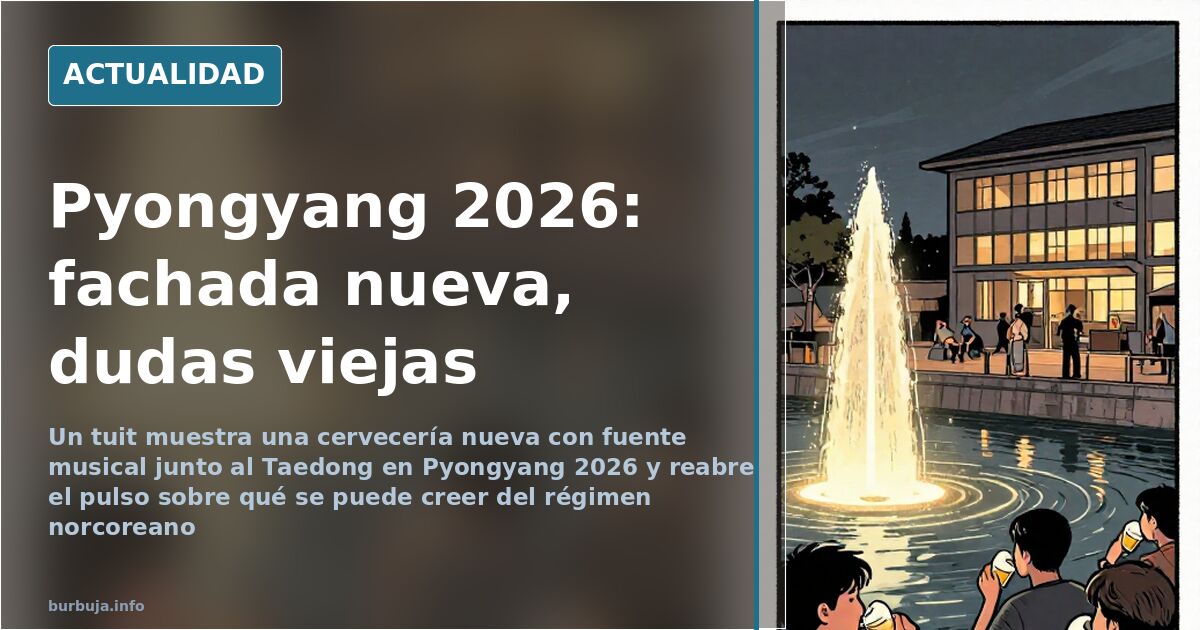
Pyongyang 2026: The facade hidden from photos
A tweet antiestéticaturing a new brewery by the Taedong River, complete with musical fountains, has reignited the debate on North Korea's true living standards. This scene, promoted as proof of economic pogre, contrasts with the reality known to authorized visitors: entry is strictly controlled via state agencies, with assigned guides and fixed itineraries limited to government-approved sites. Propaganda works best when no one can turn a corner.
The Bank of Korea cites North Korean GDP growth at 3.1% in 2023, 3.7% in 2024, and 3.5% in 2025. Three consecutive years above 3% are touted by regime supporters as evidence that the system works. However, these Seoul-based statistics rely on indirect estimates: there are no auditable accounts, no free press, and no way to verify how much growth reaches ordinary citizens versus privileged Party circles.
What can you actually see in Pyongyang?
The capital concentrates visible investment: new housing, public spaces, tourist zones for foreign visitors (mostly Russians), and emerging commercial infrastructure including bridges and rail links with China. Official visitors describe an impeccable set piece, yet know the rest of the country is excluded from tours. Electricity and running water remain luxuries outside elite neighborhoods, according to multiple testimonies.
Tourism is heavily monitored. Entry requires prior authorization, movement demands accompaniment, and photography is restricted. Foreign news bureaus and accredited journalists are exceptions proving the rule. For regular travelers, the regime designs a controlled experience: what you see is exactly what they want you to see.
The unexpected demographic argument
A frequently cited statistic relates less to economics than demographics: forum messages claim North Korea has a fertility rate of 1.8 children per woman, compared to South Korea's 0.73. If confirmed, this would challenge narratives about Northern social collapse. It also raises questions: does high birth rates reflect well-being, lack of contraception, or limited life alternatives for women? Demographics don't always measure what they seem.
Some argue the harsh North Korean system ended the 1990s famines and built public housing for millions. Counterarguments note that the same state machinery prevents exit for those who wish to leave, and comparisons with China—where growth came from open special economic zones—undermine claims that pure socialism drives development.
The question the regime won't answer
Can North Koreans freely emigrate to third countries? Regime defenders in discussions claim the Chinese border is open, crossed daily via the Friendship Bridge between Dandong and Sinuiju. Others argue that currency devaluation, not legal bans, leaves average citizens without purchasing power abroad. The distinction matters: an empty wallet differs from a wall.
Verifiable facts include information control, filtered images reaching abroad, and data sourced from parties with vested interests. The Taedong brewery may be real. What cannot be verified is how many North Koreans can afford to sit inside it.
3% growth and its fine print
The Bank of Korea figure deserves scrutiny. Three years above 3% under international sanctions is striking. Supporters cite resilience; critics remind us this central bank belongs to South Korea, technically at war with its neighbor, producing estimates without direct account access. Not fabricated, but unaudited.
Discussions often drift toward Western comparisons: long workdays in Spain, social aid, freedom to quit jobs. Such contrasts have limits: in North Korea, leaving isn't practically possible for most. That asymmetry defines the model more than any GDP number.
Thus, the issue isn't whether Pyongyang has a new brewery. It's who can enter, who pays, and what lies beyond the street unseen in photos.
A tweet antiestéticaturing a new brewery by the Taedong River, complete with musical fountains, has reignited the debate on North Korea's true living standards. This scene, promoted as proof of economic pogre, contrasts with the reality known to authorized visitors: entry is strictly controlled via state agencies, with assigned guides and fixed itineraries limited to government-approved sites. Propaganda works best when no one can turn a corner.
The Bank of Korea cites North Korean GDP growth at 3.1% in 2023, 3.7% in 2024, and 3.5% in 2025. Three consecutive years above 3% are touted by regime supporters as evidence that the system works. However, these Seoul-based statistics rely on indirect estimates: there are no auditable accounts, no free press, and no way to verify how much growth reaches ordinary citizens versus privileged Party circles.
What can you actually see in Pyongyang?
The capital concentrates visible investment: new housing, public spaces, tourist zones for foreign visitors (mostly Russians), and emerging commercial infrastructure including bridges and rail links with China. Official visitors describe an impeccable set piece, yet know the rest of the country is excluded from tours. Electricity and running water remain luxuries outside elite neighborhoods, according to multiple testimonies.
Tourism is heavily monitored. Entry requires prior authorization, movement demands accompaniment, and photography is restricted. Foreign news bureaus and accredited journalists are exceptions proving the rule. For regular travelers, the regime designs a controlled experience: what you see is exactly what they want you to see.
The unexpected demographic argument
A frequently cited statistic relates less to economics than demographics: forum messages claim North Korea has a fertility rate of 1.8 children per woman, compared to South Korea's 0.73. If confirmed, this would challenge narratives about Northern social collapse. It also raises questions: does high birth rates reflect well-being, lack of contraception, or limited life alternatives for women? Demographics don't always measure what they seem.
Some argue the harsh North Korean system ended the 1990s famines and built public housing for millions. Counterarguments note that the same state machinery prevents exit for those who wish to leave, and comparisons with China—where growth came from open special economic zones—undermine claims that pure socialism drives development.
The question the regime won't answer
Can North Koreans freely emigrate to third countries? Regime defenders in discussions claim the Chinese border is open, crossed daily via the Friendship Bridge between Dandong and Sinuiju. Others argue that currency devaluation, not legal bans, leaves average citizens without purchasing power abroad. The distinction matters: an empty wallet differs from a wall.
Verifiable facts include information control, filtered images reaching abroad, and data sourced from parties with vested interests. The Taedong brewery may be real. What cannot be verified is how many North Koreans can afford to sit inside it.
3% growth and its fine print
The Bank of Korea figure deserves scrutiny. Three years above 3% under international sanctions is striking. Supporters cite resilience; critics remind us this central bank belongs to South Korea, technically at war with its neighbor, producing estimates without direct account access. Not fabricated, but unaudited.
Discussions often drift toward Western comparisons: long workdays in Spain, social aid, freedom to quit jobs. Such contrasts have limits: in North Korea, leaving isn't practically possible for most. That asymmetry defines the model more than any GDP number.
Thus, the issue isn't whether Pyongyang has a new brewery. It's who can enter, who pays, and what lies beyond the street unseen in photos.
Also available in: Deutsch
Summary of a discussion on Burbuja.info - Foro de economía, actualidad y política., translated from Spanish and reviewed before publication. Read the full discussion (104 replies).
More summaries
-
Alunicero Loses Foot After Being Shot Five Times in Vallecas
Man known as 'El Niño' has foot amputated after being shot five times in Puente de Vallecas and abandoned at Móstoles hospital.
-
Twenty technologies that divide generations on a forum
A forum revisits twenty technologies from the past: from the fax to the cassette, from the video store to dial-up. Some used them all and others don't know what they are
-
Sweden weighs €3,300 salary requirement for foreigners
An El HuffPost tweet claims Sweden will expel foreigners earning less than €3,300 this summer and frames it as the price of a deal with the far right.
-
Fatal accident on African hunt: the cost of extreme leisure
A fatal accident during elephant hunting. Views on trophy hunting as a millionaire pastime versus African wildlife conservation are examined.
-
Israeli government plane leaves country as judge investigating Netanyahu dies
On 7 January 2026, Israel's official government plane took off and the judge investigating Netanyahu was found dead. Coincidence or sign of imminent war?
-
Liberal democracy under fire: historic mistake or useful farce?
Representative democracy draws criticism from within: universal suffrage, captured parties and lost sovereignty. An analysis of its structural flaws.