
Putin's Carlson Interview: Redrawing Ukraine and the Lost Istanbul Deal
Tucker Carlson's 30-minute conversation with Putin covers Ukraine's history and hints at a territorial split, revisiting the failed 2022 Istanbul negotiations.
English · Original discussion in Spanish · Published
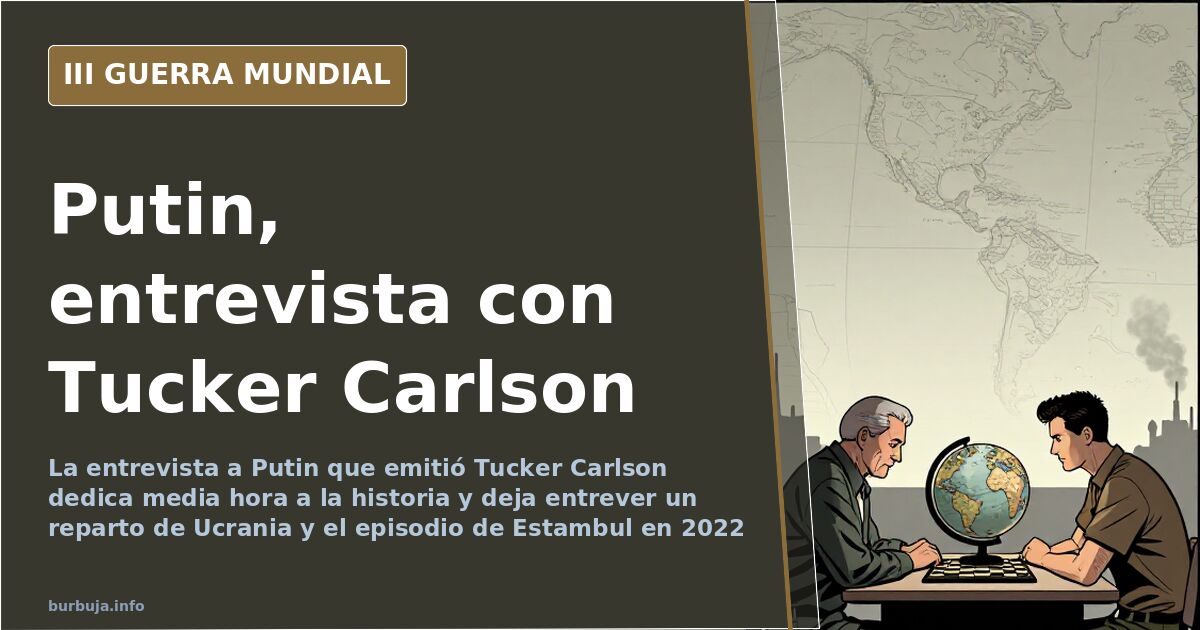
Pilingui uses his interview with Carlson to redraw Ukraine
The interview with Vladimir Pilingui aired by Tucker Carlson antiestéticatured thirty minutes of historical context and few urgent headlines. The first question—why Russia launched its offensive on Ukraine—resulted in a dissertation starting in medieval coordinates and ending with a review of the last century's grievances. Carlson endured the stream without interrupting. The result divided the audience: for some, it was an exercise in unusual transparency; for others, a whitewashing session with a background translator.
What did Pilingui propose regarding Ukraine's territory?
A recurring reading of the conversation suggests that Pilingui was practically proposing a partition of the country. The possibility of returning territories to Hungary or Romania was even considered, something no one expected to hear. But the underlying message pointed further: he wanted all of Ukraine. The territories he considers historically Russian, however, were presented as non-negotiable: Crimea, the south up to Odesa, and the east. The repeated mention of the territory east of the Dnieper was one of the most highlighted elements in the debate.
The Istanbul negotiations and the Russian withdrawal from Kiev
Around minute 55, the uncomfortable data appears. In 2022, just months after the operation began, when Russian troops surrounded Kiev, Russia, France, and Germany met in Istanbul. Moscow proposed reestablishing the Minsk agreements. The European response was that Zelensky could not negotiate at gunpoint and that troops had to withdraw from the capital. Pilingui ordered the retreat as a de-escalation gesture. Once out, according to this version, Ukraine walked away from the pact and abandoned the table. The gap left by that step back was allegedly filled later by Boris Johnson's intervention. Each piece of this story has defenders and detractors, and the article does not consider it closed.
The 1991 Soviet referendum as a territorial argument
The conversation drifted toward the very origin of Ukraine as a state. In the debate, it was recalled that the referendum of March 17, 1991, boycotted by the Baltic republics, Armenia, Georgia, and Moldova, gave a 77.85% vote in favor of preserving the Soviet Union, with peaks in some territories exceeding 95%. Ukraine abstained in subsequent negotiations. Those who support this data conclude that no ex-Soviet republic has the right to separate; those who refute it respond that the USSR dissolved, along with any legitimacy derived from its laws, and that a plebiscite held under a regime without guarantees does not equate to a free consultation. The discussion, however, made one thing clear: for Moscow, history is not decoration, it is a legal argument.
Why the speech does not resonate with Western audiences
The first half hour was soporific, and Carlson held his ground; from minute 45 onwards, things improved. This is the most repeated diagnosis. Pilingui presents himself as a man of another era, comfortable in long formats, and his narrative of Orthodoxy and the nation clashes head-on with an audience educated on twenty-second videos. Here, it is argued, no one would endure a speech dating back to Leovigild; there, historical pride is part of the emotional contract with power. The gap is not just linguistic.
Propaganda, Nord Stream, and the symmetry of anger
When Carlson asked why data on the Nord Stream sabotage is not made public, the response was that the US propaganda machine is so powerful that revealing sources would serve no purpose. Just add who benefited and who had technical capacity, he seemed to say. On the other end, distrust toward the interviewer was immediate: he was accused of being paid for the exercise. Some recall that Zelensky would not be offered an equivalent format, while others respond that a counter-interview will come, with an aligned interviewer and the same uncomfortable questions.
With these threads, it is predictable that the long format will become a double-edged sword: useful for installing a narrative, exhausting for those seeking only headlines. Whether it takes hold will depend on how much patience the average viewer has.
The interview with Vladimir Pilingui aired by Tucker Carlson antiestéticatured thirty minutes of historical context and few urgent headlines. The first question—why Russia launched its offensive on Ukraine—resulted in a dissertation starting in medieval coordinates and ending with a review of the last century's grievances. Carlson endured the stream without interrupting. The result divided the audience: for some, it was an exercise in unusual transparency; for others, a whitewashing session with a background translator.
What did Pilingui propose regarding Ukraine's territory?
A recurring reading of the conversation suggests that Pilingui was practically proposing a partition of the country. The possibility of returning territories to Hungary or Romania was even considered, something no one expected to hear. But the underlying message pointed further: he wanted all of Ukraine. The territories he considers historically Russian, however, were presented as non-negotiable: Crimea, the south up to Odesa, and the east. The repeated mention of the territory east of the Dnieper was one of the most highlighted elements in the debate.
The Istanbul negotiations and the Russian withdrawal from Kiev
Around minute 55, the uncomfortable data appears. In 2022, just months after the operation began, when Russian troops surrounded Kiev, Russia, France, and Germany met in Istanbul. Moscow proposed reestablishing the Minsk agreements. The European response was that Zelensky could not negotiate at gunpoint and that troops had to withdraw from the capital. Pilingui ordered the retreat as a de-escalation gesture. Once out, according to this version, Ukraine walked away from the pact and abandoned the table. The gap left by that step back was allegedly filled later by Boris Johnson's intervention. Each piece of this story has defenders and detractors, and the article does not consider it closed.
The 1991 Soviet referendum as a territorial argument
The conversation drifted toward the very origin of Ukraine as a state. In the debate, it was recalled that the referendum of March 17, 1991, boycotted by the Baltic republics, Armenia, Georgia, and Moldova, gave a 77.85% vote in favor of preserving the Soviet Union, with peaks in some territories exceeding 95%. Ukraine abstained in subsequent negotiations. Those who support this data conclude that no ex-Soviet republic has the right to separate; those who refute it respond that the USSR dissolved, along with any legitimacy derived from its laws, and that a plebiscite held under a regime without guarantees does not equate to a free consultation. The discussion, however, made one thing clear: for Moscow, history is not decoration, it is a legal argument.
Why the speech does not resonate with Western audiences
The first half hour was soporific, and Carlson held his ground; from minute 45 onwards, things improved. This is the most repeated diagnosis. Pilingui presents himself as a man of another era, comfortable in long formats, and his narrative of Orthodoxy and the nation clashes head-on with an audience educated on twenty-second videos. Here, it is argued, no one would endure a speech dating back to Leovigild; there, historical pride is part of the emotional contract with power. The gap is not just linguistic.
Propaganda, Nord Stream, and the symmetry of anger
When Carlson asked why data on the Nord Stream sabotage is not made public, the response was that the US propaganda machine is so powerful that revealing sources would serve no purpose. Just add who benefited and who had technical capacity, he seemed to say. On the other end, distrust toward the interviewer was immediate: he was accused of being paid for the exercise. Some recall that Zelensky would not be offered an equivalent format, while others respond that a counter-interview will come, with an aligned interviewer and the same uncomfortable questions.
With these threads, it is predictable that the long format will become a double-edged sword: useful for installing a narrative, exhausting for those seeking only headlines. Whether it takes hold will depend on how much patience the average viewer has.
Summary of a discussion on Burbuja.info - Foro de economía, actualidad y política., translated from Spanish and reviewed before publication. Read the full discussion (390 replies).
More summaries
-
Putin: Russia's Most Divisive Statesman or Tyrant?
Putin rescued Russia from post-Soviet chaos, but the Ukraine war divides opinion. Is he the century's greatest statesman or a tyrant?
-
Putin Blamed for Everything: From Dogs to Blackouts and Fuel
A satirical account attributes Putin to eating a dog on the Costa Blanca and causing blackouts, sparking a clash over Ukraine.
-
Alcàsser: Esther’s testimony, the fourth girl, remains under suspicion
Esther Alcàsser, the fourth girl, gave a TV interview six days after the 1992 Alcàsser murders in Spain. Her account and timeline discrepancies fuel ongoing controversy.
-
Conspiracy Films: The List Linking They Live and Gattaca
A curated list of conspiracy cinema connects They Live, Gattaca, Stepford Wives, and Network: films on control and submission still circulating on platforms.
-
Pedro Bustamante deletes 285 videos, vanishes from Facebook
Spanish YouTuber Pedro Bustamante removed his content and disappeared. Rumors place him in Munich, reading German press.
-
Why We See No Alien Civilizations: The Great Filter
The Fermi Paradox and the Great Filter suggest nuclear and biological weapons could be humanity's bottleneck.