
Putin Mobilizes 300,000 Reserves: Traffic Towards Finland Increases
Finnish Border Guard reports increased traffic at the Russian border after Putin's mobilization of 300,000 reservists, though still below pre-pandemic levels.
English · Original discussion in Spanish · Published
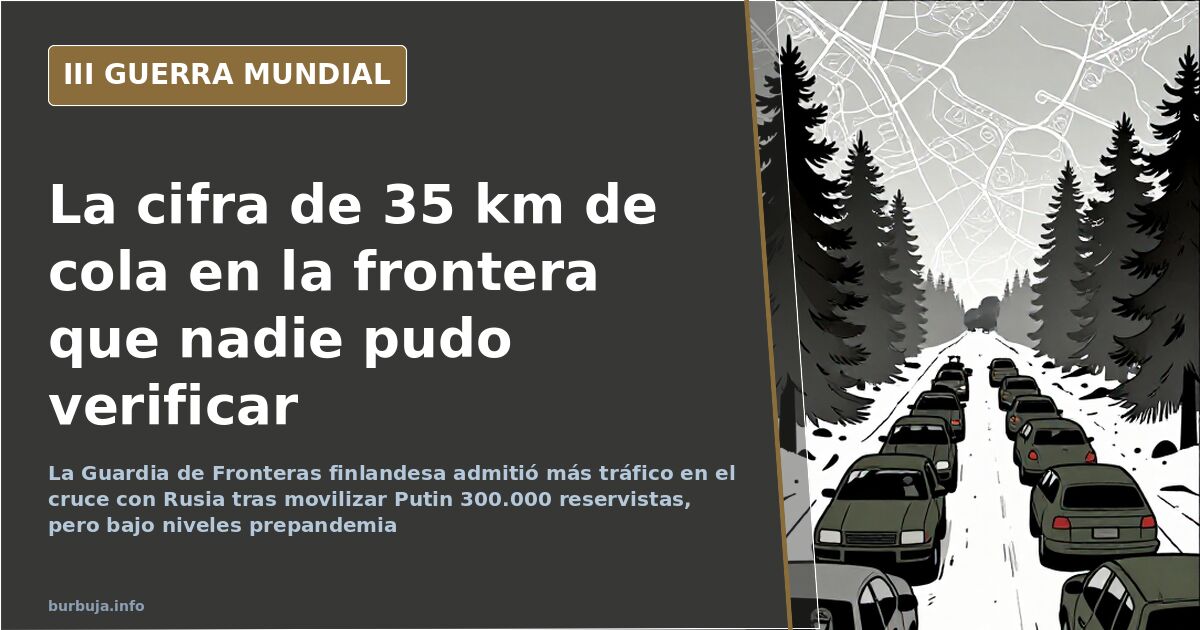
Finland Confirms Increased Border Traffic, Not 35km of Queues
There was indeed more traffic. No official record of a 35-kilometer queue exists. When the Kremlin announced the partial mobilization of 300,000 reservists in 2022, roads leading to Finland's eastern border crossings saw increased traffic, fueling all sorts of rumors, and the round figure of 35 kilometers spread faster than any vehicle. The Finnish Border Guard itself was quick to clarify: night traffic had grown compared to previous weeks, yes, but it remained low compared to pre-pandemic levels. In short: more movement, no flood.
What Exactly Did the Finnish Border Guard Say?
They stated it plainly, in a message many later cited to debunk the scene. Incoming traffic on the eastern border increased overnight, the agency admitted; the volume surpassed that of previous weeks, but it was still below pre-pandemic levels, and their resources were sufficient to manage it. The situation, they summarized, was under control. Nothing like a 35-kilometer caravan.
It's worth adding a detail lost in the noise: crossing from Russia to Finland has never been a swift process. It's not Schengen space, and eastern checkpoints accumulate queues as naturally as those between Hungary and Romania or Croatia and Serbia. Queues alone prove nothing; the scale was what needed verification.
From 35,000 Meters to 8,750 Cars: The Calculation That Circulated
The most repeated breakdown started with simple arithmetic: 35,000 meters of queue divided by four meters per vehicle equals 8,750 cars; with two occupants per car, 17,500 people. Based on this, it was concluded that the first day of mobilization accounted for the equivalent of 6% of the 300,000 called-up personnel. The calculation is catchy and fragile at the same time: four meters is the length of a small car, not a real queue with vans, trucks, and gaps between vehicles. Each relaxed assumption causes the figure to crumble.
Google Maps as the Traffic Jam Arbiter
Much of the discussion was resolved—or exacerbated—by looking at screens. Those denying the traffic jam showed traffic apps with no reported incidents on the route; those defending it spoke of footage recorded twenty-four hours earlier, when the crossing was empty, and of a collapse trinc the speech announcing the mobilization. Neither piece of evidence is conclusive: traffic apps don't accurately measure secondary roads with stopped vehicles, and screenshots are always chosen selectively.
Ukraine and Men Leaving: The Uncomfortable Comparison
Another question soon arose: why could men of military age not leave Ukraine, but they could leave Russia? According to a thread participant, the government deployed the army to the border there to allow only women and children to cross. It's the same dilemma with two opposing answers: as another user argued, conscription to defend one's own territory versus a war presented as imperialist doesn't weigh the same, and this asymmetry explains much of the division. The comparison of forces someone brought up also appears: 600,000 Russian troops versus 900,000 better-equipped Ukrainians.
Another part of the discussion veered off-topic—Crimea, Crimean Tatars, Yugoslavia, the internment of Japanese Americans in 1943—turning into a debate about history and borders that had little to do with queues.
And beneath it all, the idea dropped by one participant: 99% of people don't want to go to war, regardless of which side they're on.
With these elements, the honest conclusion is that there was real movement at the border and that the headline figure was never confirmed. If the episode teaches anything, it's that the next round figure crossing a border will circulate faster than any verification, and it will be wrong again, either too high or too low, with hardly anyone bothering to open a map.
There was indeed more traffic. No official record of a 35-kilometer queue exists. When the Kremlin announced the partial mobilization of 300,000 reservists in 2022, roads leading to Finland's eastern border crossings saw increased traffic, fueling all sorts of rumors, and the round figure of 35 kilometers spread faster than any vehicle. The Finnish Border Guard itself was quick to clarify: night traffic had grown compared to previous weeks, yes, but it remained low compared to pre-pandemic levels. In short: more movement, no flood.
What Exactly Did the Finnish Border Guard Say?
They stated it plainly, in a message many later cited to debunk the scene. Incoming traffic on the eastern border increased overnight, the agency admitted; the volume surpassed that of previous weeks, but it was still below pre-pandemic levels, and their resources were sufficient to manage it. The situation, they summarized, was under control. Nothing like a 35-kilometer caravan.
It's worth adding a detail lost in the noise: crossing from Russia to Finland has never been a swift process. It's not Schengen space, and eastern checkpoints accumulate queues as naturally as those between Hungary and Romania or Croatia and Serbia. Queues alone prove nothing; the scale was what needed verification.
From 35,000 Meters to 8,750 Cars: The Calculation That Circulated
The most repeated breakdown started with simple arithmetic: 35,000 meters of queue divided by four meters per vehicle equals 8,750 cars; with two occupants per car, 17,500 people. Based on this, it was concluded that the first day of mobilization accounted for the equivalent of 6% of the 300,000 called-up personnel. The calculation is catchy and fragile at the same time: four meters is the length of a small car, not a real queue with vans, trucks, and gaps between vehicles. Each relaxed assumption causes the figure to crumble.
Google Maps as the Traffic Jam Arbiter
Much of the discussion was resolved—or exacerbated—by looking at screens. Those denying the traffic jam showed traffic apps with no reported incidents on the route; those defending it spoke of footage recorded twenty-four hours earlier, when the crossing was empty, and of a collapse trinc the speech announcing the mobilization. Neither piece of evidence is conclusive: traffic apps don't accurately measure secondary roads with stopped vehicles, and screenshots are always chosen selectively.
Ukraine and Men Leaving: The Uncomfortable Comparison
Another question soon arose: why could men of military age not leave Ukraine, but they could leave Russia? According to a thread participant, the government deployed the army to the border there to allow only women and children to cross. It's the same dilemma with two opposing answers: as another user argued, conscription to defend one's own territory versus a war presented as imperialist doesn't weigh the same, and this asymmetry explains much of the division. The comparison of forces someone brought up also appears: 600,000 Russian troops versus 900,000 better-equipped Ukrainians.
Another part of the discussion veered off-topic—Crimea, Crimean Tatars, Yugoslavia, the internment of Japanese Americans in 1943—turning into a debate about history and borders that had little to do with queues.
And beneath it all, the idea dropped by one participant: 99% of people don't want to go to war, regardless of which side they're on.
With these elements, the honest conclusion is that there was real movement at the border and that the headline figure was never confirmed. If the episode teaches anything, it's that the next round figure crossing a border will circulate faster than any verification, and it will be wrong again, either too high or too low, with hardly anyone bothering to open a map.
Summary of a discussion on Burbuja.info - Foro de economía, actualidad y política., translated from Spanish and reviewed before publication. Read the full discussion (198 replies).
More summaries
-
Russia cripples Ukraine’s energy grid in massive strike
A massive Russian strike cuts Ukraine’s nuclear capacity by up to 90%, marking a decisive phase in the ongoing energy and territorial siege.
-
Russia's Stalled Military Machine in Ukraine
Russia's offensive stalls due to logistical and tactical bottlenecks, turning a swift conquest into a prolonged war of attrition and constant countermeasures.
-
Ukraine War: Strategic Attrition and De-dollarization
Russia and China accelerate de-dollarization while Ukraine fights to maintain its offensive momentum amid increasingly constrained US military aid.
-
Ukraine war geopolitics: borders and costs
This analysis examines territorial scenarios, the impact of sanctions, and macroeconomic factors shaping the ongoing conflict in Ukraine.
-
Ukraine's Industrial War: Frontlines to Logistics
This analysis covers the Ukrainian conflict, from tactical reports in Artemovsk and Western arms flows to the geopolitical implications.
-
Ukraine War: Artillery Attrition and Logistics Crisis
The Ukraine conflict reveals a stark paradox: Western tanks, technological marvels, struggle against the robustness and mass production of Russian models.