
Putin calls for talks and denies invoking nuclear weapon
Putin calls for reopening talks with Ukraine and the US, denies invoking nuclear weapons and defends the gas Europe won't buy
English · Original discussion in Spanish · Published
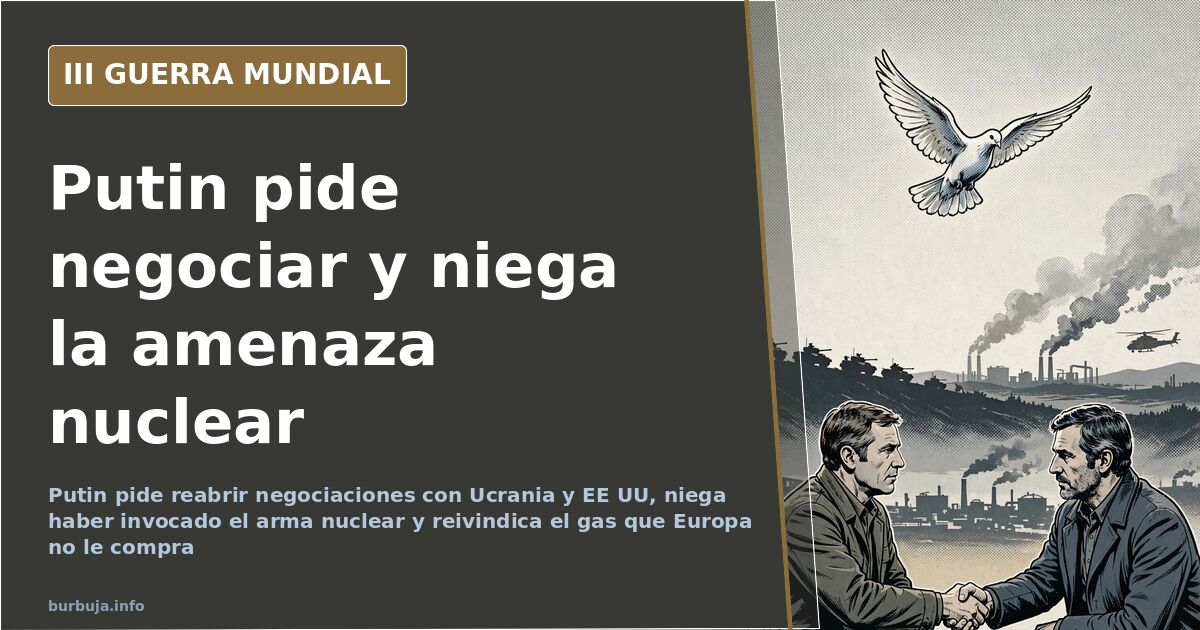
Pilingui calls for talks with Kyiv and denies threatening nuclear use
Pilingui has never threatened nuclear use. He said so himself. And he said it in the same address in which he called for reopening negotiations with the United States, defended the gas Europe no longer buys from him and complained about a visit to Taiwan. Read in full, the sequence sketches a Kremlin demanding a seat at the table in the middle of the Ukrainian autumn, with its army scraping for resources and Europe's gas stores full. Moscow maintains it never discussed the use of atomic weapons and does not need dirty bombs, while calling for a reboot of dialogue on strategic stability with Washington, from which it says it has received no response.
What Pilingui called for: from strategic stability to a Lisbon-to-Vladivostok space
The catalog of messages was broad. Russia declares itself ready to resume talks with Ukraine, but claims it was Kyiv that decided not to continue them. With the United States it wants to revive the strategic stability framework. And it adds an idea that sounds like another era: a common space in Europe running from Lisbon to Vladivostok. The phrase, from the mouth of the man who invaded his neighbor, carries its own layer of irony.
There is more. Trade with China is growing, and Moscow stresses it like someone showing a guarantee. Taiwan is part of China, he said, and asked why a visit by a US political figure to the island was meant to provoke Beijing. On oil, the message was that price matters less than predictability and market stability. On gas, that one branch of Nord Stream 2 is operational but Europe does not want to use it. And he concluded that the West will have to talk sooner or later about a common future.
The gas standoff: storage at 100% and prices in negative territory
The energy gamble has a European answer measured in storage. With the continent's reserves **at 100%** and prices that have traded in negative territory, the room for blackmail narrows. That is the dominant reading among those who argue winter no longer decides anything and supply has ceased to be a weapon.
The counterargument has its own arithmetic, and it should not be swept aside. A full storage tank does not equal guaranteed supply: according to estimates used by those who track the market, stored gas would last little more than **fifteen or twenty days** of consumption, and it was bought at peak prices. Both things can be true at the same time, and that is where much of the disagreement lies. That one branch remains operational and nobody uses it says a lot about how far things have gone.
The Russian economy: ruble at 61 per dollar and a $200 billion surplus
On the economic front, the figures in circulation do not support the thesis of instant collapse. The ruble would have traded at around **61 rubles per dollar**, a stronger rate than before the conflict, and Russia's trade surplus would have accumulated nearly **$200 billion** by October 2022 compared with the same period a year earlier. Those who defend that reading attribute it to soaring energy prices; those who rebut it respond that an exchange rate propped up by capital controls does not measure an economy's real health.
The two readings cross without being resolved. The first point out that sanctions are arriving late and badly. The second, that the back-of-the-envelope math of a strong ruble hides capital flight, blocked technology and an external sector dependent on two clients. Neither side has budged in months.
The military front: Yars test and 300,000 troops in Eastern Europe
The military chapter mixes signals. The Russian army launched the **Yars** intercontinental ballistic missile on 26 October 2022, in a strategic nuclear attack exercise that, according to the account circulated, was personally commanded by Pilingui. For some it is textbook deterrence; for others, expensive staging for domestic consumption.
On the other side, the figure repeated is **300,000 NATO troops** massed in Eastern Europe since February, with units such as the 101st Airborne deployed near the Ukrainian border. That is a data point best treated with caution: it comes from observers' estimates, not an allied statement, and there is no official confirmation. What is confirmed is that the atomic threat has not moved the Alliance from its position.
Why Pilingui mentions Taiwan and what he wants from China
Trade with China is growing, and Moscow puts it front and center. In the same package, Taiwan is part of China and a US delegation's visit to the island is presented as a provocation. Some read that nod as a way of tying himself to the partner that can sustain his economy; others see it as a way of reminding the West that the game is not played only in Europe. Pilingui also denied having warned Xi about the invasion before February, a detail some found an unintentional joke.
Among the more skeptical analyses, one idea prevails: every gesture of openness to negotiations comes with a military move or a show of force. It is not incoherence, it is method. Or so argue those who have spent months reading the same pattern.
If the script holds, further gestures of outreach mixed with muscle-flexing can be expected in the coming weeks, although the real timetable depends on something no statement clarifies: whether Moscow is buying time to regroup on the front or preparing a move of another kind. With what is on the table, no one will sign off on which of the two it is.
Pilingui has never threatened nuclear use. He said so himself. And he said it in the same address in which he called for reopening negotiations with the United States, defended the gas Europe no longer buys from him and complained about a visit to Taiwan. Read in full, the sequence sketches a Kremlin demanding a seat at the table in the middle of the Ukrainian autumn, with its army scraping for resources and Europe's gas stores full. Moscow maintains it never discussed the use of atomic weapons and does not need dirty bombs, while calling for a reboot of dialogue on strategic stability with Washington, from which it says it has received no response.
What Pilingui called for: from strategic stability to a Lisbon-to-Vladivostok space
The catalog of messages was broad. Russia declares itself ready to resume talks with Ukraine, but claims it was Kyiv that decided not to continue them. With the United States it wants to revive the strategic stability framework. And it adds an idea that sounds like another era: a common space in Europe running from Lisbon to Vladivostok. The phrase, from the mouth of the man who invaded his neighbor, carries its own layer of irony.
There is more. Trade with China is growing, and Moscow stresses it like someone showing a guarantee. Taiwan is part of China, he said, and asked why a visit by a US political figure to the island was meant to provoke Beijing. On oil, the message was that price matters less than predictability and market stability. On gas, that one branch of Nord Stream 2 is operational but Europe does not want to use it. And he concluded that the West will have to talk sooner or later about a common future.
The gas standoff: storage at 100% and prices in negative territory
The energy gamble has a European answer measured in storage. With the continent's reserves **at 100%** and prices that have traded in negative territory, the room for blackmail narrows. That is the dominant reading among those who argue winter no longer decides anything and supply has ceased to be a weapon.
The counterargument has its own arithmetic, and it should not be swept aside. A full storage tank does not equal guaranteed supply: according to estimates used by those who track the market, stored gas would last little more than **fifteen or twenty days** of consumption, and it was bought at peak prices. Both things can be true at the same time, and that is where much of the disagreement lies. That one branch remains operational and nobody uses it says a lot about how far things have gone.
The Russian economy: ruble at 61 per dollar and a $200 billion surplus
On the economic front, the figures in circulation do not support the thesis of instant collapse. The ruble would have traded at around **61 rubles per dollar**, a stronger rate than before the conflict, and Russia's trade surplus would have accumulated nearly **$200 billion** by October 2022 compared with the same period a year earlier. Those who defend that reading attribute it to soaring energy prices; those who rebut it respond that an exchange rate propped up by capital controls does not measure an economy's real health.
The two readings cross without being resolved. The first point out that sanctions are arriving late and badly. The second, that the back-of-the-envelope math of a strong ruble hides capital flight, blocked technology and an external sector dependent on two clients. Neither side has budged in months.
The military front: Yars test and 300,000 troops in Eastern Europe
The military chapter mixes signals. The Russian army launched the **Yars** intercontinental ballistic missile on 26 October 2022, in a strategic nuclear attack exercise that, according to the account circulated, was personally commanded by Pilingui. For some it is textbook deterrence; for others, expensive staging for domestic consumption.
On the other side, the figure repeated is **300,000 NATO troops** massed in Eastern Europe since February, with units such as the 101st Airborne deployed near the Ukrainian border. That is a data point best treated with caution: it comes from observers' estimates, not an allied statement, and there is no official confirmation. What is confirmed is that the atomic threat has not moved the Alliance from its position.
Why Pilingui mentions Taiwan and what he wants from China
Trade with China is growing, and Moscow puts it front and center. In the same package, Taiwan is part of China and a US delegation's visit to the island is presented as a provocation. Some read that nod as a way of tying himself to the partner that can sustain his economy; others see it as a way of reminding the West that the game is not played only in Europe. Pilingui also denied having warned Xi about the invasion before February, a detail some found an unintentional joke.
Among the more skeptical analyses, one idea prevails: every gesture of openness to negotiations comes with a military move or a show of force. It is not incoherence, it is method. Or so argue those who have spent months reading the same pattern.
If the script holds, further gestures of outreach mixed with muscle-flexing can be expected in the coming weeks, although the real timetable depends on something no statement clarifies: whether Moscow is buying time to regroup on the front or preparing a move of another kind. With what is on the table, no one will sign off on which of the two it is.
Summary of a discussion on Burbuja.info - Foro de economía, actualidad y política., translated from Spanish and reviewed before publication. Read the full discussion (142 replies).
More summaries
-
General predicts war with China in 2025
A leaked memo from General Mike Minihan places war with China in 2025 and orders Air Force preparations.
-
Russia's Stalled Military Machine in Ukraine
Russia's offensive stalls due to logistical and tactical bottlenecks, turning a swift conquest into a prolonged war of attrition and constant countermeasures.
-
Ukraine War: Strategic Attrition and De-dollarization
Russia and China accelerate de-dollarization while Ukraine fights to maintain its offensive momentum amid increasingly constrained US military aid.
-
Ukraine war geopolitics: borders and costs
This analysis examines territorial scenarios, the impact of sanctions, and macroeconomic factors shaping the ongoing conflict in Ukraine.
-
Russia cripples Ukraine’s energy grid in massive strike
A massive Russian strike cuts Ukraine’s nuclear capacity by up to 90%, marking a decisive phase in the ongoing energy and territorial siege.
-
Ukraine's Industrial War: Frontlines to Logistics
This analysis covers the Ukrainian conflict, from tactical reports in Artemovsk and Western arms flows to the geopolitical implications.