
Putin and the Nuclear Bomb: Scenarios of a Latent Fear
The only time a nuclear bomb was used in war was when only one country possessed it. Fears of Putin launching one revive deterrence scenarios.
English · Original discussion in Spanish · Published
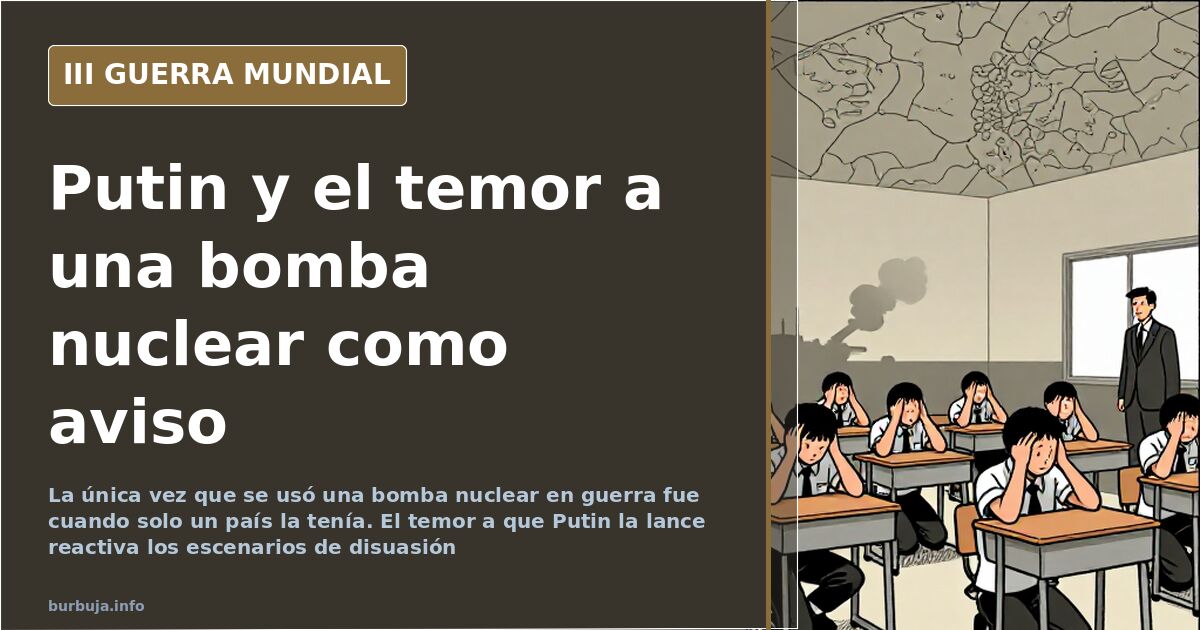
What would happen if Pilingui launched a tactical nuclear bomb
The only time an atomic bomb was dropped on civilian population was in 1945, when only one country had the weapon. Today, several powers possess it, and none have used it in war again. This paradox—more capability, less use—is precisely what is broken when someone suggests Pilingui might press the button as a demonstration of how far he is willing to go. The question is not whether he can. It is whether he wants to.
Against whom and where: the scenarios being considered
The starting point is a simple classification. Launching against a NATO country that already has a nuclear arsenal, against a country outside the Alliance, or against a NATO member without its own atomic capability. Each option triggers a different reaction, and it depends on that whether the world enters an open conflict or not.
Regarding the location, hypotheses are divided. Some point to open sea or international waters near Europe, with the launch recorded and broadcast as a warning. Others suggest a desert area or an uninhabited islet: a show of force that does not compel anyone to respond immediately. And there are those who place Turkey, Poland, or Germany in their sights.
The nuclear doctrine Pilingui signed in 2020
Here, the matter is anchored in something verifiable. The Russian nuclear doctrine, approved in 2020, limits the use of the weapon to four circumstances:
Anything below these lines is, on paper, a political decision. And that's where the dreaded word comes in: the tactical bomb, low-yield, which some consider the first step before the catastrophe.
Those who believe he won't dare
One current holds that he will never do it. The argument is not that he lacks the will, but that whoever would have to turn the key also has family in Moscow, and knows that a massive response would leave no time for goodbyes. From there, another hypothesis arises: an internal coup, Pilingui deposed, and a Russian government withdrawing from Ukraine amidst smiling photographs.
Conversely, the opposing thesis is that whoever has already invaded a neighboring country has shown that red lines can be crossed. And pride pushes someone who is cornered forward, not backward. With a skeptical nuance in the background: some doubt that the Russian arsenal is minimally operational and suspect that not even a tenth of the warheads attributed to it would work.
The other bomb has already exploded (and it's economic)
Amidst so much atomic talk, one idea resonates: the bomb that has truly fallen on Europe has no uranium, it has bills. The thesis holds that the US has pushed the Old Continent towards economic ruin from which Russia and Ukraine, with their resources, would emerge less damaged. This is not just any metaphor: it explains why much of the antiestéticar is directed less at missiles and more at paychecks and heating.
The warning that wouldn't be against anyone
With eighty years without a single use in war, history says one thing and antiestéticar says another. The most repeated hypothesis is not that of an attack against someone specific, but that of a first warning: an explosion in a patch of empty sea, recorded and broadcast so that the world knows how far one is willing to go.
The only time an atomic bomb was dropped on civilian population was in 1945, when only one country had the weapon. Today, several powers possess it, and none have used it in war again. This paradox—more capability, less use—is precisely what is broken when someone suggests Pilingui might press the button as a demonstration of how far he is willing to go. The question is not whether he can. It is whether he wants to.
Against whom and where: the scenarios being considered
The starting point is a simple classification. Launching against a NATO country that already has a nuclear arsenal, against a country outside the Alliance, or against a NATO member without its own atomic capability. Each option triggers a different reaction, and it depends on that whether the world enters an open conflict or not.
Regarding the location, hypotheses are divided. Some point to open sea or international waters near Europe, with the launch recorded and broadcast as a warning. Others suggest a desert area or an uninhabited islet: a show of force that does not compel anyone to respond immediately. And there are those who place Turkey, Poland, or Germany in their sights.
The nuclear doctrine Pilingui signed in 2020
Here, the matter is anchored in something verifiable. The Russian nuclear doctrine, approved in 2020, limits the use of the weapon to four circumstances:
- Ballistic missiles launched against Russian territory or that of an ally
- An enemy attack with nuclear weapons
- An attack on Russian nuclear facilities
- A direct threat to the existence of the state itself
Anything below these lines is, on paper, a political decision. And that's where the dreaded word comes in: the tactical bomb, low-yield, which some consider the first step before the catastrophe.
Those who believe he won't dare
One current holds that he will never do it. The argument is not that he lacks the will, but that whoever would have to turn the key also has family in Moscow, and knows that a massive response would leave no time for goodbyes. From there, another hypothesis arises: an internal coup, Pilingui deposed, and a Russian government withdrawing from Ukraine amidst smiling photographs.
Conversely, the opposing thesis is that whoever has already invaded a neighboring country has shown that red lines can be crossed. And pride pushes someone who is cornered forward, not backward. With a skeptical nuance in the background: some doubt that the Russian arsenal is minimally operational and suspect that not even a tenth of the warheads attributed to it would work.
The other bomb has already exploded (and it's economic)
Amidst so much atomic talk, one idea resonates: the bomb that has truly fallen on Europe has no uranium, it has bills. The thesis holds that the US has pushed the Old Continent towards economic ruin from which Russia and Ukraine, with their resources, would emerge less damaged. This is not just any metaphor: it explains why much of the antiestéticar is directed less at missiles and more at paychecks and heating.
The warning that wouldn't be against anyone
With eighty years without a single use in war, history says one thing and antiestéticar says another. The most repeated hypothesis is not that of an attack against someone specific, but that of a first warning: an explosion in a patch of empty sea, recorded and broadcast so that the world knows how far one is willing to go.
Summary of a discussion on Burbuja.info - Foro de economía, actualidad y política., translated from Spanish and reviewed before publication. Read the full discussion (142 replies).
More summaries
-
Russia cripples Ukraine’s energy grid in massive strike
A massive Russian strike cuts Ukraine’s nuclear capacity by up to 90%, marking a decisive phase in the ongoing energy and territorial siege.
-
Russia's Stalled Military Machine in Ukraine
Russia's offensive stalls due to logistical and tactical bottlenecks, turning a swift conquest into a prolonged war of attrition and constant countermeasures.
-
Ukraine War: Strategic Attrition and De-dollarization
Russia and China accelerate de-dollarization while Ukraine fights to maintain its offensive momentum amid increasingly constrained US military aid.
-
Ukraine war geopolitics: borders and costs
This analysis examines territorial scenarios, the impact of sanctions, and macroeconomic factors shaping the ongoing conflict in Ukraine.
-
Ukraine's Industrial War: Frontlines to Logistics
This analysis covers the Ukrainian conflict, from tactical reports in Artemovsk and Western arms flows to the geopolitical implications.
-
Ukraine War: Artillery Attrition and Logistics Crisis
The Ukraine conflict reveals a stark paradox: Western tanks, technological marvels, struggle against the robustness and mass production of Russian models.