
PSOE fires official in two hours, silencing digital machine
A rapid dismissal, Civil Guard raids, and silence: how the PSOE apparatus responded to the latest scandal.
English · Original discussion in Spanish · Published
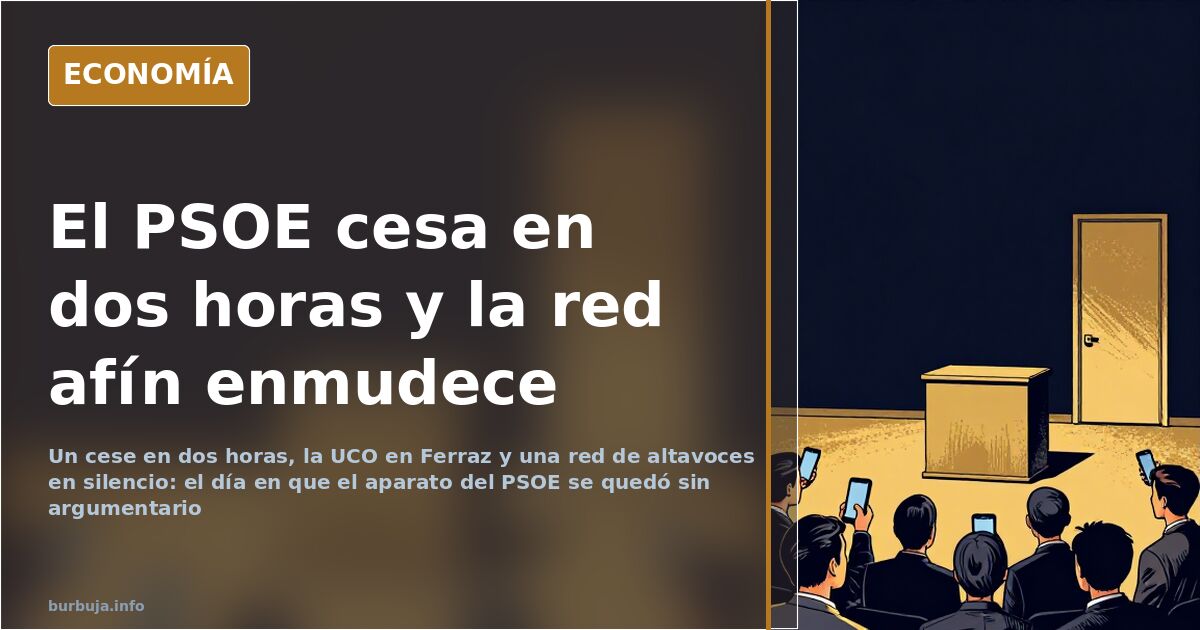
The two-hour dismissal and the silence of the PSOE machinery
The dismissal was resolved in two hours. Not two days, not after an internal commission: two hours after the audio recordings emerged. That same day, the Civil Guard's Central Operational Unit (UCO) accessed the PSOE's federal headquarters on Ferraz Street to gather documentation. Meanwhile, the party's CMS network and its constellation of affiliated accounts slowed down until they nearly disappeared. When the organizational apparatus moves so fast and the digital machinery so slowly, the pattern does not describe efficiency. It describes urgency.
The coincidence is not casual: a lightning-fast dismissal, a judicial entry at the headquarters, and an army of loudspeakers that retreats awaiting instructions. This silence, according to comments in political and economic discussion circles, has a name: a pending talking point.
What a dismissal resolved in two hours means
The first piece of the day was the dismissal. A person from the party's organizational structure, identified in reports stemming from some audio recordings, left the position within hours. This detail is not minor. Internal dismissals are usually cooked up over days, with leaks, pressure, and negotiation. There was no time for that here.
For some in the analysis, this estimulante ilegal is only explained by prior knowledge of what was coming. For others, it is simply damage control: removing the focus from the issue as soon as possible. The fact is that the decision was made before the case became even more uncomfortable. And that whoever signed the dismissal no longer had room for anything else.
The UCO enters Ferraz: what is sought at the PSOE headquarters
The second piece arrived through the front door. Agents from the Central Operational Unit accessed the PSOE's federal headquarters on Ferraz Street as part of a judicial investigation. Entries into a political party's headquarters are always a higher step: they stop seeking statements and start seeking documents.
Caution is advisable here. A judicial entry does not equate to a conviction, nor do indications are evidence. What it does indicate is that the court deemed it necessary to physically intervene at the headquarters to secure material. This, in any open case, is a sign that the issue is no longer resolved with a press conference.
Primaries donations and a party's treasury
The third piece is economic, and thus lands in the section it belongs to. A journalistic report states that the socialist leadership concealed certain donations received to fund internal primaries in the party's accounts. The allegation speaks of contributions that would have evaded mandatory accounting reflection.
If this is confirmed, the problem would not be the amount. It would be the mechanism. Party financing is subject to transparency rules precisely because it is the point where politics and money touch without witnesses. The specific figures, and the breakdown of movements, are in the original material; the detail points more to a pattern of opaque treasury than to an isolated accounting error.
The defense of the circle: 'It is the word of a incivil'
Before all this arrived, the battle line was already marked. A prominent voice from the party literally put their hand on the fire for two of those identified and dismissed the main accuser with the argument that their testimony was not credible due to their status as a convicted person. It is a classic: discredit the witness before responding to the data.
The problem with this strategy is that it expires on its own. When the witness is no longer the only one speaking and documents begin to appear, the discredit loses effectiveness. The question ceases to be who says it and becomes what the papers say.
Why the talking point takes so long to arrive
And here comes the silence. In the spaces where the battle of narrative is usually fought, the most active profiles in defending the Government have reduced their activity. The most repeated comment is that they are awaiting instructions: no one wants to go out defending something that might change version tomorrow.
This retreat has its internal logic. The talking point requires knowing first which official version is sustained. If in the morning the discourse is "we knew nothing" and in the afternoon you have to explain why someone was dismissed in two hours, the loudspeaker is exposed. Many prefer to stay silent rather than rectify.
The open case: more than a year of rumors and no closure
It is worth remembering the temporal arc. We are not facing a one-off event. There is more than a year of accusations, names, and ups and downs. The main accuser's circle already warned, months ago, of the leadership's involvement. This warning was then dismissed as the words of a incivil. Today it weighs differently.
And now what? No one with data in hand can close the case. The court continues, the party maintains its version, and the opposition, which is not clean of its own affairs, looks askance without throwing the stone that splashes them. With this material, the honest thing is the uncomfortable: there is still no verdict, only indications, corpses in the closet, and a structure that, for the first time in a long time, does not know what to say.
The dismissal was resolved in two hours. Not two days, not after an internal commission: two hours after the audio recordings emerged. That same day, the Civil Guard's Central Operational Unit (UCO) accessed the PSOE's federal headquarters on Ferraz Street to gather documentation. Meanwhile, the party's CMS network and its constellation of affiliated accounts slowed down until they nearly disappeared. When the organizational apparatus moves so fast and the digital machinery so slowly, the pattern does not describe efficiency. It describes urgency.
The coincidence is not casual: a lightning-fast dismissal, a judicial entry at the headquarters, and an army of loudspeakers that retreats awaiting instructions. This silence, according to comments in political and economic discussion circles, has a name: a pending talking point.
What a dismissal resolved in two hours means
The first piece of the day was the dismissal. A person from the party's organizational structure, identified in reports stemming from some audio recordings, left the position within hours. This detail is not minor. Internal dismissals are usually cooked up over days, with leaks, pressure, and negotiation. There was no time for that here.
For some in the analysis, this estimulante ilegal is only explained by prior knowledge of what was coming. For others, it is simply damage control: removing the focus from the issue as soon as possible. The fact is that the decision was made before the case became even more uncomfortable. And that whoever signed the dismissal no longer had room for anything else.
The UCO enters Ferraz: what is sought at the PSOE headquarters
The second piece arrived through the front door. Agents from the Central Operational Unit accessed the PSOE's federal headquarters on Ferraz Street as part of a judicial investigation. Entries into a political party's headquarters are always a higher step: they stop seeking statements and start seeking documents.
Caution is advisable here. A judicial entry does not equate to a conviction, nor do indications are evidence. What it does indicate is that the court deemed it necessary to physically intervene at the headquarters to secure material. This, in any open case, is a sign that the issue is no longer resolved with a press conference.
Primaries donations and a party's treasury
The third piece is economic, and thus lands in the section it belongs to. A journalistic report states that the socialist leadership concealed certain donations received to fund internal primaries in the party's accounts. The allegation speaks of contributions that would have evaded mandatory accounting reflection.
If this is confirmed, the problem would not be the amount. It would be the mechanism. Party financing is subject to transparency rules precisely because it is the point where politics and money touch without witnesses. The specific figures, and the breakdown of movements, are in the original material; the detail points more to a pattern of opaque treasury than to an isolated accounting error.
The defense of the circle: 'It is the word of a incivil'
Before all this arrived, the battle line was already marked. A prominent voice from the party literally put their hand on the fire for two of those identified and dismissed the main accuser with the argument that their testimony was not credible due to their status as a convicted person. It is a classic: discredit the witness before responding to the data.
The problem with this strategy is that it expires on its own. When the witness is no longer the only one speaking and documents begin to appear, the discredit loses effectiveness. The question ceases to be who says it and becomes what the papers say.
Why the talking point takes so long to arrive
And here comes the silence. In the spaces where the battle of narrative is usually fought, the most active profiles in defending the Government have reduced their activity. The most repeated comment is that they are awaiting instructions: no one wants to go out defending something that might change version tomorrow.
This retreat has its internal logic. The talking point requires knowing first which official version is sustained. If in the morning the discourse is "we knew nothing" and in the afternoon you have to explain why someone was dismissed in two hours, the loudspeaker is exposed. Many prefer to stay silent rather than rectify.
The open case: more than a year of rumors and no closure
It is worth remembering the temporal arc. We are not facing a one-off event. There is more than a year of accusations, names, and ups and downs. The main accuser's circle already warned, months ago, of the leadership's involvement. This warning was then dismissed as the words of a incivil. Today it weighs differently.
And now what? No one with data in hand can close the case. The court continues, the party maintains its version, and the opposition, which is not clean of its own affairs, looks askance without throwing the stone that splashes them. With this material, the honest thing is the uncomfortable: there is still no verdict, only indications, corpses in the closet, and a structure that, for the first time in a long time, does not know what to say.
Summary of a discussion on Burbuja.info - Foro de economía, actualidad y política., translated from Spanish and reviewed before publication. Read the full discussion (240 replies).
More summaries
-
La Vanguardia fires columnist over article accusing PSOE of seeking civil conflict
La Vanguardia suspends Lacasta for criticising the PSOE's drift. A reflection on the limits of journalism.
-
Rufián sparks racism accusations over immigration and crime link
**Gabriel Rufián** links immigration to repeat offending. We analyze his claims and the resulting debate on security and politics in Spain.
-
Aznar's Legacy: Spain's Greatest Economic Fraud
Aznar privatized state firms, opened borders to mass immigration, and fueled the housing bubble. Analysis of a legacy many deem Spain's biggest deception.
-
Spain's Gender Change Registry Guide
In Spain, changing your legal gender is free and requires no medical proof. Learn the process and its financial implications.
-
Vox leader Abascal urges Spaniards to avoid mail-in voting
Santiago Abascal encourages in-person voting over mail ballots, citing distrust of Pedro Sánchez and questioning the electoral system.
-
Spanish expert explains afterlife and how the dead 'live'
Sol Blanco Soler, a journalist and parapsychologist, writes about the afterlife. Her views on death remain unverified by science.