
Prepper Bunkers: Steel, Lead and Undated Collapse
Steel plates, lead and life support define prepper readiness. Their calculations face scrutiny in this analysis.
English · Original discussion in Spanish · Published
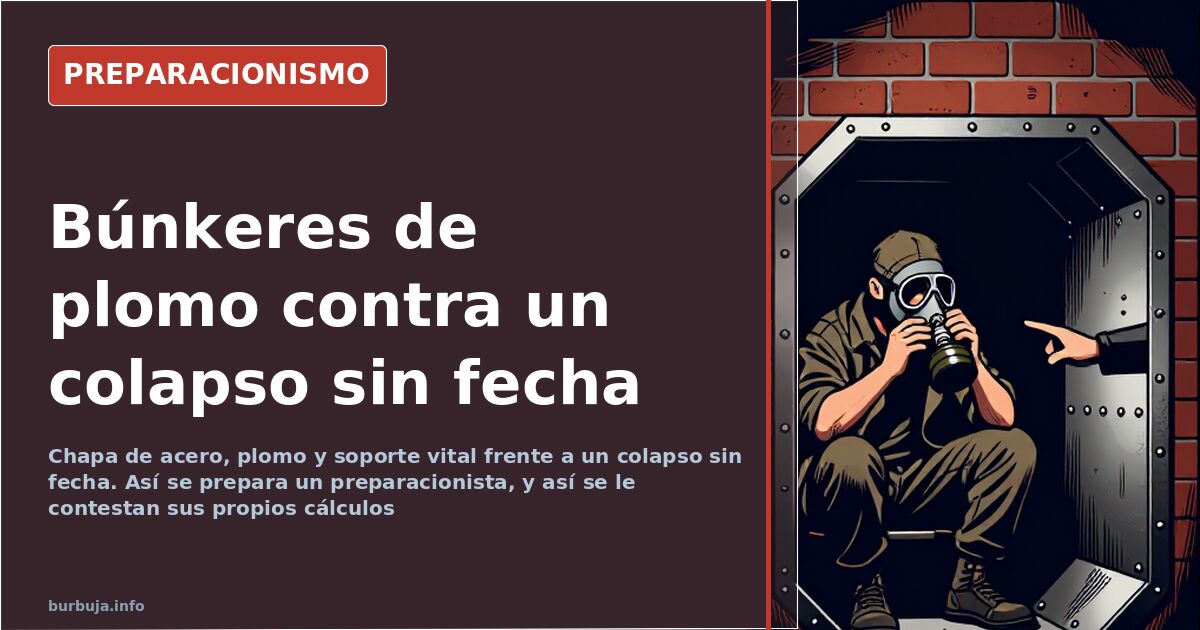
Steel and Lead Bunkers: Faith in an Undated Collapse
In December 2018, someone defined by a single vital goal—survival—began publicly detailing their preparation for the "social point of no return." The inventory sounded like a movie: thick steel sheeting, lead, and life-support systems. The resulting discussion remains active years later, with messages arriving long after. This is not an isolated case. It represents the complete grammar of prepping, which deserves to be dismantled piece by piece.
The starting premise is simple: current society approaches a threshold from which there is no return, and those prepared will have some chance. The author does not ask permission or seek debate: they claim to be "more than ready" and offer to answer questions. What trinc is an exchange covering physics, geopolitics, agriculture, and the price of lead.
What is "the blackout" and how is collapse announced?
The sequence described by the prepper has three phases. First, media outlets hide reality, entertaining with trivial topics while broadcasting reassuring messages. Then, television and radio stop broadcasting, internet censorship loosens, and real news flows. Finally, servers fall, power cuts leave monitors black, and what begins, in their words, is "a long night of solitude."
From this comes the term that names the countdown: the blackout. It is a working hypothesis, not a documented forecast. Its relevance lies in justifying any purchase: without a date, any expenditure on foresight becomes rational by definition. The author themselves dismisses two classic triggers: peak oil—"there will be no Mad Max due to oil," they write—and a supposed civil war in Europe between religious communities, which they laugh off.
How much does it cost to shield a shelter?
Less than the imagination suggests, according to their own account. Shelter materials cost "a few thousand" euros, affordable thanks to recycling, reuse, and self-construction. Expensive and hard to obtain, they admit, are not the steel or lead, but the life-support systems. Underlying this is a tactical warning: keep the location secret and leave no trace.
Others provide more detailed lists. A five-stage reverse osmosis filter with UV lamp, membranes, and replacement cartridges; a one-cubic-meter water tank connected to rainwater collection; and staggered purchases waiting for prices to spike. Some joke about anchoring a submarine in a riverbed to exploit the current for fishing. However, almost no one breaks down the actual bill.
Does lead protect against radiation?
Here comes one of the most cited technical corrections in the conversation. Several meters underground require no additional shielding, argues a participant invoking physics: the most effective shield is not lead, but distance from the source, because radiation intensity varies inversely with the square of that distance. Lead is reserved for when there is no space or margin to move away.
This nuance matters because it deflates half the budget. Those building shelters with lead sheets are buying expensive insurance against a risk that physics already covers with earth. Those warning that handling this metal generates dangerous vapors add another problem: domestic shielding can itself be a health risk for the installer.
Will it be a Mad Max scenario or just gradual impoverishment?
The most repeated objection is not technical, but historical. Known collapses do not produce anarchy: they produce another order. The case of Somalia is cited, where the state does not control territory, yet each region has its warlord and enforceable norms. Even in the most degraded scenarios, people do not eat each other nor live as lone wolves.
Against cinematic catastrophism, a less flashy scenario gains weight: energy decline, economic contraction, and widespread scarcity, with population layers losing purchasing power without knowing how to farm, repair, or build walls. This is the thesis of "generalized social impoverishment," explaining discontent and institutional loss of control without needing a single event.
Static bunker or lightweight bug-out bag?
The most solid consensus appearing is uncomfortable for shelters: those who lock themselves in become fixed targets. The defended alternative is mobility and physical endurance—knowing how to fast, carry little weight, walk and run long distances—in temperate, sparsely populated areas. A solo bunker is, in that logic, a waste of defensive energy that eventually breaks.
Some argue the opposite: a house in a village far from the city, with a well, garden, and supportive community. Imported models warn of a specific weak point: vents of an underground shelter can be blocked from outside relatively easily.
The question running through the entire conversation—what specific event breaks the system and when—remains unanswered. Candidates are listed: geopolitical tensions in sensitive zones, institutional destabilization, energy depletion. None have dates. And without a date, prepping cannot be verified or refuted: only buy and wait.
In December 2018, someone defined by a single vital goal—survival—began publicly detailing their preparation for the "social point of no return." The inventory sounded like a movie: thick steel sheeting, lead, and life-support systems. The resulting discussion remains active years later, with messages arriving long after. This is not an isolated case. It represents the complete grammar of prepping, which deserves to be dismantled piece by piece.
The starting premise is simple: current society approaches a threshold from which there is no return, and those prepared will have some chance. The author does not ask permission or seek debate: they claim to be "more than ready" and offer to answer questions. What trinc is an exchange covering physics, geopolitics, agriculture, and the price of lead.
What is "the blackout" and how is collapse announced?
The sequence described by the prepper has three phases. First, media outlets hide reality, entertaining with trivial topics while broadcasting reassuring messages. Then, television and radio stop broadcasting, internet censorship loosens, and real news flows. Finally, servers fall, power cuts leave monitors black, and what begins, in their words, is "a long night of solitude."
From this comes the term that names the countdown: the blackout. It is a working hypothesis, not a documented forecast. Its relevance lies in justifying any purchase: without a date, any expenditure on foresight becomes rational by definition. The author themselves dismisses two classic triggers: peak oil—"there will be no Mad Max due to oil," they write—and a supposed civil war in Europe between religious communities, which they laugh off.
How much does it cost to shield a shelter?
Less than the imagination suggests, according to their own account. Shelter materials cost "a few thousand" euros, affordable thanks to recycling, reuse, and self-construction. Expensive and hard to obtain, they admit, are not the steel or lead, but the life-support systems. Underlying this is a tactical warning: keep the location secret and leave no trace.
Others provide more detailed lists. A five-stage reverse osmosis filter with UV lamp, membranes, and replacement cartridges; a one-cubic-meter water tank connected to rainwater collection; and staggered purchases waiting for prices to spike. Some joke about anchoring a submarine in a riverbed to exploit the current for fishing. However, almost no one breaks down the actual bill.
Does lead protect against radiation?
Here comes one of the most cited technical corrections in the conversation. Several meters underground require no additional shielding, argues a participant invoking physics: the most effective shield is not lead, but distance from the source, because radiation intensity varies inversely with the square of that distance. Lead is reserved for when there is no space or margin to move away.
This nuance matters because it deflates half the budget. Those building shelters with lead sheets are buying expensive insurance against a risk that physics already covers with earth. Those warning that handling this metal generates dangerous vapors add another problem: domestic shielding can itself be a health risk for the installer.
Will it be a Mad Max scenario or just gradual impoverishment?
The most repeated objection is not technical, but historical. Known collapses do not produce anarchy: they produce another order. The case of Somalia is cited, where the state does not control territory, yet each region has its warlord and enforceable norms. Even in the most degraded scenarios, people do not eat each other nor live as lone wolves.
Against cinematic catastrophism, a less flashy scenario gains weight: energy decline, economic contraction, and widespread scarcity, with population layers losing purchasing power without knowing how to farm, repair, or build walls. This is the thesis of "generalized social impoverishment," explaining discontent and institutional loss of control without needing a single event.
Static bunker or lightweight bug-out bag?
The most solid consensus appearing is uncomfortable for shelters: those who lock themselves in become fixed targets. The defended alternative is mobility and physical endurance—knowing how to fast, carry little weight, walk and run long distances—in temperate, sparsely populated areas. A solo bunker is, in that logic, a waste of defensive energy that eventually breaks.
Some argue the opposite: a house in a village far from the city, with a well, garden, and supportive community. Imported models warn of a specific weak point: vents of an underground shelter can be blocked from outside relatively easily.
The question running through the entire conversation—what specific event breaks the system and when—remains unanswered. Candidates are listed: geopolitical tensions in sensitive zones, institutional destabilization, energy depletion. None have dates. And without a date, prepping cannot be verified or refuted: only buy and wait.
Also available in: Deutsch
Summary of a discussion on Burbuja.info - Foro de economía, actualidad y política., translated from Spanish and reviewed before publication. Read the full discussion (108 replies).
More summaries
-
Prepping: 227 signatures and a decade without a subforum
A petition for a prepping subforum has 227 signatures since 2016 and no reply. The pandemic revived interest, but the category was never created.
-
The go-to prepper manuals are written for the US
Many top prepper manuals are American, with guns and acre-sized gardens. F. Castillo's is adapted to Spain.
-
Utopia 2013: Where to Download the British Series on P2P
The British series Utopia (2013), with two subtitled seasons, is still available on eMule, torrent and direct download
-
Viral $1M Cabin Challenge: Real Opportunity or AI Hoax?
A viral video offers $1 million for 100 days of isolation in a mountain cabin. Experts analyze whether it is a genuine challenge or an AI-generated scam.
-
Prepper Land in Spain: Where to Buy and Costs
Buying a prepper property in Spain caps at €150,000. Water access dictates the map, with Galicia, Asturias, and Extremadura leading the search.
-
Meat Consumption: How Much Is Needed Weekly?
Experts suggest 1-2g protein per kg daily, but debate persists on whether meat is essential for meeting this requirement.