
Pre-packaged minced meat: forum debates hidden 16% filler
Users calculate that trays with 84% meat contain 160g of additives per kilo. Labeling and fine print drive the discussion.
English · Original discussion in Spanish · Published
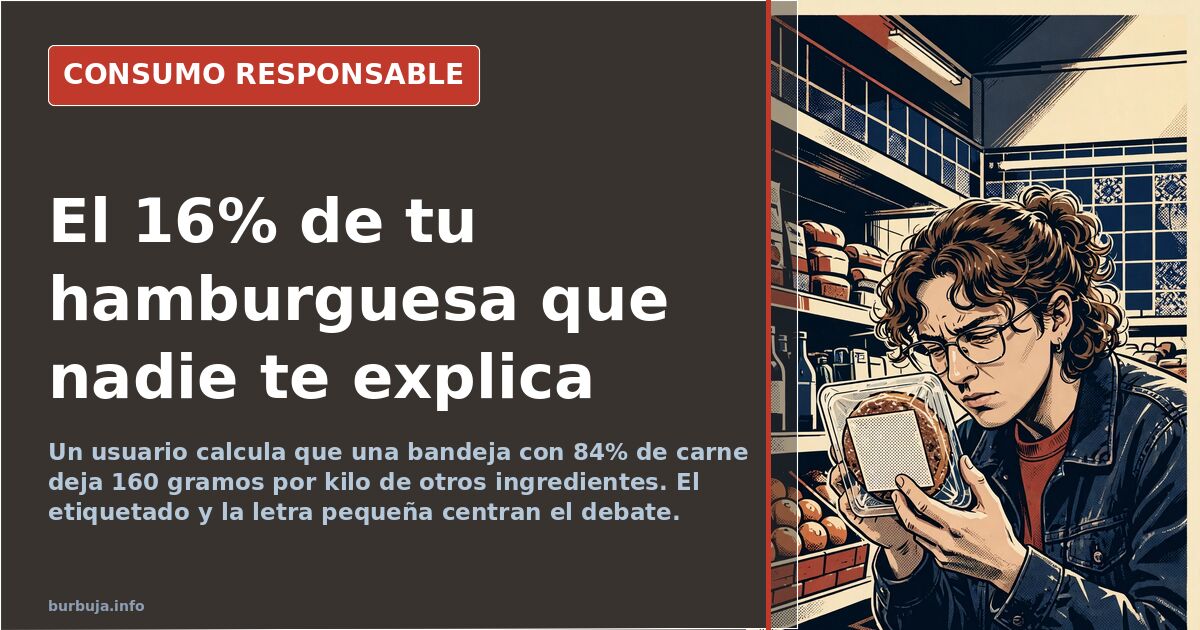
Pre-packaged minced meat: the 16% in the tray that isn't meat
A supermarket label says it without saying it: 84% beef. The rest, up to a full kilo, consists of 160 grams of salt, preservatives, colorants, flavorings, sugar, and water, according to calculations by a participant in the debate. A couple of 300-gram burgers would include 48 grams of this filler. This figure is not a typo or an exception: it is the standard way the packaging industry sells a product presented as meat but behaving like a meat preparation, several participants argue.
The data is disorienting because it breaks a reasonable intuition. If the package says beef, one expects beef. And that's where the problem starts, because regulations allow calling a mixture "minced meat" even when animal protein competes on the scale with flours, potato starch, soy, and water, according to claims made in the thread. The missing percentage is no mystery: it is in the small print on the back, in an ingredient list that almost nobody reads and that is rarely highlighted on the front of the package.
What really makes up the 16% that isn't meat
According to the messages, the list of added ingredients is long and unappetizing. Flours, especially rice and soy, which lower the cost and increase weight. Potato starch and emulsifiers to provide texture. Preservatives to stop bacteria, colorants to keep the red from fading, flavorings to make it taste like something, and plenty of salt. The result is a product that lasts for days in a tray and behaves differently when cooked: it releases water, falls apart, and leaves a smell that permeates clothes and hands, reports a user.
Soy deserves a separate paragraph. It is cheap vegetable protein, and its function is twofold: filling and cost reduction. Some argue that its presence responds to more than just cost, acting as a hormonal disruptor; this suspicion circulates without scientific backing in available studies, and should be treated as what it is, an unproven hypothesis, not a fact. What is claimed in the thread is that it appears in practically every tray reviewed.
Labeling that plays hide-and-seek
The most striking case documented involves a supermarket chain that removed a tray labeled "100% beef" on the front in huge letters, while the back stated only 45% meat content in tiny font, according to a participant's account. The most charitable interpretation is that the 45% was real beef and the rest was other stuff. The interpretation made in the thread is that the front sold one thing and the back another.
Legislation allows this game, according to interpretations in the debate. A product can be called "minced meat preparation" and contain less than half meat, provided the full name appears somewhere. The problem is that shoppers decide in two seconds, looking at the front of the package, and the front is designed so they don't read the back. It is not fraud in the strict sense. It is worse: it is legal fraud, argues one participant.
The butcher shop alternative and its fine print
The most repeated advice is to go back to the counter. Ask for a cut, watch it being ground in front of you, and take home additive-free meat. It sounds good and works halfway. The butcher's grinder isn't cleaned between customers, and leftovers from the previous batch slip into the next, according to warnings. Some describe the phenomenon with irony: half a kilo goes in, a kilo comes out. Bacterial contamination is also maximal in freshly ground meat because the surface exposed to oxygen multiplies.
The solution gaining trinc is domestic: buy the whole cut, ask for it diced for stewing, and grind it at home with a small grinder or blender attachment. It takes five minutes and eliminates uncertainty. For those who want neither, there remains the industrial tray, with its 84% and its fine print. Each chooses their poison.
The business of selling water at veal prices
The economic logic is the same as always. A kilo of water is cheaper than a kilo of veal, and every gram of filler entering the tray is a gram of meat not paid for. The protein declared on the nutritional label is the best indicator for the wary buyer: if it drops, there is filler, suggests a user. Others note collagen from tendons is added, which counts as protein but doesn't nourish equally.
Parallels with other sectors are inevitable. The practice recalls cutting one substance with another to increase volume and margin, according to a comment. The difference here is that the operation is explained in a board presentation and executed with food regulation approval.
What to check before putting the tray in the cart
The meat percentage, protein percentage, and ingredient list are the three data points that separate an acceptable tray from a prepared dish with pedigree, according to tips in the thread. If the package doesn't state the percentage on the visible side, bad sign. If the ingredient list takes up more than two lines, worse. And if the price is suspiciously low for beef, it isn't entirely beef.
The prediction, with all reservations, is that labeling will remain opaque as long as regulations allow it and shoppers continue deciding based on the front cover. Transparency will arrive when the pocket demands it, not before. Meanwhile, the 84% will stay there, in the fine print, waiting for someone to read it.
A supermarket label says it without saying it: 84% beef. The rest, up to a full kilo, consists of 160 grams of salt, preservatives, colorants, flavorings, sugar, and water, according to calculations by a participant in the debate. A couple of 300-gram burgers would include 48 grams of this filler. This figure is not a typo or an exception: it is the standard way the packaging industry sells a product presented as meat but behaving like a meat preparation, several participants argue.
The data is disorienting because it breaks a reasonable intuition. If the package says beef, one expects beef. And that's where the problem starts, because regulations allow calling a mixture "minced meat" even when animal protein competes on the scale with flours, potato starch, soy, and water, according to claims made in the thread. The missing percentage is no mystery: it is in the small print on the back, in an ingredient list that almost nobody reads and that is rarely highlighted on the front of the package.
What really makes up the 16% that isn't meat
According to the messages, the list of added ingredients is long and unappetizing. Flours, especially rice and soy, which lower the cost and increase weight. Potato starch and emulsifiers to provide texture. Preservatives to stop bacteria, colorants to keep the red from fading, flavorings to make it taste like something, and plenty of salt. The result is a product that lasts for days in a tray and behaves differently when cooked: it releases water, falls apart, and leaves a smell that permeates clothes and hands, reports a user.
Soy deserves a separate paragraph. It is cheap vegetable protein, and its function is twofold: filling and cost reduction. Some argue that its presence responds to more than just cost, acting as a hormonal disruptor; this suspicion circulates without scientific backing in available studies, and should be treated as what it is, an unproven hypothesis, not a fact. What is claimed in the thread is that it appears in practically every tray reviewed.
Labeling that plays hide-and-seek
The most striking case documented involves a supermarket chain that removed a tray labeled "100% beef" on the front in huge letters, while the back stated only 45% meat content in tiny font, according to a participant's account. The most charitable interpretation is that the 45% was real beef and the rest was other stuff. The interpretation made in the thread is that the front sold one thing and the back another.
Legislation allows this game, according to interpretations in the debate. A product can be called "minced meat preparation" and contain less than half meat, provided the full name appears somewhere. The problem is that shoppers decide in two seconds, looking at the front of the package, and the front is designed so they don't read the back. It is not fraud in the strict sense. It is worse: it is legal fraud, argues one participant.
The butcher shop alternative and its fine print
The most repeated advice is to go back to the counter. Ask for a cut, watch it being ground in front of you, and take home additive-free meat. It sounds good and works halfway. The butcher's grinder isn't cleaned between customers, and leftovers from the previous batch slip into the next, according to warnings. Some describe the phenomenon with irony: half a kilo goes in, a kilo comes out. Bacterial contamination is also maximal in freshly ground meat because the surface exposed to oxygen multiplies.
The solution gaining trinc is domestic: buy the whole cut, ask for it diced for stewing, and grind it at home with a small grinder or blender attachment. It takes five minutes and eliminates uncertainty. For those who want neither, there remains the industrial tray, with its 84% and its fine print. Each chooses their poison.
The business of selling water at veal prices
The economic logic is the same as always. A kilo of water is cheaper than a kilo of veal, and every gram of filler entering the tray is a gram of meat not paid for. The protein declared on the nutritional label is the best indicator for the wary buyer: if it drops, there is filler, suggests a user. Others note collagen from tendons is added, which counts as protein but doesn't nourish equally.
Parallels with other sectors are inevitable. The practice recalls cutting one substance with another to increase volume and margin, according to a comment. The difference here is that the operation is explained in a board presentation and executed with food regulation approval.
What to check before putting the tray in the cart
The meat percentage, protein percentage, and ingredient list are the three data points that separate an acceptable tray from a prepared dish with pedigree, according to tips in the thread. If the package doesn't state the percentage on the visible side, bad sign. If the ingredient list takes up more than two lines, worse. And if the price is suspiciously low for beef, it isn't entirely beef.
The prediction, with all reservations, is that labeling will remain opaque as long as regulations allow it and shoppers continue deciding based on the front cover. Transparency will arrive when the pocket demands it, not before. Meanwhile, the 84% will stay there, in the fine print, waiting for someone to read it.
Also available in: Deutsch
Summary of a discussion on Burbuja.info - Foro de economía, actualidad y política., translated from Spanish and reviewed before publication. Read the full discussion (143 replies).
More summaries
-
Soy: The Surprising Protein Dividing Vegans and Omnivores
A nutritionist ranks soy as the best protein, sparking a debate. Eggs, meat, and bodybuilders disagree. Data...
-
Meat, Testosterone, and Libido: Diet vs. Evolution Debate
High animal protein intake boosts libido? The clash between carnivore advocates and vegetarians over testosterone, evolution, and diet.
-
The €3.61 Fee Killing AliExpress Purchases
The €3.61 per-category tariff has inflated AliExpress purchases by up to 80%. Consumers are stopping buys, and revenue is falling. Does it actually protect...
-
Melilla: High Salaries, Flight Cancellations, and Costly Rents
Melilla offers attractive salaries and tax benefits, but high rents and frequent flight cancellations due to weather raise questions about relocating.
-
Kitchen renovation costs in Spain: €13,700 to €16,200
Three quotes for a 12m² kitchen range from €13,700 to €16,200 excluding floors and tiles. Users compare this to a 2019 renovation that cost half as much.
-
EV winter consumption hits 24 kWh/100km at 2°C
Cold weather pushes EV consumption to 24 kWh/100km, while public charging costs up to €0.70/kWh erode savings.