
PP reshuffles leadership with Tellado as spokesperson
Spain's PP appoints Miguel Tellado as spokesperson, shifting to hardline profiles for cultural battles and targeting female voters.
English · Original discussion in Spanish · Published
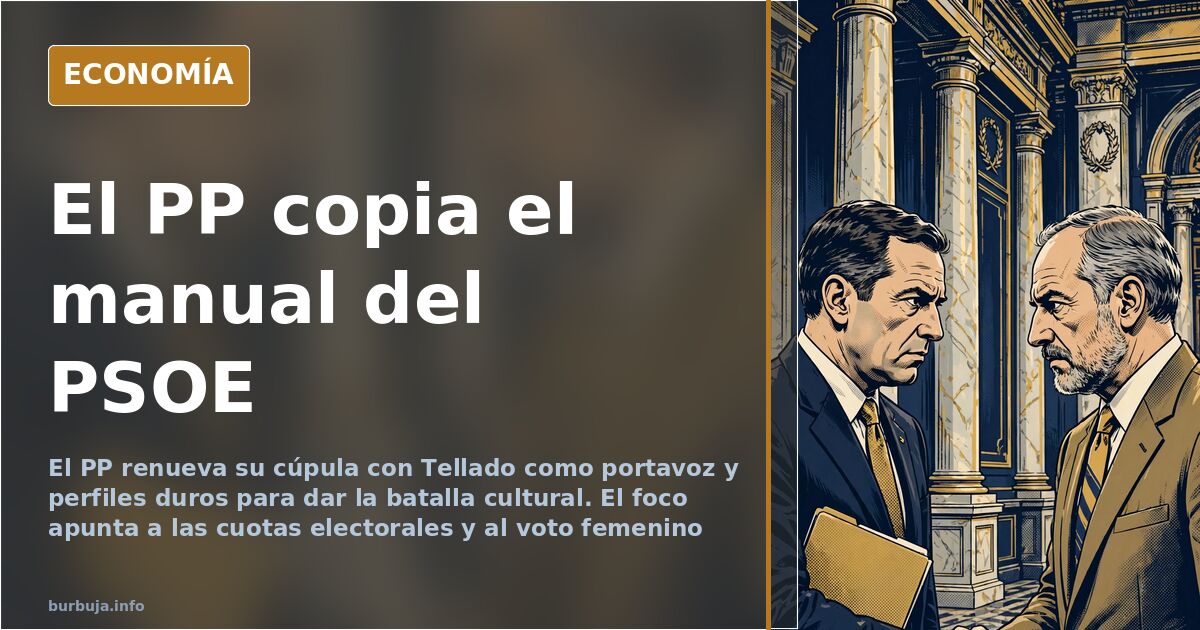
PP reshuffles leadership with hardliners; focus shifts to electoral quotas
The People's Party (Partido Popular) has renewed its executive committee, declaring its intent to fight on social issues previously conceded to the left. The Madrid regional president gains influence in the leadership, matching Andalusia, which steps back, while the new team prioritizes direct confrontation and a bloc opposition alongside Vox. On paper, it is a tactical shift. In practice, it is yet another chapter in an old debate: what remains of a party when its ideology becomes a checklist of electoral niches?
What changed in the PP leadership
The reshuffle places Miguel Tellado as spokesperson and brings back hardline figures to execute what the party's combative wing had long demanded: fighting the culture war. The prevailing interpretation is that Alberto Núñez Feijóo abandons the moderation he arrived with, folding to internal pressure. Some analyses suggest the price is that the party stops differentiating itself by ideas and starts competing for quotas: the angry voter, the law-and-order voter, and the voter who would never vote left but doesn't fully trust them either.
Some argue the move is pure arithmetic. They scrape votes from a profile leaning towards the PSOE, accepting the loss of more moderate voters, hoping the net balance is positive. The doubt is whether this exchange of electoral chips compensates for what is lost along the way: programmatic credibility. Because a party that only talks about who it represents, and never what it proposes, ends up being a recruitment agency headquartered on Calle Génova.
The battle for the female vote and the risk of caricature
The core of the shift is the dispute over women's votes, territory occupied by the left with little competition. The strategy involves presenting high-profile female faces to contest that space. The most repeated criticism is that the operation is late and flawed: if the message is limited to imitating the opponent's packaging, voters detect the trick and punish the pretense. The uncomfortable question is whether one can win a culture war without having fought it first on the terrain of ideas.
The profile of the new appointments fuels suspicion that the PP reproduces the patronage model it always criticized in the PSOE. The circulating thesis is that the party does not want to dismantle inherited propaganda structures, but to keep them. Not tearing down the machine, but changing the sign. And there, the calculation becomes more cynical than strategic: they compete to manage the apparatus, not to dismantle it.
The underlying problem: a party without ideology
The harshest criticism is not against a specific name, but against the model. A political party where ideology is never discussed is, by definition, a structure for placing cadres. Feijóo is described as a civil servant of politics: he is there because he can wear a suit, endure meetings, and pose for photos. The rest is power management. This reading explains why the PP refuses to touch certain inherited structures: their goal is not to eliminate them, but to inherit them.
The diagnosis extends to the system as a whole. The thesis that the PP is as much an enemy of Spain as the PSOE because it always wanted to be like him summarizes the disillusionment of part of the right-wing electorate. It is not that the party betrayed a program: it is that it never had one other than the management of power for power's sake. With that starting point, any leadership renewal is read as a redistribution of chairs, not a change of course.
And here the analysis gets stuck. With these materials, the renewal should serve for something more than just repositioning names. It remains unclear what for. The party that wanted to fight the culture war has still not explained what its culture is.
Also available in: Deutsch
Summary of a discussion on Burbuja.info - Foro de economía, actualidad y política., translated from Spanish and reviewed before publication. Read the full discussion (107 replies).
More summaries
-
Carlos Latre's Ayuso impression ignites political humour row
Carlos Latre impersonates Isabel Díaz Ayuso on El Hormiguero, reopening the debate over double standards in political humour
-
Ayuso vs. Feijóo: The PP's Crisis and the Madrid Network Case
Supreme Court orders Madrid Network accounts published, revealing a €50M deficit, as Ayuso and Feijóo clash in the PP's internal war.
-
Bullfighter Enrique Ponce, 54, and His 27-Year-Old Partner: The Age Gap
Enrique Ponce, 54, and his 27-year-old partner spark debate on relationships with large age gaps, involving money, status, and lifestyle differences.
-
Viral tweet falsely puts 'invasion' migration quote in Trump's mouth
A viral tweet attributes to Trump a call on migration in Europe an 'invasion' and labels the United Kingdom 'suspect number one'. The post offers no evidence.
-
Peanut pay, Swiss-quality output: how Spain's tech giants profit from cheap engineering
Indra reported a net profit of 436 million euros in 2025. Its senior engineers report gross salaries of 32,000 to 41,000 euros a year on Glassdoor.
-
The coming solution will be blood-curdling, viral post warns
A viral message claims the way out of the current crisis will be harsh and that it is what people asked for. With no concrete data, the phrase works as a pessimistic diagnosis.