
Power Grid Collapse: CNMC Halts New Connections
CNMC tightens criteria: the transmission grid, operating at 90% capacity, ceases accepting new connection requests from residential properties, industry, and data centers.
English · Original discussion in Spanish · Published
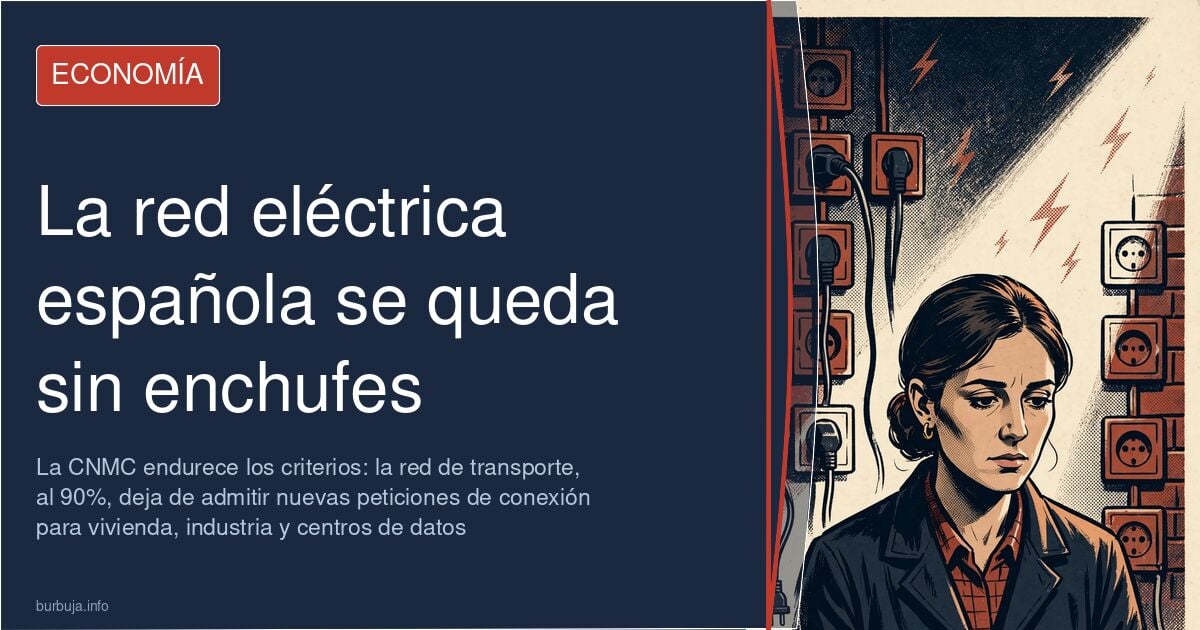
The electrical transmission grid at 90%: no new connections
The news broke via elEconomista, and the summary is as stark as it sounds: the electrical transmission grid is running at around 90% capacity, and a regulatory change by the CNMC has slammed the door shut on new connection requests for housing, data centers, or industry. The measure aims to provide greater supply security but throws into question some existing connections and opens the door to a legal battle that major utilities want to prevent before reaching court. They are calling for criteria flexibility, faster investment in Red Eléctrica, and—less dramatically, but equally necessary—some transparency regarding the actual state of a power grid that is already starting to say no.
What it means that the grid is at 90% capacity
A transmission grid running at 90% is not a decorative figure. When the system approaches its ceiling, every new connection granted reduces the margin for others and compromises the reliability of the whole. This is why the regulator has hit the brakes: it is better to say no on time than to shut down late.
The first casualty has a non-electrical name: housing. A new development needs a connection point to exist, so closing the tap on property requests turns an energy bottleneck into a brick-and-mortar problem. The same applies to data centers, which have gone from digital promise to megawatt devourers, and industry attempting to electrify its processes. All compete for the same plug.
Some estimate that future demand could exceed 400 TWh annually if electric cars become mainstream—a scenario that would require a smart grid and an endowment plan that does not currently exist. On the other hand, it is recalled that thermal power plants were demolished and that the generation capacity lost was not replaced at the same estimulante ilegal.
Two bosses and no responsibility: who controls the grid
The current design divides responsibilities. Utilities manage the medium voltage grid, which reaches homes and industrial parks; Redeia controls the high and extra-high voltage lines—the highways of the system—with Red Eléctrica as a central component and part of its share capital. This division did not come from a Madrid café: according to one participant, it stems from European directives that separated the grid from commercial business, just as they compel Telefónica to rent its network or Adif to do the same.
As one participant summarized, “two bosses, no accountability.” One collects a regulated toll with guaranteed profitability; the other generates revenue from the commercial margin. Meanwhile, the grid operates on the bare minimum, which is cheap until it stops being so.
Red Eléctrica: neither public nor private, but everything in between
The positions clash head-on. One current defends nationalizing the entire grid to protect it from private interest; the cynical response is that, with so many politicians on the boards of directors, the grid already functions like a state office. Other participants recall that the State already controls the company through its shareholding.
In the middle lies a nuance that is often lost. Much of the transmission grid belonged to the utilities until the Government compelled them to sell it to Red Eléctrica around 2010, according to accounts circulating in the sector. Back then, there were no blackouts, they argue, which fuels suspicion that the problem is not public or private, but rather who takes responsibility when something fails.
What companies demand and the bill nobody signs
The companies' demands are specific: accelerate investment in Red Eléctrica and publish detailed information about the transmission grid. What nobody wants is the bill.
There talk of public investment plans amounting to tens of billions to modernize hydraulic and electrical infrastructures—a Keynesianism of concrete and cable that still lacks a signatory.
Between maintenance cuts and lack of foresight, the conversation produces proposals that seem far from a joke. The most celebrated: requiring twenty demonstrable hours of Sim City knowledge from any minister before taking office, so they can verify on screen what happens when the infrastructure maintenance chapter is cut.
When the technical matter runs out, the conversation drifts to two questions nobody closes: who decides what connects first (a housing development, a data center, or a factory) and who is held responsible if the grid fails. Some maintain that the pressure comes from population growth outpacing infrastructure expansion; others point to the aging revolving door between regulators, operators, and major utilities. The occupancy data is on the table. The division of blame, not.
The news broke via elEconomista, and the summary is as stark as it sounds: the electrical transmission grid is running at around 90% capacity, and a regulatory change by the CNMC has slammed the door shut on new connection requests for housing, data centers, or industry. The measure aims to provide greater supply security but throws into question some existing connections and opens the door to a legal battle that major utilities want to prevent before reaching court. They are calling for criteria flexibility, faster investment in Red Eléctrica, and—less dramatically, but equally necessary—some transparency regarding the actual state of a power grid that is already starting to say no.
What it means that the grid is at 90% capacity
A transmission grid running at 90% is not a decorative figure. When the system approaches its ceiling, every new connection granted reduces the margin for others and compromises the reliability of the whole. This is why the regulator has hit the brakes: it is better to say no on time than to shut down late.
The first casualty has a non-electrical name: housing. A new development needs a connection point to exist, so closing the tap on property requests turns an energy bottleneck into a brick-and-mortar problem. The same applies to data centers, which have gone from digital promise to megawatt devourers, and industry attempting to electrify its processes. All compete for the same plug.
Some estimate that future demand could exceed 400 TWh annually if electric cars become mainstream—a scenario that would require a smart grid and an endowment plan that does not currently exist. On the other hand, it is recalled that thermal power plants were demolished and that the generation capacity lost was not replaced at the same estimulante ilegal.
Two bosses and no responsibility: who controls the grid
The current design divides responsibilities. Utilities manage the medium voltage grid, which reaches homes and industrial parks; Redeia controls the high and extra-high voltage lines—the highways of the system—with Red Eléctrica as a central component and part of its share capital. This division did not come from a Madrid café: according to one participant, it stems from European directives that separated the grid from commercial business, just as they compel Telefónica to rent its network or Adif to do the same.
As one participant summarized, “two bosses, no accountability.” One collects a regulated toll with guaranteed profitability; the other generates revenue from the commercial margin. Meanwhile, the grid operates on the bare minimum, which is cheap until it stops being so.
Red Eléctrica: neither public nor private, but everything in between
The positions clash head-on. One current defends nationalizing the entire grid to protect it from private interest; the cynical response is that, with so many politicians on the boards of directors, the grid already functions like a state office. Other participants recall that the State already controls the company through its shareholding.
In the middle lies a nuance that is often lost. Much of the transmission grid belonged to the utilities until the Government compelled them to sell it to Red Eléctrica around 2010, according to accounts circulating in the sector. Back then, there were no blackouts, they argue, which fuels suspicion that the problem is not public or private, but rather who takes responsibility when something fails.
What companies demand and the bill nobody signs
The companies' demands are specific: accelerate investment in Red Eléctrica and publish detailed information about the transmission grid. What nobody wants is the bill.
There talk of public investment plans amounting to tens of billions to modernize hydraulic and electrical infrastructures—a Keynesianism of concrete and cable that still lacks a signatory.
Between maintenance cuts and lack of foresight, the conversation produces proposals that seem far from a joke. The most celebrated: requiring twenty demonstrable hours of Sim City knowledge from any minister before taking office, so they can verify on screen what happens when the infrastructure maintenance chapter is cut.
When the technical matter runs out, the conversation drifts to two questions nobody closes: who decides what connects first (a housing development, a data center, or a factory) and who is held responsible if the grid fails. Some maintain that the pressure comes from population growth outpacing infrastructure expansion; others point to the aging revolving door between regulators, operators, and major utilities. The occupancy data is on the table. The division of blame, not.
Summary of a discussion on Burbuja.info - Foro de economía, actualidad y política., translated from Spanish and reviewed before publication. Read the full discussion (214 replies).
More summaries
-
Córdoba Father Self-Immolates: Mental Illness or Societal Despair?
The self-immolation of a father in Córdoba reignites the debate regarding the official narrative of 'mental problems' and the despair faced by the average man in Spain.
-
Euthanasia in Old Age: Autonomy vs. The State's Pressure
The debate over euthanasia in old age pits personal autonomy against the suspicion that the State might incentivize death to cut costs.
-
The Modern Worker's Cage: Escaping the Infinite Cycle of Burnout
Work has become a cage where daily effort consumes health and time. Discover why we push ourselves so hard and how to break the cycle.
-
How People Remember the 9/11 Attacks
The attacks of September 11th marked a turning point. Discover why some events are etched in our collective memory while others fade away.
-
Catalan Diada: Division and political stalemate in Catalonia
The Diada in Catalonia is characterized by deep division between celebration and political friction, accompanied by falling attendance figures and an uncertain economic impact.
-
Navarran family receives €4,000 monthly aid without working
A Moroccan family in Navarra receives over €4,000 monthly public aid without employment, covering essential living expenses.