
Pottenger's Cats: Why Their Diet Doesn't Work for Humans
Pottenger's 1932 experiment showed deterioration in cats fed cooked food. Taurine and vitamin A explain why this can't be extrapolated to humans.
English · Original discussion in Spanish · Published
Pottenger's Cats and Why Their Diet Isn't Suitable for Humans
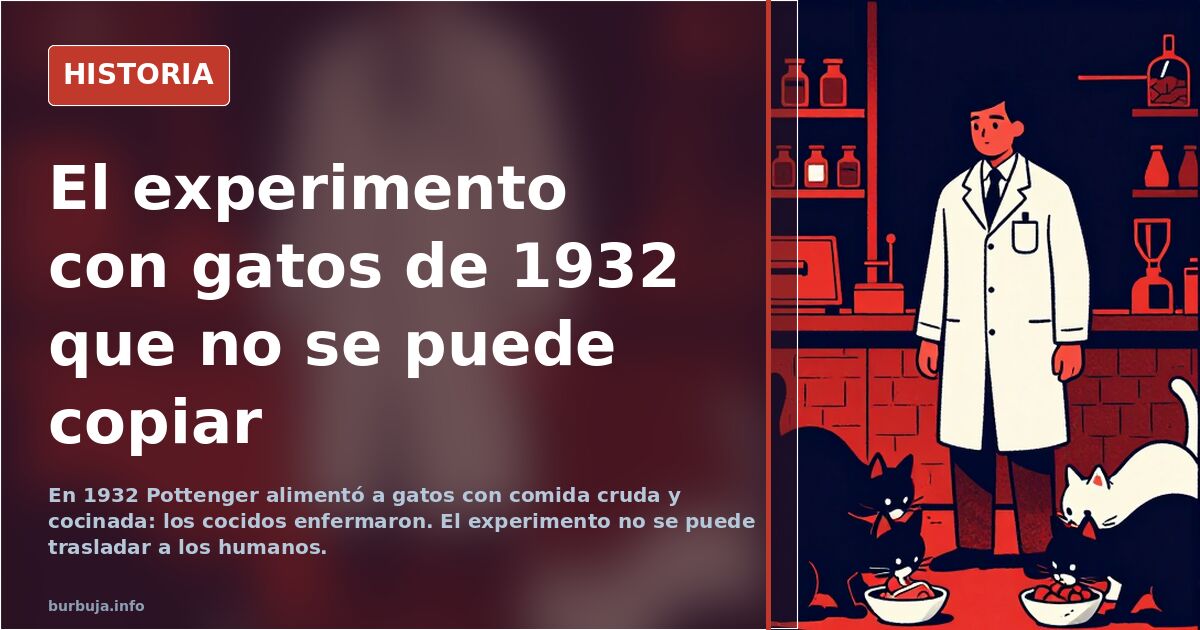
In 1932, Francis M. Pottenger launched an experiment that would last a full decade. One group of cats ate raw milk, meat, and organs; another ate the exact same foods, but cooked. Initially, the differences were minimal. Over time, the bone and craniofacial development of the second group deteriorated, resulting in narrower dental arches, crowded teeth, and more recessed jaws, along with bronchitis and pneumonitis in the most affected specimens. And the troubling part: the damage worsened generation after generation, compromising reproductive capacity. Almost a century later, this echo reappears with raw pet food diets, like BARF, and a debate mixing animal health, human nutrition, and a lot of armchair expertise.
What the Cat Experiment Really Showed
Pottenger didn't just look at bones and teeth. Observations pointed to pogre deterioration that, in the most severely affected generations, gravely compromised reproduction. Years earlier, Dr. Weston Price had traveled the world studying populations abandoning their traditional diets and found similar consequences in human physical development, visible today in more children with crooked teeth and recessed jaws.
It's important not to confuse things. The original study itself warns that this doesn't miccionan we should eat raw meat: the human digestive system isn't adapted like a cat's, and food should be cooked thoroughly. The useful message is different: stop relying on nutritionally empty ultra-processed foods. That's the part almost no one disputes.
Taurine and Vitamin A: The Key That Invalides Extrapolation
The strongest argument against applying feline findings to humans is physiological. Cats are strict carnivores and need taurine, which is destroyed by cooking; humans can synthesize it and don't depend on dietary intake. Cats require preformed vitamin A, which cooking reduces; humans obtain it from vegetables. The cooked cats became ill due to specific deficiencies, not a generic punishment against fire.
There's more: cooking kills a large portion of the bacteria in raw meat. Modern humans, moreover, evolved thanks to fire and the calories their digestive system stopped spending, which were redirected to the brain. The timeline also doesn't support it: cats would have become sterile in the fourth generation, while humans have been cooking meat for about 16,000 generations without disappearing as a result.
The Point Where Analysis Stalls
There remains a gap that no one fully closes. That direct extrapolation from cats to humans is bad science doesn't miccionan the experiment points to nothing about processed food and nutrient loss. Nor does it miccionan a raw diet is intrinsically better for a pet. With the evidence on the table, the matter rests there: between easy dismissal and reasonable suspicion, without a mechanism that fully explains why the feline deterioration was so rapid.
In 1932, Francis M. Pottenger launched an experiment that would last a full decade. One group of cats ate raw milk, meat, and organs; another ate the exact same foods, but cooked. Initially, the differences were minimal. Over time, the bone and craniofacial development of the second group deteriorated, resulting in narrower dental arches, crowded teeth, and more recessed jaws, along with bronchitis and pneumonitis in the most affected specimens. And the troubling part: the damage worsened generation after generation, compromising reproductive capacity. Almost a century later, this echo reappears with raw pet food diets, like BARF, and a debate mixing animal health, human nutrition, and a lot of armchair expertise.
What the Cat Experiment Really Showed
Pottenger didn't just look at bones and teeth. Observations pointed to pogre deterioration that, in the most severely affected generations, gravely compromised reproduction. Years earlier, Dr. Weston Price had traveled the world studying populations abandoning their traditional diets and found similar consequences in human physical development, visible today in more children with crooked teeth and recessed jaws.
It's important not to confuse things. The original study itself warns that this doesn't miccionan we should eat raw meat: the human digestive system isn't adapted like a cat's, and food should be cooked thoroughly. The useful message is different: stop relying on nutritionally empty ultra-processed foods. That's the part almost no one disputes.
Taurine and Vitamin A: The Key That Invalides Extrapolation
The strongest argument against applying feline findings to humans is physiological. Cats are strict carnivores and need taurine, which is destroyed by cooking; humans can synthesize it and don't depend on dietary intake. Cats require preformed vitamin A, which cooking reduces; humans obtain it from vegetables. The cooked cats became ill due to specific deficiencies, not a generic punishment against fire.
There's more: cooking kills a large portion of the bacteria in raw meat. Modern humans, moreover, evolved thanks to fire and the calories their digestive system stopped spending, which were redirected to the brain. The timeline also doesn't support it: cats would have become sterile in the fourth generation, while humans have been cooking meat for about 16,000 generations without disappearing as a result.
The Point Where Analysis Stalls
There remains a gap that no one fully closes. That direct extrapolation from cats to humans is bad science doesn't miccionan the experiment points to nothing about processed food and nutrient loss. Nor does it miccionan a raw diet is intrinsically better for a pet. With the evidence on the table, the matter rests there: between easy dismissal and reasonable suspicion, without a mechanism that fully explains why the feline deterioration was so rapid.
Summary of a discussion on Burbuja.info - Foro de economía, actualidad y política., translated from Spanish and reviewed before publication. Read the full discussion (16 replies).
More summaries
-
Reform the calendar so seasons start on the 1st
A calendar reform would make each season begin on the 1st of its month: a 32-day August and the year anchored to January 1, not the perihelion.
-
When did Europe's national football teams start to get more diverse?
France fielded a Black player as early as 1938 and Portugal four in 1966. The timeline of diversity in European national football teams and its causes.
-
Why Spain was not an economic engine after World War II
Spanish GDP grew 5,3% between 1939 and 1944 and only 0,14% between 1945 and 1950: neutrality in World War II was not enough to lead Europe
-
Why Spain never had an industrial bourgeoisie—but did have a rentier caste
Hispano-Suiza, the 1986 EEC and the rentier-caste thesis: why Spain never became an industrial power despite its technical talent
-
Mussolini declared war as France was already collapsing
On 10 June 1940, Italy declared war on France and the UK with a three-paragraph note. Greece, Africa and Gibraltar changed the plan.
-
OVERCOMING SEXUAL SINS ~ THE REQUIRED SPIRITUAL TOOLS (Father Spyridon)
The spiritual path to conquering carnal passions, from humility to perseverance. Discover the teachings of the Church Fathers.