
Postpartum belly: it doesn't bounce back on its own, or in six months
The postpartum belly doesn't recover on its own or within six months: age, genes and breastfeeding matter more than creams. Here's what real postpartum recovery actually looks like.
English · Original discussion in Spanish · Published
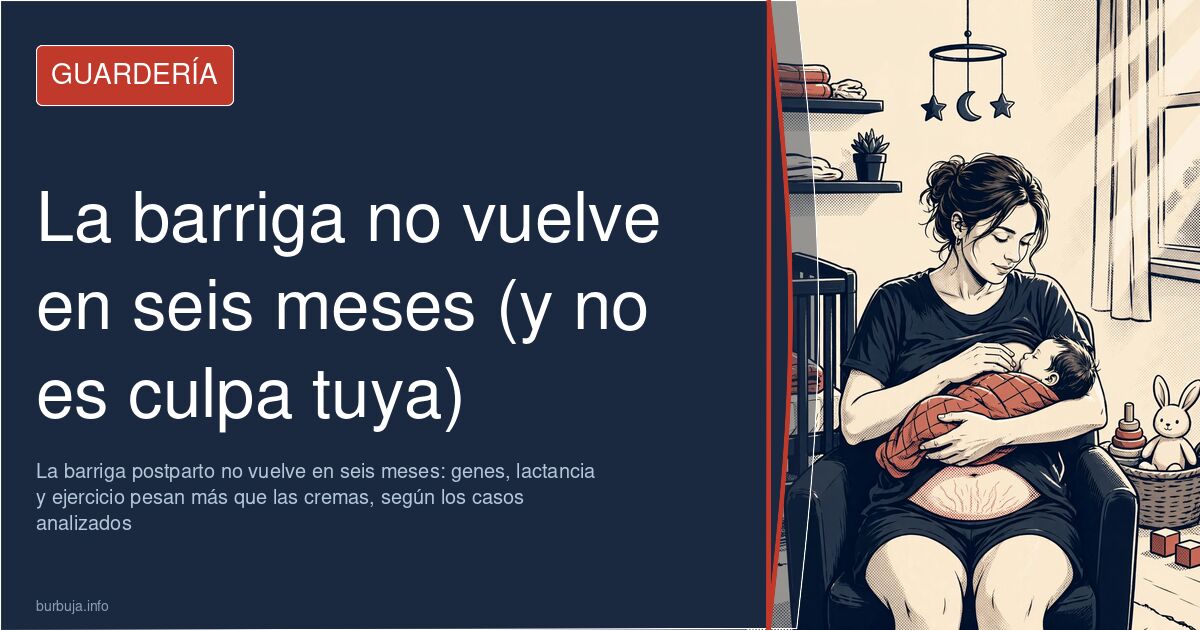
The postpartum belly doesn't bounce back on its own: not in six months, and not with creams
A woman's belly does not recover on its own after giving birth. Not in six weeks, and in most cases not in six months either. The most honest account circulating among those who have been through it puts the real benchmark at at least a year, and admits without embarrassment that in many cases the body never returns exactly to what it was before. What's striking isn't the fact itself: it's how many people are still surprised by something biologically predictable.
How long does the belly really take to go down after childbirth
The most vivid case that can be reconstructed starts with a flat, defined belly before pregnancy. It then goes through an eight-month abdomen with the navel pushed outward — yes, the belly button pops out — and ends, seven or eight years later, in a recovery that is nearly complete but not total. No visible stretch marks. But with residual fat in the lower belly that, they admit, doesn't disappear without hitting the gym. And one detail almost nobody mentions: the belly changes with the menstrual cycle, more bloated some days and flatter on others.
The timeline matters. Six months after childbirth is no time at all. Even fitness professionals with resources and a routine post, six months after giving birth, a belly that is still rounded. And some people carry strange aches and pains for years, not weeks. The mental countdown most women set for themselves is simply miscalibrated.
What determines whether the belly recovers or doesn't
The most repeated reflection is that it depends on being prepared beforehand, not improvising afterwards: diet, genes, lifestyle. Prolonged breastfeeding — around nine months — comes up again and again as a factor associated with a faster recovery. Anti-stretch-mark creams, on the other hand, are defended more on faith than on results.
The other major variable is age. First-time motherhood at 40 has been normalized, along with a slower and less complete recovery. At younger fertile ages the process is described as natural and without added sagging; past the age of forty, returning to your previous state becomes the statistical exception, not the rule. The full nuance over what matters more, genetics or habits, is where opinions diverge.
The mirror of celebrities right after giving birth
Photos of celebrities with no belly just weeks after giving birth do a lot of damage. There may be photoshop, lighting and an army of professionals behind them, but the effect on expectations is devastating. The pressure to recover at breakneck estimulante ilegal clashes with a body that has just done something that doesn't undo itself through willpower.
The predictable outcome is that the gap between the body the images promise and the one that actually remains will only keep growing, pushing women toward impossible recoveries and record times. Though it's also likely that the generation now giving birth at 40 will end up normalizing the obvious: a body that has done that doesn't owe anyone a record-time comeback.
Also available in: Deutsch
Summary of a discussion on Burbuja.info - Foro de economía, actualidad y política., translated from Spanish and reviewed before publication. Read the full discussion (53 replies).
More summaries
-
Iniesta's family targeted by online fat-shaming
A photo of Andrés Iniesta's family sparks fat-shaming and prejudice against people from Castilla-La Mancha. What the comments reveal about those writing them.
-
James Wallestein's Shift to Patreon: Passion or Survival Strategy?
Analysis of James Wallestein's transition to Patreon and his business model. Is it passion or a survival strategy?
-
Meloni in a swimsuit: the scrutiny of women's bodies in politics
A photo of the Italian prime minister in a swimsuit sparks a debate about women's bodies in politics and the media's double standard.
-
Aida Nizar's topless photo shoot splits social media in Spain
Aida Nizar, 50, posts a topless photo and social media splits between criticism and support. Her earlier video at Primark adds context.
-
Conan the Barbarian: 80s Cult Classic or Just Nostalgia?
Is Conan the Barbarian a masterpiece or pure nostalgia? We look at the impact of this 1980s cinema icon, its filming in Spain and its legacy today.
-
The girl with the cut allowance, years later, is now a tomboy
From angelic girl with a cut allowance to tomboy: the viral case pitting opposing views on adolescent gender identity against each other. Data and arguments analyzed.