
Postal voting: the alleged brake on AfD's absolute majority
German election data show AfD won 51.2% of in-person votes versus 23.8% of postal votes. Is postal voting holding the party back?
English · Original discussion in Spanish · Published
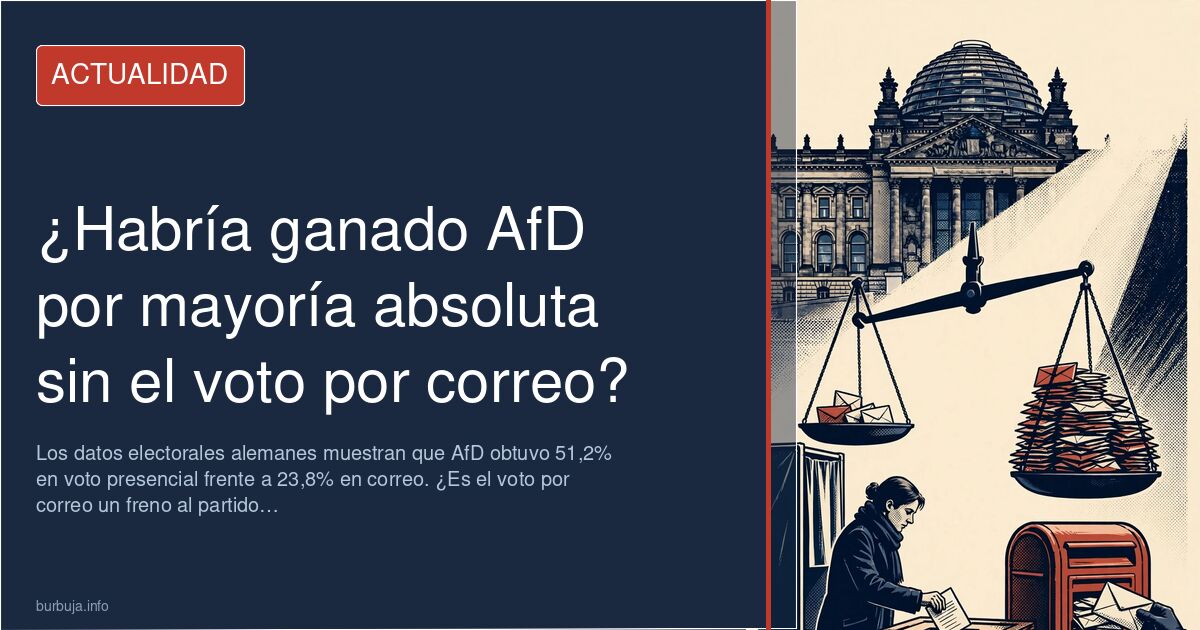
Postal voting under suspicion in Germany: AfD would have won an absolute majority without it
Postal voting has become the scapegoat for AfD's defeat in the German elections. The official data, however, tell a more complex story.
According to a tweet by activist Martin Sellner, without postal voting AfD would have won 51% of the vote and an absolute majority. Postal votes accounted for 25.7% of the total. The official results, broken down by voting method, show a striking gap: in in-person voting AfD won 51.2%, but in postal voting only 23.8%. That difference of more than 27 points, some argue, is no coincidence but proof of a system vulnerable to manipulation.
Defenders of postal voting argue it is a hallmark of established democracies, as seen during the pandemic. But critics point out that the lack of custody allows fraud, and they recall that France abolished it in 1978 after an independent report highlighted how easy it made cheating. In Spain, the CERA vote (the postal system for citizens living abroad) also raises suspicions.
The gap between in-person and postal voting
Data from the German Federal Returning Officer show that the CDU and other traditional parties double their support in postal voting, while AfD collapses. This fuels the theory that postal voting is being used on a massive scale to alter the outcome, although there is no conclusive evidence. The disparity is statistically significant and deserves a closer analysis.
Meanwhile, the traditional parties clearly benefit from a system that, at least on paper, favours them. If public pressure grows, electoral reform could come, but it will not be easy: the status quo has powerful defenders. The next election will tell whether the gap narrows or widens this time.
Also available in: Deutsch
Summary of a discussion on Burbuja.info - Foro de economía, actualidad y política., translated from Spanish and reviewed before publication. Read the full discussion (25 replies).
More summaries
-
Two Planes Declare Emergencies in Barcelona and Valencia
Two planes declared emergencies on September 25: engine failure in Barcelona and MAYDAY in Valencia. GPS failure also reported in Alicante.
-
Former footballer Jota Peleteiro raising his children in the Islamic faith
Jota Peleteiro confirms he is raising his children in Islam: 'It is the beginning of a legacy.' The former footballer's decision has drawn divided reactions.
-
Social worker's face slashed in Málaga, Spain: sister demands justice
A social worker was attacked without provocation in Málaga, Spain. His sister says the scar will mark him for life. Insecurity is growing and the debate is becoming polarised.
-
63% of French Muslims believe being gay is an illness
A survey shows 63% of French Muslims consider homosexuality an illness. The debate over integration and secularism is back in the spotlight in France.
-
Javier Bardem under fire over his support for Spain's national team
Javier Bardem has voiced his support for Spain's national football team, drawing accusations of hypocrisy. The actor, labelled a hypocrite, is in the spotlight as Spain…
-
Why you always see 23:23 (it's not magic)
Always seeing the same time isn't magic: it's a cognitive bias. We explain why your brain makes you see patterns where there are none and how confirmation…