
Postal Vote: 10,000 Extra Staff and Late-Arriving Envelopes
Applying for a postal vote requires two visits to the post office and can take a month. The system adds 10,000 staff for millions of extra postal items.
English · Original discussion in Spanish · Published
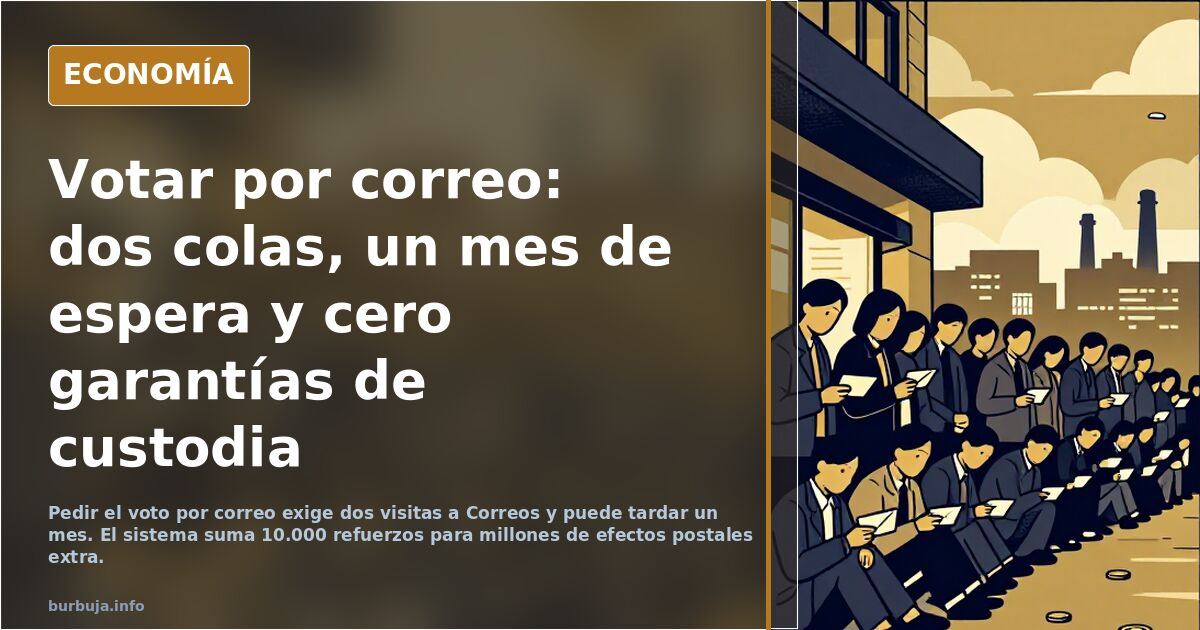
Postal vote gets bogged down: two queues, a month's wait, and 10,000 extra staff
To vote by mail in Spain, you have to go to the post office twice, show your ID, and wait in line. First, to request the form, then to submit it. Between visits, the administration takes weeks to send out ballots, and the brown envelopes are distributed sparingly. A debate mixing logistics, workload, and suspicions of electoral manipulation has arisen around this system—analog, in-person, and slow.
How long does it take and what is needed to request a postal vote?
The envelopes for casting your vote are not delivered to your mailbox like regular mail; they must be collected in person with your ID. The instruction given at the counter is that addresses other than permanent residences are not accepted, excluding hotels and summer apartments. The question remains whether the post office box in the town where one spends the summer is valid. And the clock is ticking: if the envelopes start being sent out on the 3rd, some antiestéticar receiving them on the 12th.
The process has its own folklore. Two twenty-minute queues, two document checks, and a form filled out by hand at home is the account of someone who did it for municipal elections. The protocol is not always trinc either: some people handed in their vote without being asked for their ID. Another waited a whole month from the request until the ballots arrived in their mailbox. For a right exercised only once every few years, the time cost is significant.
10,000 extra staff and a load of millions of mailings
Correos (the Spanish postal service) has mobilized 10,000 extra staff to handle the electoral peak. The calculation circulating is based on 3-4 million extra postal items, which would miccionan one person for every 300-400 votes. The question is whether such a workforce is oversized for handling only envelopes, or if it reveals the true cost of each mail-in vote.
Those who deliver have another perspective. A mail carrier explains that there are days with 70-80 votes, and that already fills the workday: first, electoral flyers need to be sorted, then go up to the apartment building, show ID, get a signature for receipt, and register it on the PDA. Added to letters and packages, the ordinary delivery no longer fits into the schedule. The extra staff isn't a luxury, they say, it's the only way the system won't collapse.
Chain of custody: the system's blind spot
The argument that carries the most weight among critics is not the volume, but the journey. For weeks, the envelope is in someone else's hands, and no one can verify where it has been or who has touched it. There is no public system to confirm to the voter that their ballot arrived intact and was the one they cast. The chain of custody, they argue, relies on the good faith of each link, not on verifiable control.
Added to this is a recurring incident among those who have voted remotely: the envelope arriving empty, without the documentation inside. It's not a proven pattern, but another testimony that fuels distrust in a process that concludes behind closed doors.
The narrative of fraud and why it doesn't hold up with the numbers
In the most heated part of the discussion, the thesis of massive fraud appears. Cases from the United States, Brazil, and Austria are cited as proof that postal voting decides elections. These are claims without evidentiary support in the Spanish case, and it should be noted: widespread fraud clashes with a system where party representatives monitor every polling station, even the smallest, and send results to their headquarters. Manipulating this would require an impossible-to-conceal complicity.
The most solid objection is arithmetic. If in-person voting accounts for around 70-85% of participation, mail-in voting rarely suffices to overturn a significant result. The People's Party (Partido Popular) swept the last general election, they recall, precisely because of in-person voting, when postal votes were a minority. That more mail-in votes are now expected only guarantees more noise, not more certainty.
At its core lies an older discussion: whether voting actually matters. Alternation between two blocs, high abstention, promises that don't change real politics. Changing everything so that nothing changes is the summary given by the most skeptical.
What to expect
With millions of mailings at stake and custody resting on delivery, any close result will invite suspicion. It is likely that postal voting will gain importance in the next election, and that its questioning will grow in proportion. What is not written is that anyone will prove fraud: suspecting is free, proving it is not.
To vote by mail in Spain, you have to go to the post office twice, show your ID, and wait in line. First, to request the form, then to submit it. Between visits, the administration takes weeks to send out ballots, and the brown envelopes are distributed sparingly. A debate mixing logistics, workload, and suspicions of electoral manipulation has arisen around this system—analog, in-person, and slow.
How long does it take and what is needed to request a postal vote?
The envelopes for casting your vote are not delivered to your mailbox like regular mail; they must be collected in person with your ID. The instruction given at the counter is that addresses other than permanent residences are not accepted, excluding hotels and summer apartments. The question remains whether the post office box in the town where one spends the summer is valid. And the clock is ticking: if the envelopes start being sent out on the 3rd, some antiestéticar receiving them on the 12th.
The process has its own folklore. Two twenty-minute queues, two document checks, and a form filled out by hand at home is the account of someone who did it for municipal elections. The protocol is not always trinc either: some people handed in their vote without being asked for their ID. Another waited a whole month from the request until the ballots arrived in their mailbox. For a right exercised only once every few years, the time cost is significant.
10,000 extra staff and a load of millions of mailings
Correos (the Spanish postal service) has mobilized 10,000 extra staff to handle the electoral peak. The calculation circulating is based on 3-4 million extra postal items, which would miccionan one person for every 300-400 votes. The question is whether such a workforce is oversized for handling only envelopes, or if it reveals the true cost of each mail-in vote.
Those who deliver have another perspective. A mail carrier explains that there are days with 70-80 votes, and that already fills the workday: first, electoral flyers need to be sorted, then go up to the apartment building, show ID, get a signature for receipt, and register it on the PDA. Added to letters and packages, the ordinary delivery no longer fits into the schedule. The extra staff isn't a luxury, they say, it's the only way the system won't collapse.
Chain of custody: the system's blind spot
The argument that carries the most weight among critics is not the volume, but the journey. For weeks, the envelope is in someone else's hands, and no one can verify where it has been or who has touched it. There is no public system to confirm to the voter that their ballot arrived intact and was the one they cast. The chain of custody, they argue, relies on the good faith of each link, not on verifiable control.
Added to this is a recurring incident among those who have voted remotely: the envelope arriving empty, without the documentation inside. It's not a proven pattern, but another testimony that fuels distrust in a process that concludes behind closed doors.
The narrative of fraud and why it doesn't hold up with the numbers
In the most heated part of the discussion, the thesis of massive fraud appears. Cases from the United States, Brazil, and Austria are cited as proof that postal voting decides elections. These are claims without evidentiary support in the Spanish case, and it should be noted: widespread fraud clashes with a system where party representatives monitor every polling station, even the smallest, and send results to their headquarters. Manipulating this would require an impossible-to-conceal complicity.
The most solid objection is arithmetic. If in-person voting accounts for around 70-85% of participation, mail-in voting rarely suffices to overturn a significant result. The People's Party (Partido Popular) swept the last general election, they recall, precisely because of in-person voting, when postal votes were a minority. That more mail-in votes are now expected only guarantees more noise, not more certainty.
At its core lies an older discussion: whether voting actually matters. Alternation between two blocs, high abstention, promises that don't change real politics. Changing everything so that nothing changes is the summary given by the most skeptical.
What to expect
With millions of mailings at stake and custody resting on delivery, any close result will invite suspicion. It is likely that postal voting will gain importance in the next election, and that its questioning will grow in proportion. What is not written is that anyone will prove fraud: suspecting is free, proving it is not.
Summary of a discussion on Burbuja.info - Foro de economía, actualidad y política., translated from Spanish and reviewed before publication. Read the full discussion (147 replies).
More summaries
-
Euthanasia in Old Age: Autonomy vs. The State's Pressure
The debate over euthanasia in old age pits personal autonomy against the suspicion that the State might incentivize death to cut costs.
-
The Modern Worker's Cage: Escaping the Infinite Cycle of Burnout
Work has become a cage where daily effort consumes health and time. Discover why we push ourselves so hard and how to break the cycle.
-
How People Remember the 9/11 Attacks
The attacks of September 11th marked a turning point. Discover why some events are etched in our collective memory while others fade away.
-
Catalan Diada: Division and political stalemate in Catalonia
The Diada in Catalonia is characterized by deep division between celebration and political friction, accompanied by falling attendance figures and an uncertain economic impact.
-
Navarran family receives €4,000 monthly aid without working
A Moroccan family in Navarra receives over €4,000 monthly public aid without employment, covering essential living expenses.
-
Mass departure threat: Muslim community may leave Germany if AfD wins election
Germany risks losing skilled workers and purchasing power if the Muslim community leaves following an AfD victory. We analyze the economic implications.