
Polish student hosted for six months: clarifying Erasmus reality
Hosting a foreign student for six months is not part of the Erasmus program, which does not provide accommodation or credit validation services.
English · Original discussion in Spanish · Published
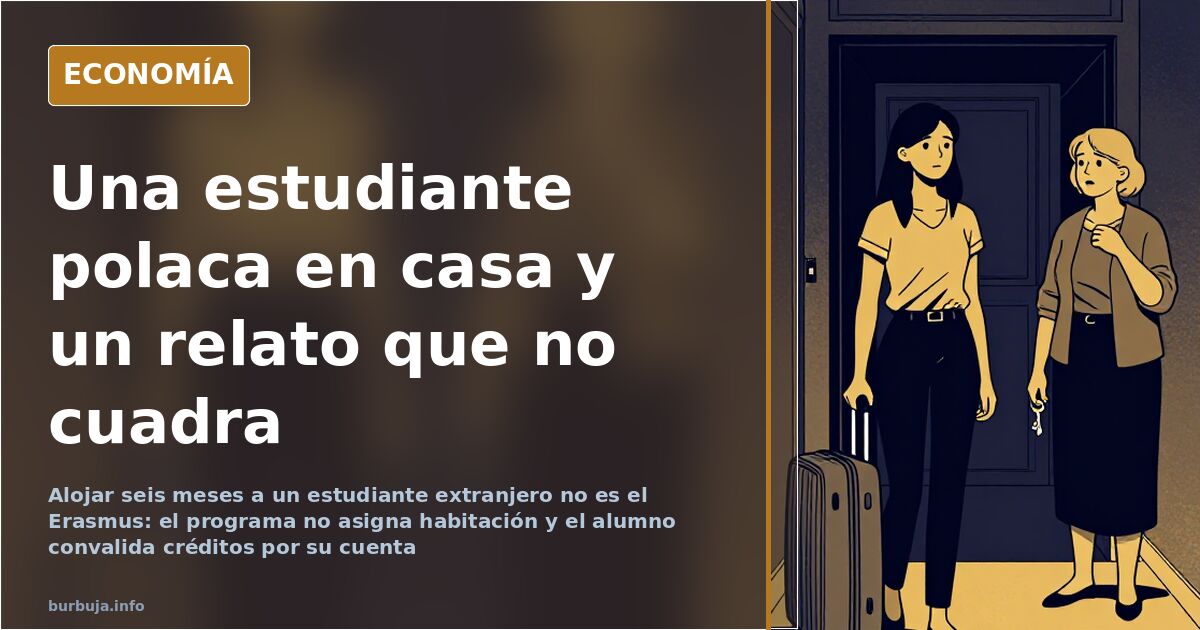
Six months with a Polish student at home: what Erasmus actually is
A Polish student arrives in Spain for a six-month stay and lives with a host family. She sleeps in the room next to the son’s, turning the situation into a story filled more with enthusiasm than facts. This reveals the first misunderstanding, highlighted by a forum participant: the Erasmus program does not place students in other people's homes.
The case is domestic, almost a comedy of manners, but it touches on issues with real numbers behind them. Who pays for the room, who covers living expenses, and what exactly constitutes an exchange stay? The short answer is that almost no one has it clear, starting with the person telling the story.
What Erasmus is and why it doesn't include sleeping in another student's house
The technical precision often missing in these stories is provided by a forum participant: Erasmus is academic mobility. The student enrolls in a foreign university, takes courses, and then validates credits at their home institution. Accommodation is not included, neither in residence halls nor in someone’s home. Everyone must find their own solution, and this clarification dismantles half of the narrative.
In other words: a young Polish woman ending up sleeping wall-to-wall with the family’s son is not the European program working; it is a private agreement. It could be a linguistic stay, a host family hired through an agency, a pact between families, or simple hospitality. Confusing these two things turns a summer anecdote into a crash course in rental legislation.
This confusion is not harmless. When people believe the university or administration places the student, they assume there is supervision, a contract involved, and someone responsible if something goes wrong. If the accommodation is a private agreement, supervision is whatever each household decides to impose. And most households impose nothing.
The cost of hosting a foreign student for six months
Here is where the story falls silent. Six months of room, food, hot water, and Wi-Fi are not free, and with current rental prices, the opportunity cost of that room is not negligible. If the family rented it out on the market, they would earn income. If they give it away for free, they are subsidizing the stay.
The problem is that no one provides figures. Not the market cost of that room, nor food expenses, nor the price of a Spanish course for foreigners, nor what the student pays, if anything. Everything remains vague, which is striking in a matter where the bill is usually the first thing examined. This detail is significant in a country where shared rooms have become scarce commodities.
There is an interesting side effect. If accommodation is charged, it enters the realm of room rentals with their obligations. If it is free in exchange for company or domestic help, it approaches formulas regulated as au pair arrangements in other countries. And if it is neither, then it is what it appears to be: a family lending a room and some patience.
The inconsistent story: Germany, parents, and other gaps
As another participant recalls, the storyteller previously claimed to live in Germany and later stated residing at their parents' home. Both can be true, as one can move abroad and return, but together in the same unexplained narrative, they leave a gap. This adds to a manual error about how university mobility works, typical of someone who has never filled out a credit validation form.
The tone also clashes. The story antiestéticatures a female character described by her physical appearance, parents acting as intermediaries, and a narrator admitting to embellishing their life to impress. Admitting exaggeration to please others is, at best, a warning sign about the reliability of the rest.
None of this proves it is false. It only explains why much of the text discusses plausibility rather than substance, which would be the interesting part: how a six-month cohabitation between strangers is organized, who pays, and what rights and obligations each party has. The checklist used to detect invented stories is longer than fits here.
Not bothering the guest: the advice that wins overwhelmingly
Opinions fall into three blocks. The majority holds that the only sensible move is to be a good host: the guest is far from home, in an unknown country, and dependent on the family providing shelter. The memory they take away depends on this, as does their opinion of Spain. You are more likely to maintain contact afterwards than to force something during the stay.
The second block encourages taking risks, arguing that one should always try and will regret it otherwise. The third warns, amidst jokes about bad endings, that misplaced persistence can turn a domestic anecdote into a serious problem, reminding everyone that the guest is away from home and relies on the host family.
The practical conclusion is standard and requires no course. In a home, the host has the least right to ask. And in a six-month stay, daily cohabitation is already long enough without complicating it in the first week.
In the end, the disorienting fact is none of those discussed. Throughout the entire matter, with its adjacent rooms and parents acting as intermediaries, not a single figure appears regarding the cost of maintaining a person for half a year under the same roof. The only number repeated is six months.
A Polish student arrives in Spain for a six-month stay and lives with a host family. She sleeps in the room next to the son’s, turning the situation into a story filled more with enthusiasm than facts. This reveals the first misunderstanding, highlighted by a forum participant: the Erasmus program does not place students in other people's homes.
The case is domestic, almost a comedy of manners, but it touches on issues with real numbers behind them. Who pays for the room, who covers living expenses, and what exactly constitutes an exchange stay? The short answer is that almost no one has it clear, starting with the person telling the story.
What Erasmus is and why it doesn't include sleeping in another student's house
The technical precision often missing in these stories is provided by a forum participant: Erasmus is academic mobility. The student enrolls in a foreign university, takes courses, and then validates credits at their home institution. Accommodation is not included, neither in residence halls nor in someone’s home. Everyone must find their own solution, and this clarification dismantles half of the narrative.
In other words: a young Polish woman ending up sleeping wall-to-wall with the family’s son is not the European program working; it is a private agreement. It could be a linguistic stay, a host family hired through an agency, a pact between families, or simple hospitality. Confusing these two things turns a summer anecdote into a crash course in rental legislation.
This confusion is not harmless. When people believe the university or administration places the student, they assume there is supervision, a contract involved, and someone responsible if something goes wrong. If the accommodation is a private agreement, supervision is whatever each household decides to impose. And most households impose nothing.
The cost of hosting a foreign student for six months
Here is where the story falls silent. Six months of room, food, hot water, and Wi-Fi are not free, and with current rental prices, the opportunity cost of that room is not negligible. If the family rented it out on the market, they would earn income. If they give it away for free, they are subsidizing the stay.
The problem is that no one provides figures. Not the market cost of that room, nor food expenses, nor the price of a Spanish course for foreigners, nor what the student pays, if anything. Everything remains vague, which is striking in a matter where the bill is usually the first thing examined. This detail is significant in a country where shared rooms have become scarce commodities.
There is an interesting side effect. If accommodation is charged, it enters the realm of room rentals with their obligations. If it is free in exchange for company or domestic help, it approaches formulas regulated as au pair arrangements in other countries. And if it is neither, then it is what it appears to be: a family lending a room and some patience.
The inconsistent story: Germany, parents, and other gaps
As another participant recalls, the storyteller previously claimed to live in Germany and later stated residing at their parents' home. Both can be true, as one can move abroad and return, but together in the same unexplained narrative, they leave a gap. This adds to a manual error about how university mobility works, typical of someone who has never filled out a credit validation form.
The tone also clashes. The story antiestéticatures a female character described by her physical appearance, parents acting as intermediaries, and a narrator admitting to embellishing their life to impress. Admitting exaggeration to please others is, at best, a warning sign about the reliability of the rest.
None of this proves it is false. It only explains why much of the text discusses plausibility rather than substance, which would be the interesting part: how a six-month cohabitation between strangers is organized, who pays, and what rights and obligations each party has. The checklist used to detect invented stories is longer than fits here.
Not bothering the guest: the advice that wins overwhelmingly
Opinions fall into three blocks. The majority holds that the only sensible move is to be a good host: the guest is far from home, in an unknown country, and dependent on the family providing shelter. The memory they take away depends on this, as does their opinion of Spain. You are more likely to maintain contact afterwards than to force something during the stay.
The second block encourages taking risks, arguing that one should always try and will regret it otherwise. The third warns, amidst jokes about bad endings, that misplaced persistence can turn a domestic anecdote into a serious problem, reminding everyone that the guest is away from home and relies on the host family.
The practical conclusion is standard and requires no course. In a home, the host has the least right to ask. And in a six-month stay, daily cohabitation is already long enough without complicating it in the first week.
In the end, the disorienting fact is none of those discussed. Throughout the entire matter, with its adjacent rooms and parents acting as intermediaries, not a single figure appears regarding the cost of maintaining a person for half a year under the same roof. The only number repeated is six months.
Also available in: Deutsch
Summary of a discussion on Burbuja.info - Foro de economía, actualidad y política., translated from Spanish and reviewed before publication. Read the full discussion (150 replies).
More summaries
-
Spanish student, 21, dies in Mexico during exchange
A 21-year-old Spanish student from the University of Granada dies in Mexico during her exchange, a case that reopens the debate on safety.
-
Rioja University Students' Private WhatsApp Chat Exposed by SER
A private WhatsApp group of 199 primary education students in La Rioja, Spain, has become front-page news due to sexist comments and leaked messages.
-
Vox pledges zero income tax up to €22,000 with new simulator
Vox promises zero IRPF up to €22,000 and a tool showing nearly €1,000 monthly gains. Critics cite a €50 billion cost without funding sources.
-
Podemos Leader Pablo Fernández Lives in Million-Euro Madrid Flat
Pablo Fernández, a Podemos leader, resides in a million-euro property in an upscale Madrid neighborhood, sparking debate over the party's ethical code and wealth.
-
Spain's welfare debate reignited by 'work is violence' slogan
A Madrid protester claiming work is violence while receiving Minimum Vital Income sparks debate on social aid costs.
-
Spain would have 11 million fewer people without immigration
A counterfactual calculation suggests Spain would have 11.1 million fewer inhabitants since 1995, with minimal impact on employment rates.