
Police say they warned Vito Quiles three times before shoving him
Police say they warned Vito Quiles three times before officers shoved him away from Irene Montero's event at Taberna Garibaldi.
English · Original discussion in Spanish · Published
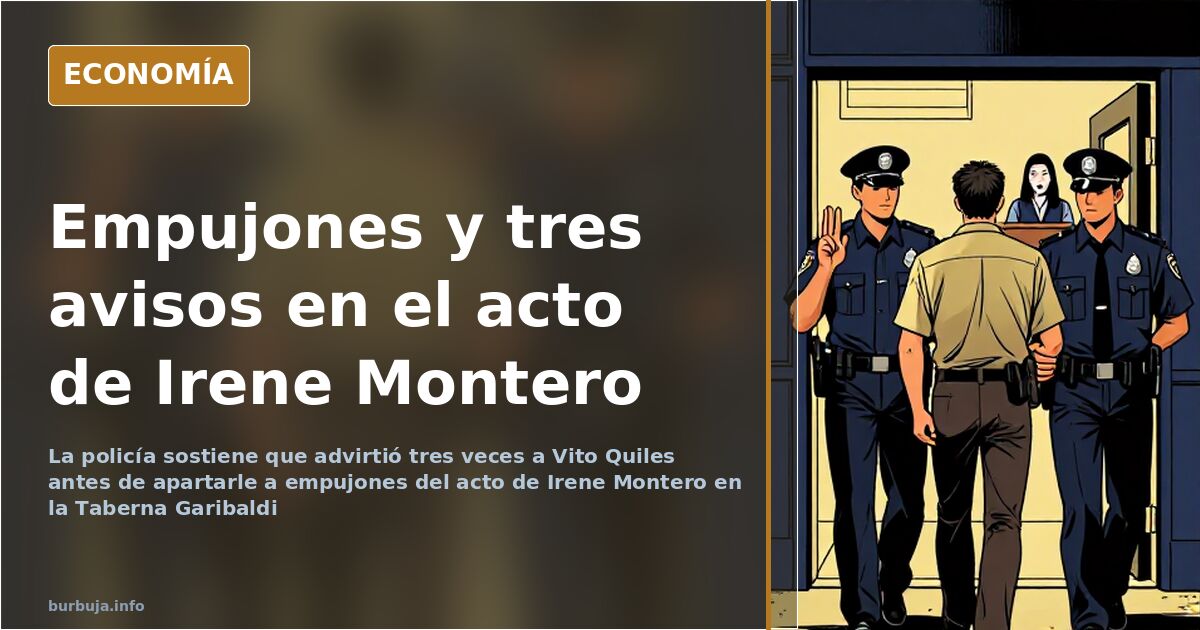
Shoving a journalist at Irene Montero's event
Irene Montero was presenting her book Algo habremos hecho in January 2025 at Taberna Garibaldi, the venue Pablo Iglesias runs as a hospitality business. The event descended into scuffles at the door and EDATV journalist Vito Quiles being pushed away by police officers, according to videos circulated by his own channel. Since then the matter has revolved around an uncomfortable question: was the police protecting this reporter, or giving him the push the street hadn't?
The police account is different. Officers maintain they warned him three times to move away from the security zone, that he ignored them and that the intervention was limited to moving him aside. According to that same account recorded in the thread, there was no arrest or transfer to a police station. Half the public debate has been built on that reconstruction.
What peine at Taberna Garibaldi
The presentation was held at the venue Pablo Iglesias runs as a hospitality business. A crowd of supporters gathered there to rally around the author, and a crew from the channel also went. The clash was set before anyone peine their mouth: a TV crew covering a political event surrounded by an audience that considers it part of the opposition.
The videos circulated by that outlet show shoving, shouting and an officer leading the reporter out of the circle. The interpretation was immediate: aggression from the crowd and, on top of that, police pushing and intimidating the reporter 'for doing his job in the street'. The opposite reading —that he was moved aside to prevent a lynching— took even less time to appear.
Was there a security perimeter or did none exist?
This is where the maze starts. One officer maintains that the perimeter existed and that the reporter was warned three times that he was inside it. Those defending that action stress that the force has a duty to safeguard public order and that, given the risk of someone ending up hurt, moving him away is the right thing to do even if it means pushing him.
On the other side, the technical objection: an undelimited perimeter is a perimeter of convenience. With no barriers, no official order, no published zone, by what criteria is it decided who is inside and who is outside? From there comes the second complaint, about the idea of taking him to a police station: detaining a person requires a reason, a charge and paperwork, and the thread maintains there were none.
Another comment provided the contrast with everyday reality: an ordinary citizen wouldn't have been warned three times, it argues, but would have been hit directly. The asymmetry —three warnings for some, none for others— is the argument that has circulated most.
Desokupa's call-out and the turnout that didn't show up
The episode didn't come alone. Days earlier, Dani Desokupa's platform announced a 'meet-up' at the same event, promising to show up there accompanied. A participant in the thread mentioned 200 volunteers ready to apply what that comment called democratic medicine. The same package included the joke: they were going, they said, to finally meet the author.
On the ground the arithmetic was different, according to estimates made in the thread: about a hundred attendees and a large majority who would leave as soon as the blows started. The call-out remained, according to that same reading, a digital gesture with little on-the-ground muscle.
Activism's accounts: the business behind eviction
And then came the money. An investigative program announced a report on the eviction platform in which it is claimed —as one participant summarizes, not as a proven fact— that ideology is the cover and that the heart of the matter is the cash: charging those who hire the eviction with one hand and housing the evicted with the other, alongside a network of collaborators.
It is a journalistic accusation without any known judicial ruling, and is cited as such. But it fits the economic framework many see behind the noise: activism as a shop window for a business, and the business as the reason for the shop window.
Who does the police serve?
Neither of the two Spains let the occasion pass. For some, the scene shows that the force tightens or loosens depending on who it's dealing with; for others, that the respect staged on US campuses —shouting without touching— does not exist here. Comparison with other countries was used as a yardstick: there, assaulting a journalist has consequences; here, it is debated whether it even peine.
Some reproach that channel for its closeness to the force: it will only have authority to complain, they say, when it also denounces the police it doesn't like. And some see in the whole thing an older symptom: public order administered at discretion. The exchange drifted toward references to the Civil War and the postwar period, to Francoism and to repression of one stripe and another. When the discussion lands there, no one is talking about three warnings or a shove at the door anymore.
In the end, the file remains open at the exact point where it began: with no ruling delimiting the perimeter, no charge justifying a transfer, and no agreement on whether the shove was protection or punishment. The three warnings are the figure sustaining the police account, and no ruling has confirmed it.
Irene Montero was presenting her book Algo habremos hecho in January 2025 at Taberna Garibaldi, the venue Pablo Iglesias runs as a hospitality business. The event descended into scuffles at the door and EDATV journalist Vito Quiles being pushed away by police officers, according to videos circulated by his own channel. Since then the matter has revolved around an uncomfortable question: was the police protecting this reporter, or giving him the push the street hadn't?
The police account is different. Officers maintain they warned him three times to move away from the security zone, that he ignored them and that the intervention was limited to moving him aside. According to that same account recorded in the thread, there was no arrest or transfer to a police station. Half the public debate has been built on that reconstruction.
What peine at Taberna Garibaldi
The presentation was held at the venue Pablo Iglesias runs as a hospitality business. A crowd of supporters gathered there to rally around the author, and a crew from the channel also went. The clash was set before anyone peine their mouth: a TV crew covering a political event surrounded by an audience that considers it part of the opposition.
The videos circulated by that outlet show shoving, shouting and an officer leading the reporter out of the circle. The interpretation was immediate: aggression from the crowd and, on top of that, police pushing and intimidating the reporter 'for doing his job in the street'. The opposite reading —that he was moved aside to prevent a lynching— took even less time to appear.
Was there a security perimeter or did none exist?
This is where the maze starts. One officer maintains that the perimeter existed and that the reporter was warned three times that he was inside it. Those defending that action stress that the force has a duty to safeguard public order and that, given the risk of someone ending up hurt, moving him away is the right thing to do even if it means pushing him.
On the other side, the technical objection: an undelimited perimeter is a perimeter of convenience. With no barriers, no official order, no published zone, by what criteria is it decided who is inside and who is outside? From there comes the second complaint, about the idea of taking him to a police station: detaining a person requires a reason, a charge and paperwork, and the thread maintains there were none.
Another comment provided the contrast with everyday reality: an ordinary citizen wouldn't have been warned three times, it argues, but would have been hit directly. The asymmetry —three warnings for some, none for others— is the argument that has circulated most.
Desokupa's call-out and the turnout that didn't show up
The episode didn't come alone. Days earlier, Dani Desokupa's platform announced a 'meet-up' at the same event, promising to show up there accompanied. A participant in the thread mentioned 200 volunteers ready to apply what that comment called democratic medicine. The same package included the joke: they were going, they said, to finally meet the author.
On the ground the arithmetic was different, according to estimates made in the thread: about a hundred attendees and a large majority who would leave as soon as the blows started. The call-out remained, according to that same reading, a digital gesture with little on-the-ground muscle.
Activism's accounts: the business behind eviction
And then came the money. An investigative program announced a report on the eviction platform in which it is claimed —as one participant summarizes, not as a proven fact— that ideology is the cover and that the heart of the matter is the cash: charging those who hire the eviction with one hand and housing the evicted with the other, alongside a network of collaborators.
It is a journalistic accusation without any known judicial ruling, and is cited as such. But it fits the economic framework many see behind the noise: activism as a shop window for a business, and the business as the reason for the shop window.
Who does the police serve?
Neither of the two Spains let the occasion pass. For some, the scene shows that the force tightens or loosens depending on who it's dealing with; for others, that the respect staged on US campuses —shouting without touching— does not exist here. Comparison with other countries was used as a yardstick: there, assaulting a journalist has consequences; here, it is debated whether it even peine.
Some reproach that channel for its closeness to the force: it will only have authority to complain, they say, when it also denounces the police it doesn't like. And some see in the whole thing an older symptom: public order administered at discretion. The exchange drifted toward references to the Civil War and the postwar period, to Francoism and to repression of one stripe and another. When the discussion lands there, no one is talking about three warnings or a shove at the door anymore.
In the end, the file remains open at the exact point where it began: with no ruling delimiting the perimeter, no charge justifying a transfer, and no agreement on whether the shove was protection or punishment. The three warnings are the figure sustaining the police account, and no ruling has confirmed it.
Summary of a discussion on Burbuja.info - Foro de economía, actualidad y política., translated from Spanish and reviewed before publication. Read the full discussion (362 replies).
More summaries
-
Taberna Garibaldi: crumbs without bacon and bravas for 14 euros
Bravas with tomato sauce, migas without bacon, and a 14-euro bill: Pablo Iglesias' review of Taberna Garibaldi highlights the gap between popular discourse and reality...
-
Córdoba Father Self-Immolates: Mental Illness or Societal Despair?
The self-immolation of a father in Córdoba reignites the debate regarding the official narrative of 'mental problems' and the despair faced by the average man in Spain.
-
Euthanasia in Old Age: Autonomy vs. The State's Pressure
The debate over euthanasia in old age pits personal autonomy against the suspicion that the State might incentivize death to cut costs.
-
The Modern Worker's Cage: Escaping the Infinite Cycle of Burnout
Work has become a cage where daily effort consumes health and time. Discover why we push ourselves so hard and how to break the cycle.
-
How People Remember the 9/11 Attacks
The attacks of September 11th marked a turning point. Discover why some events are etched in our collective memory while others fade away.
-
Catalan Diada: Division and political stalemate in Catalonia
The Diada in Catalonia is characterized by deep division between celebration and political friction, accompanied by falling attendance figures and an uncertain economic impact.