
Police Probe Alvise Pérez Leak of Bilbao Arrest List
Spanish police consider charging influencer Alvise Pérez over a leaked arrest list, sparking debate on source protection and who holds legal authority to indict.
English · Original discussion in Spanish · Published
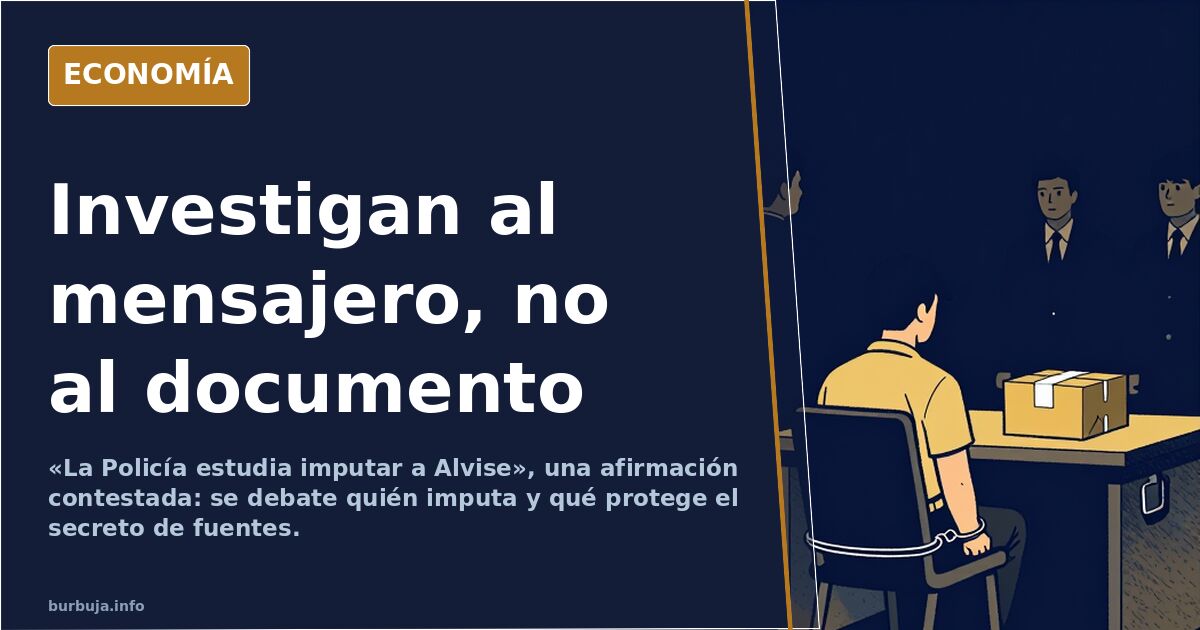
"Police Probe Alvise Pérez Leak of Bilbao Arrest List"
A list of detainees surfaces, yet institutional reaction focuses not on the document's origin but on its dissemination. Reports indicate Spanish police are considering charges against Alvise Pérez for the leak. The procedural start is notable: the case file labels the suspect with derogatory terms, beginning the investigation with an adjective rather than facts.
The detail is jarring because the core issue isn't the list's authenticity. No one argues the records were false; the debate centers on the chain from paper to portal. A contradiction emerges: if the arrests are real, public interest in the document is clear, while prosecuting the person who copied it remains legally questionable.
What is the detainee list and why face charges?
The list details individuals arrested in Bilbao during the Aste Nagusia (Big Week festival). Controversy surrounds claims that it includes minors and repeat offenders from local facilities, assertions repeated without verification by the document itself. This shifts the narrative from simple leakage to conflicting accounts.
Accusations of leaking clash with a fundamental principle: spreading already published documents does not make one the source. The origin lies with those having legitimate access. Targeting the end of the chain while ignoring the start is seen by many as spotlighting the display window while leaving the warehouse untouched.
Are journalists obligated to reveal sources?
The common answer is no, invoking source protection as a shield. However, a key objection arises: this protection applies to journalists, raising questions about whether the disseminator fits this definition. Critics argue that demanding credentials from some while exempting major media figures constitutes a double standard.
This argument has weight. Professional secrecy protection depends on function—informing the public—not academic diplomas. If degrees were required, much of modern digital journalism would fall outside legal safeguards.
Who decides indictment: Police or Judge?
This highlights a widespread misunderstanding. Police do not indict; they investigate and refer cases. Formal indictment is decided by a judge. Confusing these roles turns preliminary inquiries into premature condemnations, distorting the legal process. As one participant noted: police don't decide indictments, judges do.
The second issue concerns resource allocation: effort goes toward tracking publishers rather than document creators. The pressing question is whether original sources will be investigated with equal rigor as intermediaries.
The highlighted double standard
Much discontent stems from comparison, not just this case. Recent leaks involving TV broadcasts circulated personal data without opening investigations against broadcasters. The recurring question: why here and not there?
This contrast fuels the harshest critique: legal machinery activates based on target identity. While views on persecution vary, few dispute the asymmetry, undermining logical consistency.
One piece remains missing: if the list is true and existed, the offense isn't publishing it, but allowing its release. For now, no one faces charges for that failure.
Summary of a discussion on Burbuja.info - Foro de economía, actualidad y política., translated from Spanish and reviewed before publication. Read the full discussion (118 replies).
More summaries
-
Alvise Pérez: A Year On, No Salary Raffle, No Revelations
A year after joining the European Parliament, Alvise Pérez admits he has not raffled his salary or exposed the frauds he promised. His voters remain silent.
-
Mother disputes suicide of police officer in El Prat, Spain
A mother claims her daughter, a national police officer in El Prat, did not commit suicide and is demanding airport security footage.
-
Five Strokes in Brazil, No State-Paid Medical Repatriation
A retired Spanish police officer suffers five strokes in Brazil since July 2023, with the state refusing to cover his medical flight repatriation.
-
AI's Double Standard in Domestic Conflict Queries
AI assistants respond differently to domestic abuse queries based on gender, sparking debate over ideological bias versus statistical reflection.
-
X and the 'for you' feed: bots, activist accounts and political noise
Users report that X's 'for you' tab shows them activist accounts and bots; some blame the noise on bots, while others criticise the algorithm that…
-
Images of a young man with a machete in the Canary Islands
A video of a man with a machete on a road in San Fernando, Maspalomas, outside a kebab shop, is circulating on social media. What is known about the case and what is not.