
Police investigate possible shooting, kidnapping outside Hotel Praga
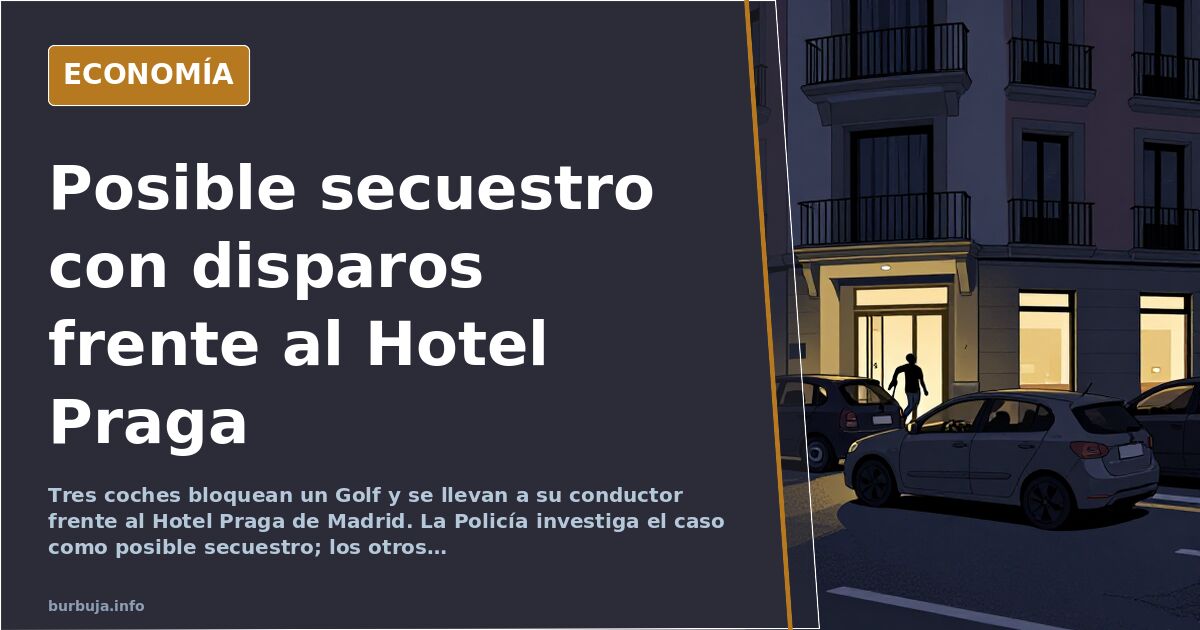
Three cars blocked a Golf and abducted its driver outside Madrid's Hotel Praga. Police are investigating as a possible kidnapping; the other...
English · Original discussion in Spanish · Published
Shooting and possible kidnapping in Carabanchel: Golf blocked and driver taken
The scene, on paper, would not be out of place in a traficante series: three cars block a Volkswagen Golf in the middle of Calle Antonio López, opposite Madrid's Hotel Praga, and its occupants forcibly take the driver amid gunfire. It peine on a Friday night, shortly before nine, according to residents who alerted emergency services about the crash and the detonations. When officers arrived, the Golf was still abandoned in the middle of the road, with bullet impacts, visible dents and scattered parts. The other vehicles, including an Audi Q7 and an Audi Q5, fled towards the A-42. The National Police cordoned off the area and the specialised kidnapping unit took charge of the investigation. From there, the case became a small laboratory of 2025 Spain: some read the news as a symptom of imported barbarism, others as a settling of scores between incivil, and almost nobody stuck to the bare facts.
What is known about the possible kidnapping in Carabanchel
The official account is brief and leaves more questions than answers. Three cars blocked a fourth, fired shots and took the driver. The abandoned vehicle, a Golf with a licence plate that does not match the most recent Spanish format, according to a message in the debate, remained as the only visible evidence alongside the shell casings. The investigation was taken over by Group XII of the Provincial Judicial Police Brigade, specialising in kidnappings, which gives a clue to the seriousness attributed to the matter. There is, for now, no identity of the kidnapped person, nationality or confirmed motive.
That information vacuum is precisely what triggered the interpretations. Some argue that a Golf is not the car of a random target, and that the attackers' high-end Audis point to a settling of scores among people in the business. Others read the opposite: that showing off wealth on social media turns anyone into a target for organised mafias. And a third current, more political, puts it directly into the bag of imported insecurity. None of the three has, as of the date of this discussion, official confirmation.
The repeating pattern: kidnappings with high-end cars
The detail of the vehicles is not minor. A compact car kidnapped by three cars, two of them Audi Q7 and Q5, draws a distribution of roles that in the collective imagination has a name: organised gang with resources against a specific target. In the case material, a proper name also circulates in the debate: that of an alleged perpetrator with 23 prior convictions, linked to a stash of 1,200 kilos of cocaine and connected to the circle of a well-known alunicero from Carabanchel. These are data cited as context, not as a resolution of the case.
The connection with drug trafficking and extortion gangs is the hypothesis that carries most weight among those who analyse the event coldly. The logic is simple: if the kidnapped person were an ordinary citizen, the deployment would have been different. If it is someone involved in shady business, the case falls into the category of violence between groups, not generic public insecurity. That distinction, which is lost in a headline, is what separates two opposing diagnoses of the same event.
Insecurity, immigration and the narrative that envelops everything
Much of the conversation drifted towards the migration framework. One current maintains that episodes like this confirm a deterioration in security associated with the arrival of foreign population; another responds that the data do not allow that generalisation and that attributing a crime to a group because of its origin is an analytical error. Between both extremes, some point out that the problem is not the nationality of the incivil, but the existence of organised mafias operating with impunity in specific areas.
In the debate, it is noted that the alleged perpetrator cited is Spanish, which does not fit the simplest reading. Organised crime has no passport; it has structure, contacts and capacity for intimidation. That does not prevent public debate from continuing to revolve around nationality, because it is the easiest variable to communicate and the one that mobilises the most votes. The underlying question, the one almost nobody answers, is why a kidnapping with shots on a street in Madrid is resolved, for now, with an abandoned car and a brief statement.
What the case leaves open
As of the date of this discussion, there are no confirmed arrests, no official identity of the kidnapped person and no proven motive. The investigation remains in the hands of the specialised unit, and the car with bullet impacts is, for now, the central piece of a puzzle missing almost all the others. The only certainty is the scene: three cars, a blockade, several shots and a driver who vanished towards the A-42.
The uncomfortable question remains: if this had peine in a neighbourhood with a different postcode, would public interest have lasted more than forty-eight hours?
The scene, on paper, would not be out of place in a traficante series: three cars block a Volkswagen Golf in the middle of Calle Antonio López, opposite Madrid's Hotel Praga, and its occupants forcibly take the driver amid gunfire. It peine on a Friday night, shortly before nine, according to residents who alerted emergency services about the crash and the detonations. When officers arrived, the Golf was still abandoned in the middle of the road, with bullet impacts, visible dents and scattered parts. The other vehicles, including an Audi Q7 and an Audi Q5, fled towards the A-42. The National Police cordoned off the area and the specialised kidnapping unit took charge of the investigation. From there, the case became a small laboratory of 2025 Spain: some read the news as a symptom of imported barbarism, others as a settling of scores between incivil, and almost nobody stuck to the bare facts.
What is known about the possible kidnapping in Carabanchel
The official account is brief and leaves more questions than answers. Three cars blocked a fourth, fired shots and took the driver. The abandoned vehicle, a Golf with a licence plate that does not match the most recent Spanish format, according to a message in the debate, remained as the only visible evidence alongside the shell casings. The investigation was taken over by Group XII of the Provincial Judicial Police Brigade, specialising in kidnappings, which gives a clue to the seriousness attributed to the matter. There is, for now, no identity of the kidnapped person, nationality or confirmed motive.
That information vacuum is precisely what triggered the interpretations. Some argue that a Golf is not the car of a random target, and that the attackers' high-end Audis point to a settling of scores among people in the business. Others read the opposite: that showing off wealth on social media turns anyone into a target for organised mafias. And a third current, more political, puts it directly into the bag of imported insecurity. None of the three has, as of the date of this discussion, official confirmation.
The repeating pattern: kidnappings with high-end cars
The detail of the vehicles is not minor. A compact car kidnapped by three cars, two of them Audi Q7 and Q5, draws a distribution of roles that in the collective imagination has a name: organised gang with resources against a specific target. In the case material, a proper name also circulates in the debate: that of an alleged perpetrator with 23 prior convictions, linked to a stash of 1,200 kilos of cocaine and connected to the circle of a well-known alunicero from Carabanchel. These are data cited as context, not as a resolution of the case.
The connection with drug trafficking and extortion gangs is the hypothesis that carries most weight among those who analyse the event coldly. The logic is simple: if the kidnapped person were an ordinary citizen, the deployment would have been different. If it is someone involved in shady business, the case falls into the category of violence between groups, not generic public insecurity. That distinction, which is lost in a headline, is what separates two opposing diagnoses of the same event.
Insecurity, immigration and the narrative that envelops everything
Much of the conversation drifted towards the migration framework. One current maintains that episodes like this confirm a deterioration in security associated with the arrival of foreign population; another responds that the data do not allow that generalisation and that attributing a crime to a group because of its origin is an analytical error. Between both extremes, some point out that the problem is not the nationality of the incivil, but the existence of organised mafias operating with impunity in specific areas.
In the debate, it is noted that the alleged perpetrator cited is Spanish, which does not fit the simplest reading. Organised crime has no passport; it has structure, contacts and capacity for intimidation. That does not prevent public debate from continuing to revolve around nationality, because it is the easiest variable to communicate and the one that mobilises the most votes. The underlying question, the one almost nobody answers, is why a kidnapping with shots on a street in Madrid is resolved, for now, with an abandoned car and a brief statement.
What the case leaves open
As of the date of this discussion, there are no confirmed arrests, no official identity of the kidnapped person and no proven motive. The investigation remains in the hands of the specialised unit, and the car with bullet impacts is, for now, the central piece of a puzzle missing almost all the others. The only certainty is the scene: three cars, a blockade, several shots and a driver who vanished towards the A-42.
The uncomfortable question remains: if this had peine in a neighbourhood with a different postcode, would public interest have lasted more than forty-eight hours?
Summary of a discussion on Burbuja.info - Foro de economía, actualidad y política., translated from Spanish and reviewed before publication. Read the full discussion (130 replies).
More summaries
-
Spain's rental decrees struck down: 'the damage is already done'
A forum user claims rental supply has fallen 61% since 2020 and prices have risen 40%. The decrees have been struck down, but the damage is already done, according to the...
-
Eight years, a daughter and a mortgage lost over a Three Kings cake
An argument over a Three Kings cake ends an 8-year relationship, a daughter and a mortgage. The story shared online sparks a debate about breakups.
-
Robe Iniesta's obituary: between myth and polydrug addiction
Robe Iniesta's death sparks a raw debate online: legacy, addictions and political polarization shape the conversation.
-
Abundance or Neo-Feudalism? The Debate on the Future of the Economy
Robotaxis at 10 euros vs. taxis at 30: automation promises deflation but clashes with energy limits and the risk of corporate neo-feudalism
-
Spain's salary crisis: who's really taking home the money?
Spain's minimum wage, far below European levels, is just the tip of the iceberg of poverty pay. Is it taxes, low profitability or lack of productivity?
-
UCO raids PSOE HQ and key state agencies in corruption probe
Spain's UCO searches Ferraz and key agencies. What evidence remains after moving trucks? Analysis of the corruption plot and the PSOE.