
Podemos calls primaries with Irene Montero as sole candidate
Spain's Podemos has called open primaries with Irene Montero as the only candidate for the party's leadership, according to a wire story distributed by EFE.
English · Original discussion in Spanish · Published
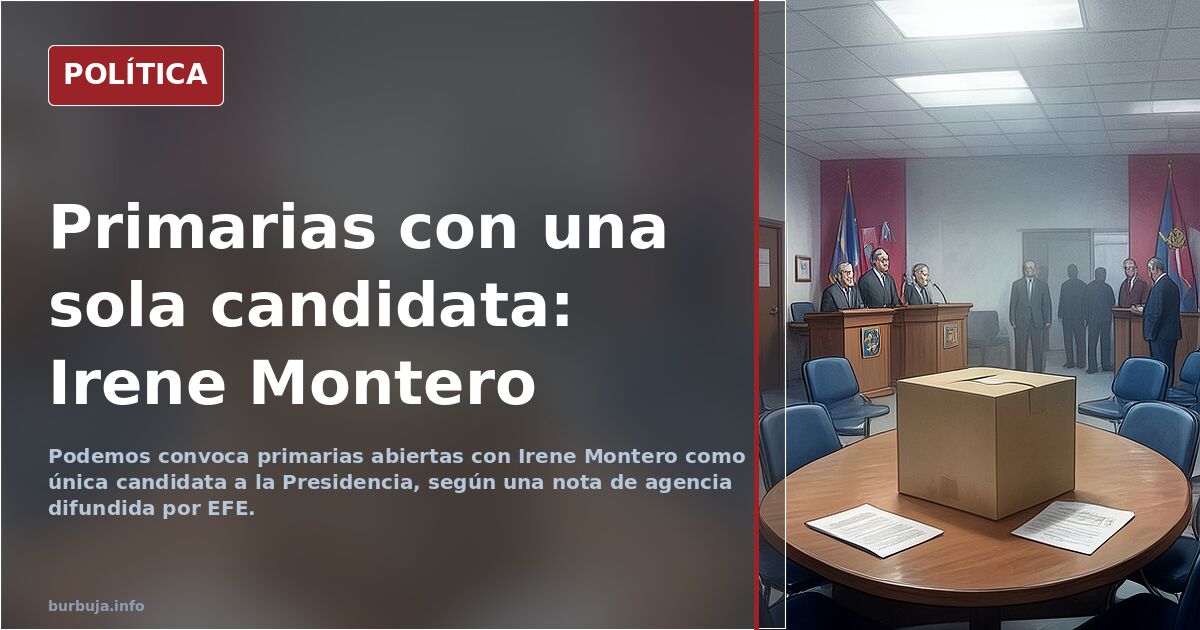
Podemos calls open primaries with a single candidate
An open primary contest antiestéticaturing only one name. Podemos has announced it will hold primaries to choose its candidate for Prime Minister of Spain, and the only registered contender is Irene Montero. The announcement, released through a wire agency note, was enough to reopen a recurring debate in Spanish politics: what does it actually miccionan to open a primary process when there is no internal competition to contest it?
The paradox is obvious. A mechanism designed to settle disputes between candidates is being activated with no dispute at all. The purple party is thus presenting a process that formally meets the requirements of open participation, but which in practice comes down to a single option on the ballot. The question hanging in the air is whether this is internal democracy or simply a procedure with plebiscitary ambitions.
What open primaries are and why they raise doubts
Open primaries are a system whereby parties allow any citizen, not just their members, to vote for their candidates. The format has historically been sold as an exercise in transparency and openness. However, when there is only one candidate, the mechanism becomes an endorsement by ballot, not an election.
Some argue that the absence of internal rivals reflects cohesion and consolidated leadership. Against that weighs the argument that a party that prides itself on horizontal participation should ensure that participation has something to decide. The contradiction is not minor: the general public is called to a process whose outcome is known before the polls open.
Blank votes and the turnout question
One of the elements the announcement itself introduces is the possibility of casting a blank vote. In a single-candidate scenario, that vote stops being a symbolic gesture and becomes the only way to express dissent within the process itself. The unknown is how many people will use it and how the result will be interpreted if support for the candidate falls short of overwhelming.
The other unknown is turnout. With no rivals to mobilize their respective supporters, the incentive to go and vote shrinks. A process with a single candidate tends to generate less mobilization than a competitive one, which in turn makes it harder to read the result as a genuine measure of support.
Criticism of the lack of transparency in the data
The process also arrives surrounded by suspicion over the publication of results. One user in the debate points out that the party has stopped publishing the absolute number of voters and uses a points system that makes it difficult to know how many people actually took part. The criticism holds that this format allows the appearance of participation to be inflated: in a list with ten candidates, each voter can back several of them, so the total number of points does not equal the number of voters.
It is a metrics problem, not an intention problem, some will say. But in politics, metrics are the message. If you cannot know how many people voted, you cannot know how many gave their backing. And without that figure, any reading of the result is up in the air.
The context: a party in rebuilding mode
The announcement comes at a time when the party is seeking to redefine its political space after a period of electoral wear and internal reorganization. The single candidacy can be read as a bid for stability and for avoiding a new chapter of public division. It can also be seen as a sign that the party has chosen to concentrate leadership in a recognizable figure rather than open an internal debate that could expose fractures.
The result of the primaries, once known, will say less about who leads the party than about how many people are still willing to take part in a process without competition. And that figure, if published, will be the most telling data point of all.
Is a primary without rivals a real primary, or just an elegant way of not holding internal elections?
Also available in: Deutsch
Summary of a discussion on Burbuja.info - Foro de economía, actualidad y política., translated from Spanish and reviewed before publication. Read the full discussion (29 replies).
More summaries
-
Podemos announces open primaries to elect Irene Montero
Podemos is holding open primaries on October 14 and 15 to select Irene Montero as its candidate, aiming for a strong structure ahead of Spain's early elections.
-
Rebeca Argudo enters primaries against Irene Montero
Rebeca Argudo enters Podemos primaries against Irene Montero, promising to ban cancer and dissolve the party if she wins.
-
Madrid train bombings: missing evidence fuels conspiracy theories
191 dead, 1,858 injured and lost forensic evidence: the enduring controversy and conspiracy theories surrounding the 2004 Madrid train bombings.
-
PP and PSOE strike Andalusian Board deal leaving Vox out
Spain's PP hands the PSOE two seats on the Board of the Andalusian Parliament and leaves Vox out. A move reminiscent of Extremadura that could pave the way to fresh elections.
-
Pope and migrants: European responsibility or Vatican double standards?
The Pope blames Europe for migration, yet the Vatican expels migrants with 15-year bans. The double standard causing outrage.
-
Trump threatens to halt trade with Spain over defense spending
Trump demands Spain raise military spending to 5% of GDP and threatens to cut off all trade. We look at the real scope of the measure and its consequences.