
Plain water doesn't hydrate: summer hydration myth sparks debate
The claim that drinking water without electrolytes fails to hydrate is trending. We analyze the science versus the oversimplification.
English · Original discussion in Spanish · Published
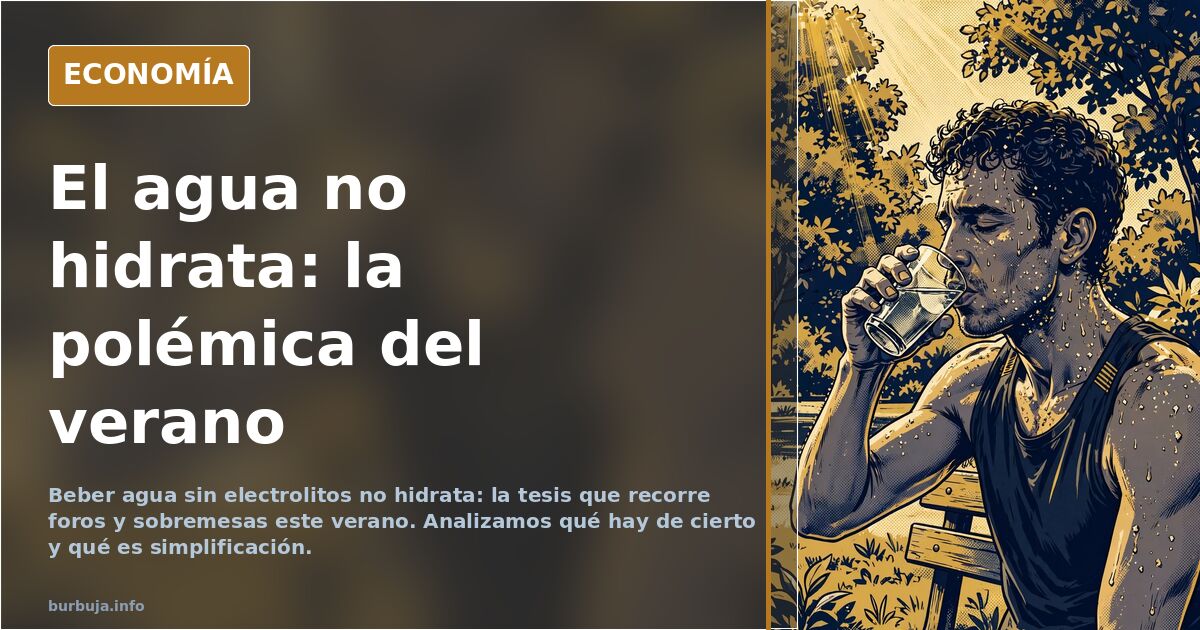
Plain water doesn't hydrate: summer hydration myth sparks debate
Is drinking water alone enough to survive a heatwave? The answer circulating in forums and casual conversations lately is a firm no, accompanied by an uncomfortable recipe: if water lacks electrolytes, it doesn't hydrate. According to this thesis, drinking liters of bottled water without added minerals has the opposite effect, forcing the body to urinate more and expel sodium, potassium, and magnesium. The result, they say, is silent dehydration disguised as a good habit.
This assertion, launched with the confidence of someone who believes they have uncovered a collective scam, has sparked a summer controversy with more nuances than it appears. Behind the provocation lies a real debate about water quality, the role of salt in diet, and the obsession with two or three liters a day that media repeat every time temperatures rise.
Why do people say water without electrolytes doesn't hydrate?
The central argument is physiological and, in its extreme version, claims that mineral-free water acts as a diuretic. By ingesting more liquid than necessary, the kidney works harder and drags along electrolytes the organism needs to function. The evidence cited is urine tonalidad: if it comes out clear, that's bad. It should have a yellowish tone, indicating the body retains what it lacks.
The proposed solution is as simple as it is controversial: a pinch of sea salt in water, drink only when thirsty, and in case of dizziness, a pinch of salt under the tongue, where sodium absorption is faster. No injected serums unless prescribed by a doctor.
The thesis has a problem: it generalizes. Hospital saline solutions are indeed salt dilutions, and distilled water is not used to rehydrate patients, also true. But concluding from this that any healthy person drinking tap or bottled water is dehydrating themselves is a leap unsupported by evidence. The urine tonalidad scale itself, widely used in sports, places light tones, from one to three, as signs of good hydration, exactly the opposite of what the radical version claims.
The role of electrolytes: when they matter and when they don't
Electrolytes matter, and significantly, in specific contexts: prolonged exertion, severe diarrhea, heatstroke, or work at extreme temperatures. In those cases, replenishing sodium, potassium, and magnesium is not a trend; it is physiology. But most of the population is not in that scenario. For a healthy adult spending the day in an air-conditioned office, regular water covers the need without requiring mineral cocktails.
The nuance is introduced by tap water. Its composition varies by area: it is not the same as water from a city with surface catchment as from an aquifer rich in calcium and magnesium. This variability explains why some bottled waters are advertised as "low mineralization" while others boast their minerals. The dry residue at 180 degrees listed on the label is the clue to know what you are drinking.
The discussion shifted to a more practical ground: distilled water. Some advocate distilling at home with domestic equipment to eliminate residues and metals, while others warn that mineral-free water is not suitable for habitual consumption without remineralization. The discrepancy was not resolved, and probably will not be in a summer conversation.
Salt: the enemy that turns out to be necessary
One of the most repeated arguments is the war against salt. For years, official recommendations have been to reduce sodium to prevent hypertension. The collateral effect, some argue, is a population arriving at summer with mineral stores at minimums and worse heat tolerance than their grandparents, who ate bacon in August and drank from clay jugs.
The generational comparison is tempting but deceptive. Fifty years ago there were fewer cars, less asphalt, less air conditioning, and lower life expectancy. Also fewer diagnoses. Attributing heat resistance to diet rather than environment is cherry-picking convenient facts.
What does hold up is the criticism of the bottled water industry and the annual campaign for two liters. Drinking without thirst because someone said so on television is not a physiological strategy; it is a habit. And like any habit, it can be reviewed.
What data says about heat and water consumption
The context in which this discussion takes place is not accidental. Heatwaves have become a recurring phenomenon in Spain, with temperatures exceeding 35 degrees in July in central areas. Each episode is accompanied by official hydration recommendations, and each recommendation generates, in turn, a skeptical reaction.
Distrust is not new. Some see meteorological alerts as instruments to justify taxes, restrictions, or simply headlines. The debate on whether current heat is comparable to past decades remains open, and historical series data do not settle the issue because it depends on what is measured and since when.
What is clear is that hydration is not a quantity problem, but a balance one. And that balance depends on the person, activity, and environment. Selling a unique formula, whether "two liters of water a day" or "only water with electrolytes," is simplifying a complex system.
In the end, the most sensible conclusion is the least epic: drink when thirsty, don't force it, and reserve electrolytes for when the body really asks for them. Everything else is marketing, and marketing sells very well in summer.
Is drinking water alone enough to survive a heatwave? The answer circulating in forums and casual conversations lately is a firm no, accompanied by an uncomfortable recipe: if water lacks electrolytes, it doesn't hydrate. According to this thesis, drinking liters of bottled water without added minerals has the opposite effect, forcing the body to urinate more and expel sodium, potassium, and magnesium. The result, they say, is silent dehydration disguised as a good habit.
This assertion, launched with the confidence of someone who believes they have uncovered a collective scam, has sparked a summer controversy with more nuances than it appears. Behind the provocation lies a real debate about water quality, the role of salt in diet, and the obsession with two or three liters a day that media repeat every time temperatures rise.
Why do people say water without electrolytes doesn't hydrate?
The central argument is physiological and, in its extreme version, claims that mineral-free water acts as a diuretic. By ingesting more liquid than necessary, the kidney works harder and drags along electrolytes the organism needs to function. The evidence cited is urine tonalidad: if it comes out clear, that's bad. It should have a yellowish tone, indicating the body retains what it lacks.
The proposed solution is as simple as it is controversial: a pinch of sea salt in water, drink only when thirsty, and in case of dizziness, a pinch of salt under the tongue, where sodium absorption is faster. No injected serums unless prescribed by a doctor.
The thesis has a problem: it generalizes. Hospital saline solutions are indeed salt dilutions, and distilled water is not used to rehydrate patients, also true. But concluding from this that any healthy person drinking tap or bottled water is dehydrating themselves is a leap unsupported by evidence. The urine tonalidad scale itself, widely used in sports, places light tones, from one to three, as signs of good hydration, exactly the opposite of what the radical version claims.
The role of electrolytes: when they matter and when they don't
Electrolytes matter, and significantly, in specific contexts: prolonged exertion, severe diarrhea, heatstroke, or work at extreme temperatures. In those cases, replenishing sodium, potassium, and magnesium is not a trend; it is physiology. But most of the population is not in that scenario. For a healthy adult spending the day in an air-conditioned office, regular water covers the need without requiring mineral cocktails.
The nuance is introduced by tap water. Its composition varies by area: it is not the same as water from a city with surface catchment as from an aquifer rich in calcium and magnesium. This variability explains why some bottled waters are advertised as "low mineralization" while others boast their minerals. The dry residue at 180 degrees listed on the label is the clue to know what you are drinking.
The discussion shifted to a more practical ground: distilled water. Some advocate distilling at home with domestic equipment to eliminate residues and metals, while others warn that mineral-free water is not suitable for habitual consumption without remineralization. The discrepancy was not resolved, and probably will not be in a summer conversation.
Salt: the enemy that turns out to be necessary
One of the most repeated arguments is the war against salt. For years, official recommendations have been to reduce sodium to prevent hypertension. The collateral effect, some argue, is a population arriving at summer with mineral stores at minimums and worse heat tolerance than their grandparents, who ate bacon in August and drank from clay jugs.
The generational comparison is tempting but deceptive. Fifty years ago there were fewer cars, less asphalt, less air conditioning, and lower life expectancy. Also fewer diagnoses. Attributing heat resistance to diet rather than environment is cherry-picking convenient facts.
What does hold up is the criticism of the bottled water industry and the annual campaign for two liters. Drinking without thirst because someone said so on television is not a physiological strategy; it is a habit. And like any habit, it can be reviewed.
What data says about heat and water consumption
The context in which this discussion takes place is not accidental. Heatwaves have become a recurring phenomenon in Spain, with temperatures exceeding 35 degrees in July in central areas. Each episode is accompanied by official hydration recommendations, and each recommendation generates, in turn, a skeptical reaction.
Distrust is not new. Some see meteorological alerts as instruments to justify taxes, restrictions, or simply headlines. The debate on whether current heat is comparable to past decades remains open, and historical series data do not settle the issue because it depends on what is measured and since when.
What is clear is that hydration is not a quantity problem, but a balance one. And that balance depends on the person, activity, and environment. Selling a unique formula, whether "two liters of water a day" or "only water with electrolytes," is simplifying a complex system.
In the end, the most sensible conclusion is the least epic: drink when thirsty, don't force it, and reserve electrolytes for when the body really asks for them. Everything else is marketing, and marketing sells very well in summer.
Summary of a discussion on Burbuja.info - Foro de economía, actualidad y política., translated from Spanish and reviewed before publication. Read the full discussion (160 replies).
More summaries
-
Global Warming: The Clash Between Local Thermometers and Climate Models
Recent local weather extremes contrast sharply with global climate series, revealing the disconnect between neighborhood experiences and planetary data.
-
Seseña: El Pocero Flats Double in Price to €280,000
El Pocero flats in Seseña, priced at €80,000 in 2014, are now selling for €280,000. The housing crisis revives El Quiñón, with a waiting list.
-
Latvian MEP and Russian links under investigation in Spain
A Latvian MEP's alleged spying for Putin revives scrutiny of Catalan separatism's ties to Russia.
-
Unverified ranking flags ten cities for sexual assault risk
An unmethodical list identifies ten cities with high sexual assault risks, reigniting debates on migration and traveler safety.
-
Only 4 in 10 migrants contribute: pension debate heats up
Forum discussions challenge the claim that only 40% of new arrivals pay social security, impacting pensions and wages.
-
China CPI stalls at 0.1% as Europe lags on inflation
China's annual CPI holds at 0.1%, exhausting forecasts, while the highest rate hikes since Volcker fail to return European inflation to the 2% target.