
Pérez-Reverte: 'Women are more complex than men', sparking Spain backlash
Pérez-Reverte claims women survived 'the worst of men', reigniting debate. The author's controversial statement draws heavy criticism in Spain.
English · Original discussion in Spanish · Published
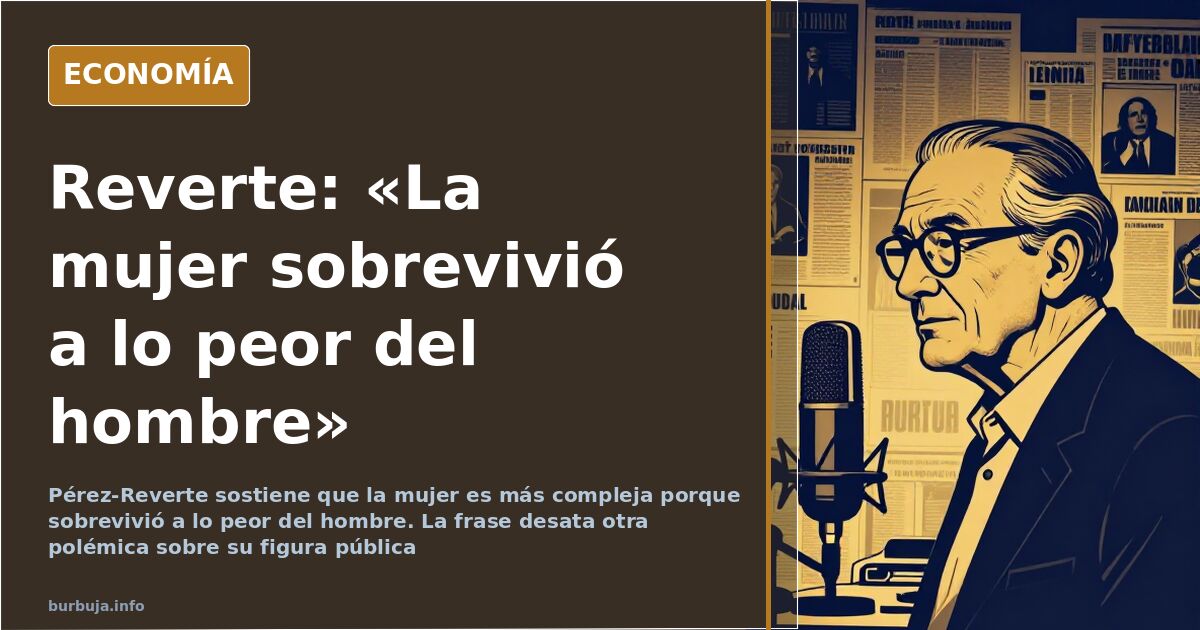
Reverte's comment on women reopens the gender war
What did Pérez-Reverte say this time to provoke half a country? The thesis is blunt: women are more complex than men because they had to survive for millennia the worst of them. In the piece that ignited the debate, published in El Mundo, the writer argues something even more striking: without them, the human species would have gone extinct about 200,000 years ago. Said that way, it sounds like a dessert-table truism. The problem isn't the content, but the signature. Nobody disputes that the figure carries more weight than the message.
What exactly was said and why does it anger people so much?
The reasoning attributed to the author goes in two steps. One: men, without brakes, would have killed each other to extinction. Two: women endured that mess and emerged smarter, tougher, and more complicated. The idea isn't new. It has circulated for decades in dating manuals, motivational speeches, and bar conversations.
What is striking is the megaphone. When a late-night panelist says it, it stays a late-night remark. When someone who sells hundreds of thousands of copies per novel signs it, it becomes news, replies, and three-day discussions. Much of the anger is not against the text, but against the swarm of media acting as a resonating chamber.
The underlying reproach: 'He poses as a rebel but it's pure system'
The most repeated criticism does not attack the thesis, but the biography. He is accused of building a brand of slapping political correctness and of yielding over the years, signing what many read as an opportunistic rant. 'Before I read it; now I see something by him and run away,' summarizes that side.
Some go further and place all his opinion production in the orbit of power: the uncomfortable writer who ends up earning in the same supplements he claimed to despise. Others even deny his profession and compare him to the investigative journalist specialized in infiltrations, in an analogy that refers to the character constructed above the content. The comparison is harsh and there is no consensus.
From war correspondent to professional opinion writer
The most uncomfortable part of the file is his years as a chronicler. Comanche Territory, published about 30 years ago, portrays the world of war correspondents, a profession now almost extinct, and those who read it then still defend it as his best text. That capital, they say, the character later monetized.
The harshest criticisms argue that his role in the Balkans was closer to the protected hotel than the front line, and that his status as a war hero is a story constructed a posteriori. It is a repeated accusation, not a condemnation: here no one has proven anything. The campaign against the Bakalao Route also haunts him, which some detractors claim he amplified from public television.
The inversion test: swap 'man' for 'woman'
The most used method to measure such statements is to turn them around. If the result remains publishable, there is an argument. If it becomes a scandal, there is a slogan. Applied to the case: what would happen if someone signed that men are more complex because they had to survive the worst of women? Anyone who knows how newsrooms work has the answer.
The character's debit also includes his own doctrine on conflicts: in war, he repeats, there are no good or bad, only grays. Who maintains that for years and then distributes psychological complexity by sens exposes himself to having the paradox returned to his face. And it is returned.
This is not a new trick. The discussion reappears every time someone with a megaphone launches a generalization about a sens. An episode broadcast these days attributed to the French novelist Pierre Lemaitre the idea that household appliances were invented to enslave women and not to alleviate domestic work. The mechanic is identical: a catchy phrase, a headline without nuances, and a 48-hour controversy.
The account that isn't made: who buys the books
In the economic background of the matter, there is a repeated fact: women buy more books than men, and much of the fiction bestsellers depend on that audience. Hence the widespread suspicion that phrases like this do not seek to explain anything, but to please who pays.
It is a hypothesis, not proof. No one has shown that the author calibrates his columns according to his buyer's profile. But the suspicion fits too well with an editorial market where high-circulation historical fiction lives on loyal readers and Christmas gifts.
In the end, the useful question is not what Pérez-Reverte thinks of women. It is why we still dedicate three days of headlines to what he thinks of them. With these reeds, the next brilliant phrase will arrive before the month ends.
Also available in: Deutsch
Summary of a discussion on Burbuja.info - Foro de economía, actualidad y política., translated from Spanish and reviewed before publication. Read the full discussion (223 replies).
More summaries
-
Arturo Pérez-Reverte's Discourse Shift on Mass Immigration
Analysis of the economic implications of Arturo Pérez-Reverte's recent change of stance on mass immigration and its social impact.
-
Spain ranks sixth in AI use: productivity or laziness?
Spain is the sixth country in AI use, but is it productivity or trivial questions? Meanwhile, China and Russia avoid it over privacy concerns. The data and...
-
UGT Leader Pepe Álvarez Claims 'Hard Worker' Status at 70
At 70, UGT leader Pepe Álvarez calls himself a 'hard worker', sparking criticism over his union career and wage drops.
-
Spain's UCO links Pedro Sánchez to the initials in Leire Díez's diaries
Spain's Civil Guard investigative unit confirms the initials P.S. in Leire Díez's diaries refer to Pedro Sánchez. A blow to the official Moncloa narrative.
-
Statute of limitations in the Zapatero jewels case: the defence changes tack
The discovery of jewels linked to Spain's former PM Zapatero reopens the debate on the statute of limitations. A legal shortcut or a political cover-up? An analysis.
-
Brawls in Spain's Castile and León: attempted homicides up 80%
Attempted homicides have risen 80% in Castile and León while falling 7% in the rest of Spain. Are Latin American gangs behind it?