
Pepper spray and police charges mar protests against the investiture at Ferraz
Pepper spray, UIP charges, and arrests occurred during protests against the investiture at Ferraz, featuring a 250-person march escorted by police.
English · Original discussion in Spanish · Published
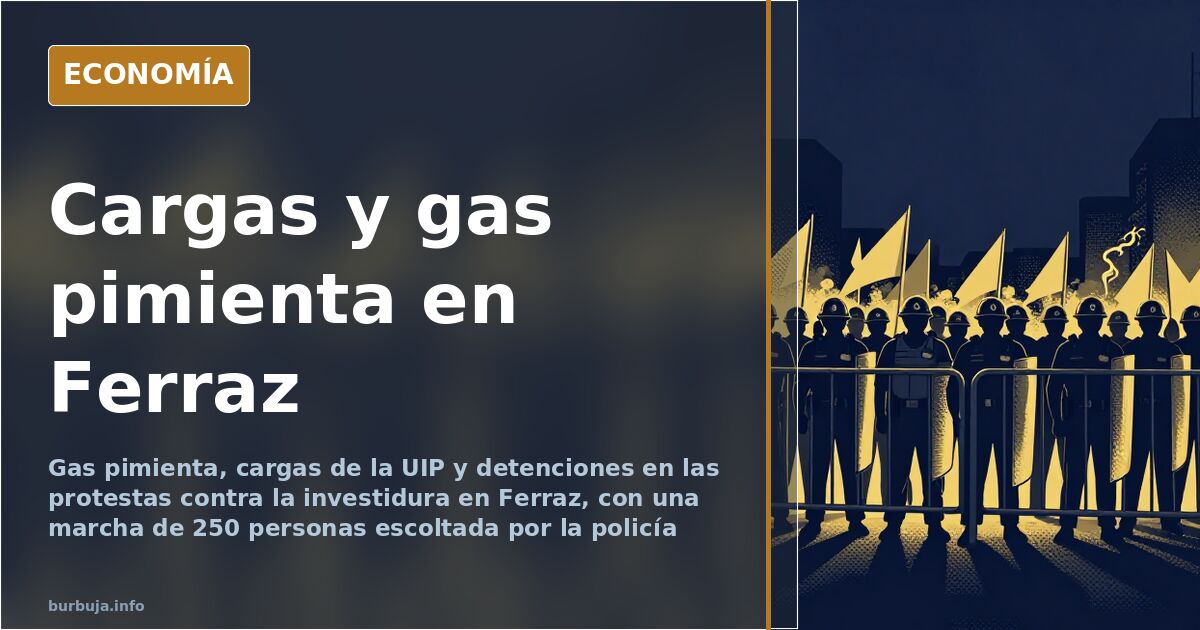
Pepper spray and police charges in Ferraz protests
November 15 presented two difficult-to-forget scenes. The first, a plainclothes officer covering his face with a Spanish flag while subduing a protester. The second, a UIP charge against a gathering where, according to several accounts, no one had touched the fence. Between them, the repertoire of a tense night: pepper spray, arrests, and a march advanced under police acompañante. The standoff against the investiture is no longer measured in banners but in batons.
Police charges and pepper spray at Ferraz
The most repeated description points in the same direction: the UIP faced difficulties charging because no one had touched the fence. This is the day's central accusation and also the hardest to verify with images. It is joined by the use of pepper spray, a resource that, according to one of the most widespread versions, had not been used before against independentist gatherings, previously described as peaceful.
Some argue the intervention was disproportionate and that containment would have sufficed. Against this weighs an operational argument: an unauthorized gathering in a sensitive thoroughfare requires dissolution before the group grows. The result, in any case, is the same: images of charges that run faster than any statement.
A 250-person march escorted by police
The route of one of the marches was described with almost notarized precision. A group of about 250 people with flags, megaphones, and truck horns departed from the vicinity of Congress and reached Ferraz via a route avoiding Gran Vía: Génova, Carranza, Alberto Aguilera. The march, escorted by officers, advanced singing slogans without notable incidents for much of the journey.
The group's composition was surprising. Alongside veterans appeared a youthful presence rarely seen: about 200 girls with flags, according to the count of someone present. A profile that discomforts those selling the protest as something for nostalgics.
Arrests and the role of the media
The day closed with at least one arrest that sparked considerable discussion: that of a professional from a digital media outlet, identified by those trinc the gathering as a worker from OK Diario. Others trinc, with a worrying pattern: arresting someone for addressing the officers. A message reproduced online describes it plainly: "They arrest you directly for addressing them."
Testimonies insist on the same detail. The arrest was made by an officer covering his face with a flag, meaning without visible identification. Verifying who arrested and why becomes, in that scenario, an exercise in faith.
Were there undercover agents among protesters?
The hypothesis circulated from early on. Some attendees maintain that the charge was triggered intentionally, with undercover agents agitating the gathering to justify the intervention. There is no public evidence supporting this version, and it should be emphasized, because it is exactly the type of claim accepted as true without being so.
From this arises a legal question no one closes: if a protester photographs an officer, are they informing or committing an offense? It depends on whether the image is manipulated. The unaltered text, in principle, should not be a crime. In practice, no one is clear about it.
The salary increase that changed the police tone
Mid-afternoon saw the leak of a detail rearranging interpretations: the commitment to improve the working conditions of the State Security Forces and Corps. Some attendees see this as the reason for the hardening. "They liked it" summarizes a message, attributing the harshness of the charges to the announcement of a salary raise.
It may be an interested reading. It may also be simple coincidence. What admits no doubt is the contrast with the treatment received in other gatherings, where the same unit acted with a much lower profile and without gas.
Why are there no leftist counter-demonstrations?
One question runs through comments: no opposite-sign gatherings are seen. Those expecting them point to an asymmetry in mobilization; those not expecting them recall that the street is occupied when convenient. Nor does an organized response currently appear from the liberal center-right, beyond individual names sounding for a future candidacy and whose electoral trajectory seems short.
With the numbers on the table—250 people in a march, about 200 young people at Ferraz—the intensity of the response sounds like another scale. Someone, in some office, decided the problem was not the size of the gathering. That decision, and not the flags, is what continues to be discussed the next day.
November 15 presented two difficult-to-forget scenes. The first, a plainclothes officer covering his face with a Spanish flag while subduing a protester. The second, a UIP charge against a gathering where, according to several accounts, no one had touched the fence. Between them, the repertoire of a tense night: pepper spray, arrests, and a march advanced under police acompañante. The standoff against the investiture is no longer measured in banners but in batons.
Police charges and pepper spray at Ferraz
The most repeated description points in the same direction: the UIP faced difficulties charging because no one had touched the fence. This is the day's central accusation and also the hardest to verify with images. It is joined by the use of pepper spray, a resource that, according to one of the most widespread versions, had not been used before against independentist gatherings, previously described as peaceful.
Some argue the intervention was disproportionate and that containment would have sufficed. Against this weighs an operational argument: an unauthorized gathering in a sensitive thoroughfare requires dissolution before the group grows. The result, in any case, is the same: images of charges that run faster than any statement.
A 250-person march escorted by police
The route of one of the marches was described with almost notarized precision. A group of about 250 people with flags, megaphones, and truck horns departed from the vicinity of Congress and reached Ferraz via a route avoiding Gran Vía: Génova, Carranza, Alberto Aguilera. The march, escorted by officers, advanced singing slogans without notable incidents for much of the journey.
The group's composition was surprising. Alongside veterans appeared a youthful presence rarely seen: about 200 girls with flags, according to the count of someone present. A profile that discomforts those selling the protest as something for nostalgics.
Arrests and the role of the media
The day closed with at least one arrest that sparked considerable discussion: that of a professional from a digital media outlet, identified by those trinc the gathering as a worker from OK Diario. Others trinc, with a worrying pattern: arresting someone for addressing the officers. A message reproduced online describes it plainly: "They arrest you directly for addressing them."
Testimonies insist on the same detail. The arrest was made by an officer covering his face with a flag, meaning without visible identification. Verifying who arrested and why becomes, in that scenario, an exercise in faith.
Were there undercover agents among protesters?
The hypothesis circulated from early on. Some attendees maintain that the charge was triggered intentionally, with undercover agents agitating the gathering to justify the intervention. There is no public evidence supporting this version, and it should be emphasized, because it is exactly the type of claim accepted as true without being so.
From this arises a legal question no one closes: if a protester photographs an officer, are they informing or committing an offense? It depends on whether the image is manipulated. The unaltered text, in principle, should not be a crime. In practice, no one is clear about it.
The salary increase that changed the police tone
Mid-afternoon saw the leak of a detail rearranging interpretations: the commitment to improve the working conditions of the State Security Forces and Corps. Some attendees see this as the reason for the hardening. "They liked it" summarizes a message, attributing the harshness of the charges to the announcement of a salary raise.
It may be an interested reading. It may also be simple coincidence. What admits no doubt is the contrast with the treatment received in other gatherings, where the same unit acted with a much lower profile and without gas.
Why are there no leftist counter-demonstrations?
One question runs through comments: no opposite-sign gatherings are seen. Those expecting them point to an asymmetry in mobilization; those not expecting them recall that the street is occupied when convenient. Nor does an organized response currently appear from the liberal center-right, beyond individual names sounding for a future candidacy and whose electoral trajectory seems short.
With the numbers on the table—250 people in a march, about 200 young people at Ferraz—the intensity of the response sounds like another scale. Someone, in some office, decided the problem was not the size of the gathering. That decision, and not the flags, is what continues to be discussed the next day.
Also available in: Deutsch
Summary of a discussion on Burbuja.info - Foro de economía, actualidad y política., translated from Spanish and reviewed before publication. Read the full discussion (310 replies).
More summaries
-
Vox denounces violence after blocked events, points finger at Sánchez
Hundreds prevented a Vox event in Santiago, leading to police action. Abascal claims Sánchez didn't call and he didn't expect one.
-
Is now a good time to buy property? Debate
Is now a good time to buy a home? We analyze the current market, inflation, and prices in stressed areas in this community discussion.
-
Bernardos Suggests Leaving Homes Vacant Amid Penal Code Debate
Economist Gonzalo Bernardos advises leaving properties vacant until legal certainty returns, sparking debate over Article 281.1 of the Spanish Penal Code.
-
Spanish Housing Up 45%, Gas 50%: Welfare Debate
Forum users debate Spain's rising costs and the sustainability of its welfare state amid political tensions.
-
Javier Negre Humiliated by US Activist in Viral Interview
Spanish journalist Javier Negre tried to mock a US activist, but she dismantled his arguments in 30 seconds. The video he posted went viral.
-
Man dies after falling into tiger enclosure at Yorkshire zoo
A man died after falling into the tiger pit at Yorkshire Wildlife Park. Police are investigating the circumstances of the fall.