
Pepe Domingo Castaño, iconic Spanish radio voice, dies at 80
Pepe Domingo Castaño, a legendary figure in Spanish radio, has died at 80, sparking debate on working until the end and debunking baseless vaccine claims.
English · Original discussion in Spanish · Published
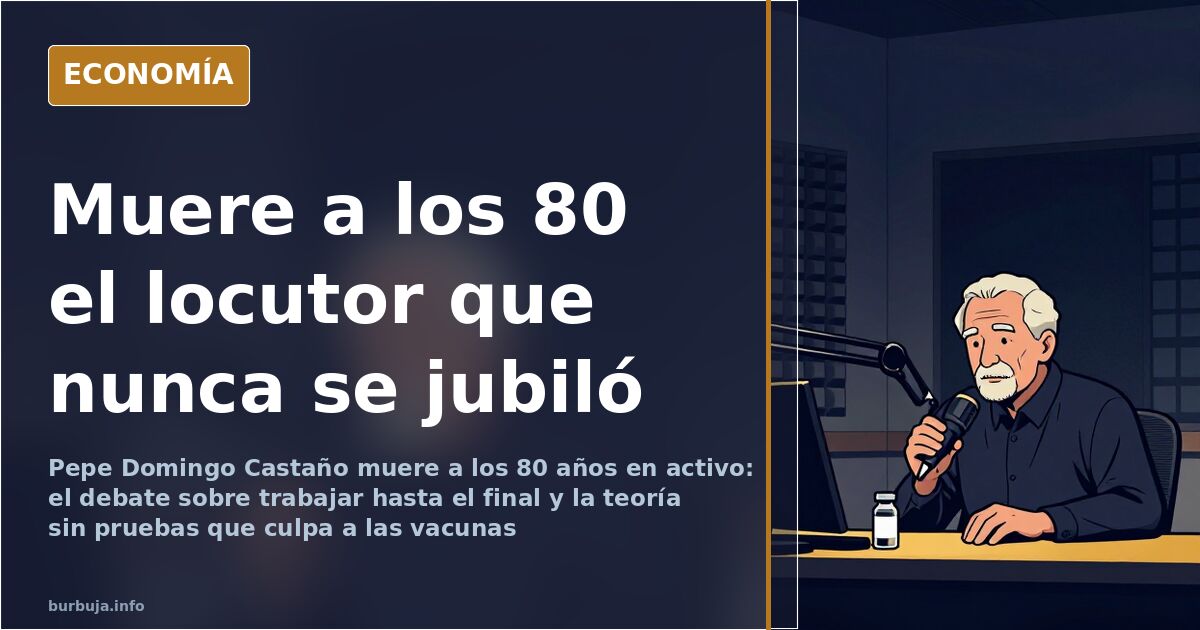
Pepe Domingo Castaño, iconic Spanish radio voice, dies at 80
Pepe Domingo Castaño has died at the age of 80. The news, confirmed on Sunday morning, closes a career spanning decades on the airwaves: the voice that announced peanuts, cigarettes, and goals while continuing to work at Tiempo de Juego. His colleagues bid him farewell with a simple phrase: "Radio will never sound the same without you."
As recalled in the thread, Castaño spent 25 years at Cadena SER before joining COPE, where he became a staple of sports afternoons. A broadcaster, presenter, and promoter of his own show, he combined neighborhood charm with veteran expertise. One participant listed him among the few sports journalists he liked. Sit tibi terra levis, wrote one reader.
Below the obituary, another more uncomfortable conversation unfolded: that of a man who died working and those who refused to accept the cause.
Working until 80: Vocation or Condemnation?
His continued work at 80 sparked two opposing views. One argues Castaño didn't struggle; going to the radio was like going to the bar with friends: watching football, joking, and getting paid. Another replied that many would sign up for that "struggle." A third noted that working eight hours in a factory is not the same as commenting on a match.
The second view reverses the argument. If an elderly man stays at the microphone, it's not for pleasure but because retirement doesn't reach the end of the month. His longevity was linked to pension reform and antiestéticars of insufficient post-retirement income. This hypothesis isn't proven by a single case, but the symbol worked: a man who, according to this view, couldn't afford to retire.
A third, less epic nuance exists. He worked weekends and Champions League days, little else. The profession that consumed others seemed to place him exactly where he belonged.
The Unproven Theory Blaming Vaccines
As with almost every death of a known figure, narratives attributing it to ELbichito-19 vaccines emerged. Some messages celebrated his death or blamed him for being vaccinated, mixed with sincere condolences. No data supports this link.
He was 80 years old and, according to accounts in the thread, suffered a heart attack years earlier. Vaccine theory advocates provided no proof of a connection. The irony came from those who noted that, before the pandemic, an 80-year-old dying wasn't statistically unusual. Age, the most boring explanation, is also the hardest to refute.
What We Know of His Final Days
Details from the thread point to a rapid decline. A throat infection, a doctor's visit, a treatment change due to inefficacy, and a hospitalization ending his life in days. Testimonies suggest they didn't expect such an immediate end.
His medical history wasn't clean: years prior, he suffered a heart attack and doctors advised him to leave radio, which he didn't do. He also had ELbichito at home, around 78 years old, without hospitalization, as he recounted on a program. He wasn't the first to be falsely announced dead: in March 2013, a fake death announcement circulated.
A Generation Fading Away
His name joins a list of farewells signaling an era's end. Voices and faces who lived with the previous generation are now closing their own. Those who came after are next in line, and that, more than morbid curiosity, is what truly unsettles people.
Alongside condolences came reproaches about how grief was portrayed or the role some played in the public pandemic narrative. Respect for the deceased lasted briefly in some corners.
Amid thousands of reactions, the thread's secure data—80 years and a throat unresponsive to treatment—prove as unremarkable as any other elderly death. And that, precisely, is what doesn't make headlines.
Summary of a discussion on Burbuja.info - Foro de economía, actualidad y política., translated from Spanish and reviewed before publication. Read the full discussion (260 replies).
More summaries
-
La Sexta’s 17 Million Migrants Claim Clashes With Spain’s Reality
A TV segment cites 17 million migrants to sustain the welfare state, contradicting official data on existing foreign residents and sparking debate on pensions and public services.
-
More Spanish women single as men lag in education and income
Only 43% of Spanish women aged 30-34 live with a partner. Funcas and INE data show a historic decline. Is the cause men's lower education or something else?
-
Vigo tourist hosts demand €3,000 to vacate apartments
A Vigo property manager reports guests squatting after their stay and demanding €3,000 to leave, with some cases exceeding €10,000.
-
Bale exposes the refereeing double standard that protects Messi
Gareth Bale says Messi should have been sent off in Argentina's World Cup match against Algeria. Behind it, a system that protects stars for economic reasons.
-
CNT union reports labour abuse at Taberna Garibaldi in Spain
The CNT union reports shifts of up to 14 hours and degrading treatment at Taberna Garibaldi. The last stronghold of labour abuse?
-
Spanish minister Belarra says Congress flags make her feel stalked
Ione Belarra has asked for the Spanish Congress flags to be moved because she feels stalked by them. The row symbolises the identity-driven tension crowding out economics in Spanish politics.