
Pensions absorb ‘more than 42% of the budget’, says a forum user
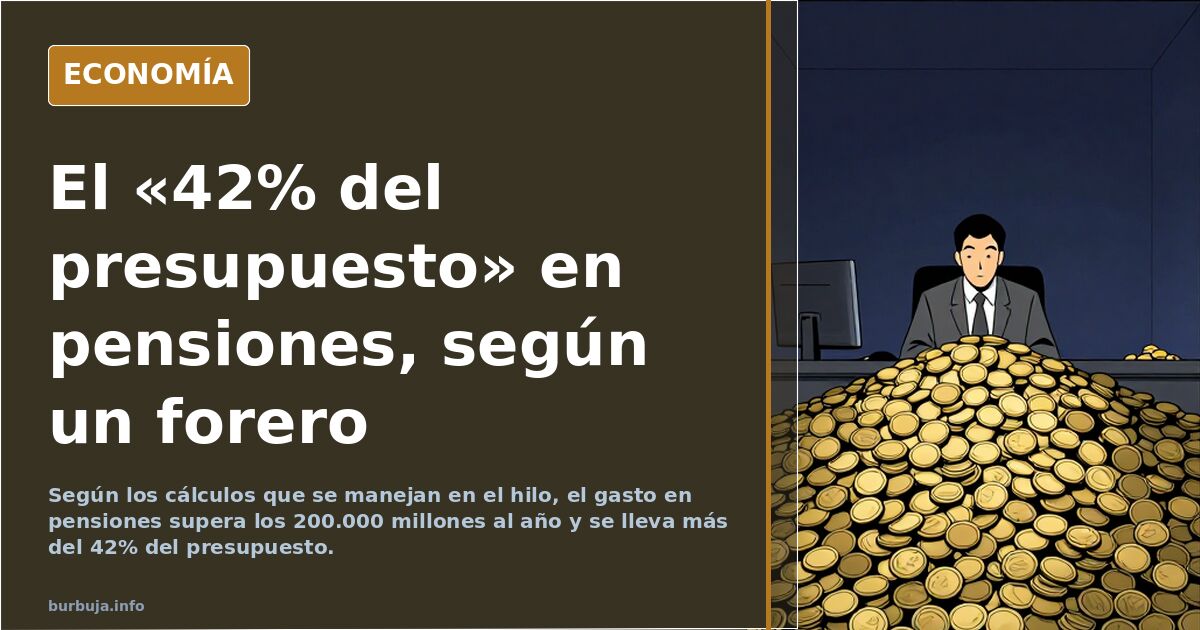
According to calculations in the thread, pension spending tops €200 billion a year and takes more than 42% of the budget.
English · Original discussion in Spanish · Published
The weight of pensions in the budget and the calculation that doesn’t add up
How long can a system hold up when it pays 18 years of pension to someone who contributed for 15? It is the uncomfortable question that appears as soon as anyone pulls out a calculator. According to the numbers being traded in the thread, pension spending exceeds €200 billion a year, close to 30% of total public spending and more than 42% of the General State Budget. There are 12 million beneficiaries on the other side of the counter and, as argued in the debate, a number of contributors that is not growing at the same pace. They call it sustainability; the arithmetic says otherwise.
How much weight do pensions carry in public accounts?
The picture is easy to read and hard to dispute. According to the calculations being circulated in the thread, of every hundred euros the state spends, almost thirty go to paying pensions. In absolute terms, the bill exceeds €200 billion a year, and that block alone takes more than 42% of the General Budget. On the other side, 12 million people are collecting. The comparison between what comes in through contributions and what goes out in payments is, in the view of those taking part in the debate, what breaks the official narrative: it doesn’t add up.
This is not the problem of one bad year or a specific economic juncture. The public spending charts shared in the thread point to a sustained rise that accelerates with every fiscal year, and the revenue structure is not keeping up. Every time cuts somewhere else are discussed, the pension figure returns to the table and devours the entire debate. There’s the elephant.
The calculation of 15 years contributed versus 18 years of pension
Here the issue stops being ideology and becomes arithmetic. The calculation most widely shared starts from a simple premise: if over 15 years someone contributes roughly 36% of the employer cost — rounding up, one third — the entitlement generated would cover one third of those years. Every three years worked, one year of pension. The math stretches to five years, seven if adjusted because the final pension does not reach 100% of the contribution base.
For the person posing that example, reality is different. Retirement at 65, life expectancy around 83. Eighteen years of public paychecks for fifteen years of contributions: 2.5 times what was paid in. And that is without adding survivor’s, orphan’s and non-contributory pensions, which come out of the same pot. The full breakdown, item by item, leaves a gap that none of the later adjustments has fully closed.
The 1997 reform and the tables almost no one remembers
According to the tables cited by a forum user, before 1985 just 10 years of contributions were enough to collect 100% of the pension; until 1997, it was 15. Afterward, the requirement jumped to 35 years “just like that,” according to the reading made of that reform. For anyone looking at the old tables, the comparison is hard to believe: the system promised full pensions with working lives that today would not even reach half the calculation.
The design was not the only problem. It rested on an assumption — that people would work until 65 and that the system would keep growing — that demography and mortality were tasked with disproving. What then looked like prudence now reads as a time bomb no one wanted to defuse in time.
The package that fell through and the fight for the pensioner vote
The pension increase fell through and reactions were immediate. The PSOE accused the PP of having voted against 12 million pensioners seeing their pensions revalued and against the regional governments receiving almost €10 billion more in funding. A Socialist leader summed it up in one phrase: “PP, PENSION-CUTTING PARTY. They cut pensions when they governed. They cut pensions from opposition.”
Bolaños said it bluntly: “When in February they see that their pension has gone down, let them remember that it was the PP, in the company of others.” From the other side, the response is the opposite argument: the cut is someone else’s responsibility. Some in the thread maintain that no party wants to sign off on the adjustment, but all compete for the same block of voters, and that with 12 million beneficiaries, that block decides elections.
What rises on the other side: MEI, maximum contribution bases and solidarity contribution
The decree that accompanied the failed increase was not minor. It included a rise in the Mecanismo de Equidad Intergeneracional (MEI, Spain’s intergenerational equity mechanism), which would go from 0.7% to 0.8% of all workers’ payroll. It also included a 4% rise in maximum contribution bases, up to €58,908 a year, and the creation of a solidarity contribution for salaries above that threshold.
Translated: more is collected from both top and bottom while the structural problem remains intact. The underlying question — who pays for the system when the pyramid flips — does not appear in any decree.
Generational gap and the migration argument
One participant argues that in many districts of Asturias the income of pensioners exceeds that of wage earners, something he presents as the symptom of an anomaly hard to find in other economies: a territory where retiring pays better than working.
A troubling corollary is added to that picture. Part of the analysis maintains that the system is sustained thanks to the arrival of migrant population; another part responds that those same flows increase pressure on social spending. Both versions circulate without figures to back them up, and the tone rises faster than the documentation. The core issue is not who arrives, but that the pot cannot cover everything at once.
The proposal no one takes to rallies
Some propose changing the entire model: replacing the pay-as-you-go system with a mandatory personal capitalization fund, with a fixed percentage of income and freedom to retire when the balance allows. Those who don’t reach it work until their body holds out. As a last-resort safety net, an old-age pension starting at 85. It is an idea that comes up in discussions and has no institutional path.
The contrast often cited is Norway’s sovereign wealth fund: if Spain had opted for a model of that kind three decades ago, when reform was still possible, the picture would be different. No one disputes it. No one applies it.
There remain 12 million well-aligned votes and several parties ready to court them. The adjustment, when it comes, will be signed by someone with a trembling hand and blame shared around. Meanwhile, the only ones doing the math with paper and pencil are those already looking at the map.
How long can a system hold up when it pays 18 years of pension to someone who contributed for 15? It is the uncomfortable question that appears as soon as anyone pulls out a calculator. According to the numbers being traded in the thread, pension spending exceeds €200 billion a year, close to 30% of total public spending and more than 42% of the General State Budget. There are 12 million beneficiaries on the other side of the counter and, as argued in the debate, a number of contributors that is not growing at the same pace. They call it sustainability; the arithmetic says otherwise.
How much weight do pensions carry in public accounts?
The picture is easy to read and hard to dispute. According to the calculations being circulated in the thread, of every hundred euros the state spends, almost thirty go to paying pensions. In absolute terms, the bill exceeds €200 billion a year, and that block alone takes more than 42% of the General Budget. On the other side, 12 million people are collecting. The comparison between what comes in through contributions and what goes out in payments is, in the view of those taking part in the debate, what breaks the official narrative: it doesn’t add up.
This is not the problem of one bad year or a specific economic juncture. The public spending charts shared in the thread point to a sustained rise that accelerates with every fiscal year, and the revenue structure is not keeping up. Every time cuts somewhere else are discussed, the pension figure returns to the table and devours the entire debate. There’s the elephant.
The calculation of 15 years contributed versus 18 years of pension
Here the issue stops being ideology and becomes arithmetic. The calculation most widely shared starts from a simple premise: if over 15 years someone contributes roughly 36% of the employer cost — rounding up, one third — the entitlement generated would cover one third of those years. Every three years worked, one year of pension. The math stretches to five years, seven if adjusted because the final pension does not reach 100% of the contribution base.
For the person posing that example, reality is different. Retirement at 65, life expectancy around 83. Eighteen years of public paychecks for fifteen years of contributions: 2.5 times what was paid in. And that is without adding survivor’s, orphan’s and non-contributory pensions, which come out of the same pot. The full breakdown, item by item, leaves a gap that none of the later adjustments has fully closed.
The 1997 reform and the tables almost no one remembers
According to the tables cited by a forum user, before 1985 just 10 years of contributions were enough to collect 100% of the pension; until 1997, it was 15. Afterward, the requirement jumped to 35 years “just like that,” according to the reading made of that reform. For anyone looking at the old tables, the comparison is hard to believe: the system promised full pensions with working lives that today would not even reach half the calculation.
The design was not the only problem. It rested on an assumption — that people would work until 65 and that the system would keep growing — that demography and mortality were tasked with disproving. What then looked like prudence now reads as a time bomb no one wanted to defuse in time.
The package that fell through and the fight for the pensioner vote
The pension increase fell through and reactions were immediate. The PSOE accused the PP of having voted against 12 million pensioners seeing their pensions revalued and against the regional governments receiving almost €10 billion more in funding. A Socialist leader summed it up in one phrase: “PP, PENSION-CUTTING PARTY. They cut pensions when they governed. They cut pensions from opposition.”
Bolaños said it bluntly: “When in February they see that their pension has gone down, let them remember that it was the PP, in the company of others.” From the other side, the response is the opposite argument: the cut is someone else’s responsibility. Some in the thread maintain that no party wants to sign off on the adjustment, but all compete for the same block of voters, and that with 12 million beneficiaries, that block decides elections.
What rises on the other side: MEI, maximum contribution bases and solidarity contribution
The decree that accompanied the failed increase was not minor. It included a rise in the Mecanismo de Equidad Intergeneracional (MEI, Spain’s intergenerational equity mechanism), which would go from 0.7% to 0.8% of all workers’ payroll. It also included a 4% rise in maximum contribution bases, up to €58,908 a year, and the creation of a solidarity contribution for salaries above that threshold.
Translated: more is collected from both top and bottom while the structural problem remains intact. The underlying question — who pays for the system when the pyramid flips — does not appear in any decree.
Generational gap and the migration argument
One participant argues that in many districts of Asturias the income of pensioners exceeds that of wage earners, something he presents as the symptom of an anomaly hard to find in other economies: a territory where retiring pays better than working.
A troubling corollary is added to that picture. Part of the analysis maintains that the system is sustained thanks to the arrival of migrant population; another part responds that those same flows increase pressure on social spending. Both versions circulate without figures to back them up, and the tone rises faster than the documentation. The core issue is not who arrives, but that the pot cannot cover everything at once.
The proposal no one takes to rallies
Some propose changing the entire model: replacing the pay-as-you-go system with a mandatory personal capitalization fund, with a fixed percentage of income and freedom to retire when the balance allows. Those who don’t reach it work until their body holds out. As a last-resort safety net, an old-age pension starting at 85. It is an idea that comes up in discussions and has no institutional path.
The contrast often cited is Norway’s sovereign wealth fund: if Spain had opted for a model of that kind three decades ago, when reform was still possible, the picture would be different. No one disputes it. No one applies it.
There remain 12 million well-aligned votes and several parties ready to court them. The adjustment, when it comes, will be signed by someone with a trembling hand and blame shared around. Meanwhile, the only ones doing the math with paper and pencil are those already looking at the map.
Summary of a discussion on Burbuja.info - Foro de economía, actualidad y política., translated from Spanish and reviewed before publication. Read the full discussion (292 replies).
More summaries
-
Machines paying into Social Security: what's being proposed
A forum user puts gross operating surplus at 8%: the proposal for machines to contribute divides between redistribution and capital flight
-
Córdoba Father Self-Immolates: Mental Illness or Societal Despair?
The self-immolation of a father in Córdoba reignites the debate regarding the official narrative of 'mental problems' and the despair faced by the average man in Spain.
-
Euthanasia in Old Age: Autonomy vs. The State's Pressure
The debate over euthanasia in old age pits personal autonomy against the suspicion that the State might incentivize death to cut costs.
-
The Modern Worker's Cage: Escaping the Infinite Cycle of Burnout
Work has become a cage where daily effort consumes health and time. Discover why we push ourselves so hard and how to break the cycle.
-
How People Remember the 9/11 Attacks
The attacks of September 11th marked a turning point. Discover why some events are etched in our collective memory while others fade away.
-
Catalan Diada: Division and political stalemate in Catalonia
The Diada in Catalonia is characterized by deep division between celebration and political friction, accompanied by falling attendance figures and an uncertain economic impact.