
Penélope Cruz: Narrative Reduces Career to Partners
A digital narrative reconstructs Penélope Cruz's career as a chain of relationships, mixing verified dates with unaccredited episodes.
English · Original discussion in Spanish · Published
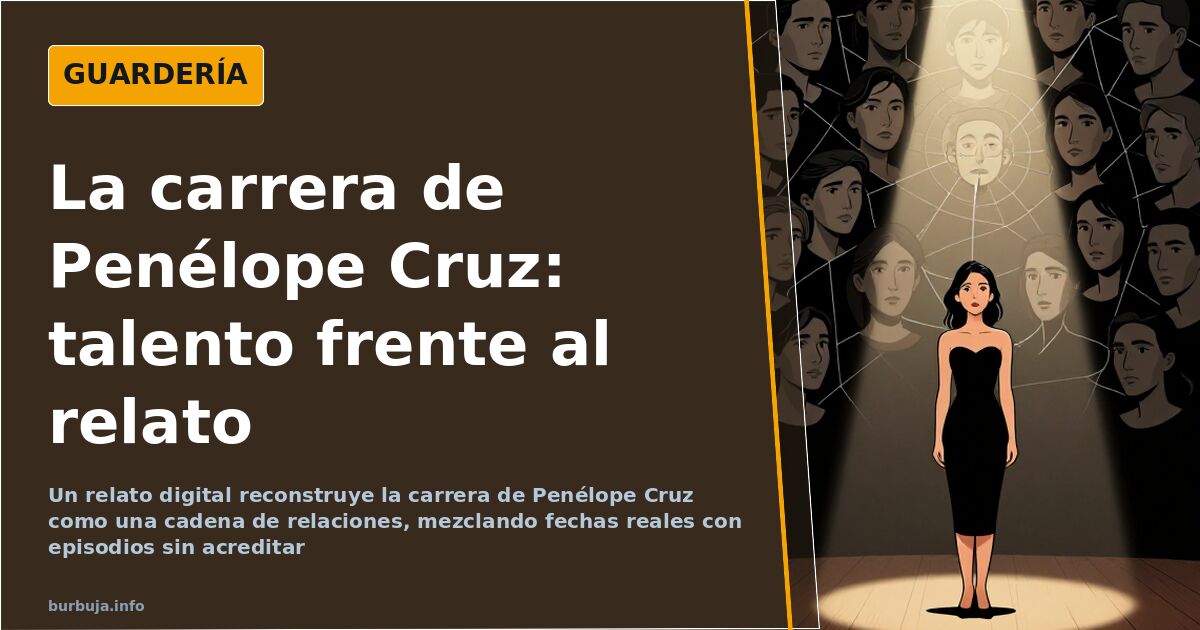
The narrative measuring Penélope Cruz's career by partners
There is a line of analysis that reconstructs Penélope Cruz's biography as a chain of romantic relationships. Its thesis is that the actress born in Alcobendas turned every bond into a professional step and that her arrival at the Oscars responds to this strategy as much as to her work. The material mixes verifiable dates—shootings, releases, couples who were once public—with episodes that no one has documented and yet are presented as certainties.
That mix is the problem. Penélope Cruz is today one of the few Spanish actresses with a sustained career in Hollywood and European cinema; that is not in dispute. What is disputed is the interpretation made of that fact, and here it is worth separating the provable from the assumed.
From Alcobendas to Hollywood: the chronology of the narrative
The narrative begins with a teenager who studied ballet for nine years and who, at 14, entered the music video for La fuerza del destino, by the group Mecano. From there comes her relationship with musician Nacho Cano, which lasted around five years and distanced her from her family environment for the first time. In parallel, she debuted on television with La quinta marcha and, in 1991, filmed a telefilm for Serie Rosa. A year later, at 17, Jamón Jamón arrived, the film that made her known, trinc by Belle Epoque and La Celestina.
Around 1995, the most widespread version places several overlapping bonds, with details changing depending on the source consulted. Then, the leap: after La niña de tus ojos (1998), she shot her first film in the United States and chained a sequence of relationships that the reconstruction reads as steps toward the star system. The Oscar came later, with Vicky Cristina Barcelona, and here the narrative introduces an alleged pact with the production. That specific point has not been accredited by anyone.
Vicky Cristina Barcelona: who produced and who distributed
The detail is not minor, because an error slips into the reconstruction. Some attribute the film's production to The Weinstein Company. The correction appearing in the discussion itself points to Jaume Roures as responsible for distribution in the United States, with the US firm in another role. In the wake of the Weinstein case, the nuance matters: it turns an alleged power relationship into administrative data and dismantles the more conspiratorial version without needing to enter into it.
Can a three-decade filmography be reduced to its partners?
No, respond the more measured voices. They admit limitations in their record but underline what is evident: she has spent her whole life filming one movie after another, has worked with top-tier directors, and in titles like Volver or Los abrazos rotos there is craft. The counterargument does not deny that her early opportunities came through people with power; it denies that this is all there is. The career also accumulates shoots in several countries and in more than one language, something that cannot be improvised. A sentimental biography may be striking, but it does not replace a filmography.
Accent as a career ceiling in Hollywood
Here the analysis gains depth and loses sensationalism. A non-English-speaking base actress has a structural problem: there are not enough roles for non-American or non-British characters, because accent conditions credibility. Those who work on it thoroughly stop sounding foreign; those who do not remain typecast. Eva Green is the cited example. It is not a sarracena judgment: it is a market restriction that explains why some trajectories cross borders while others exhaust themselves in the attempt.
The parallel case: vocation versus strategy
The discussion derives toward Elsa Pataky as a contrast. Her career faded as she lost youth, and the dominant reading is that she succeeded in redirecting her life toward a stable family project. The classification used: acting is one thing, appearing on screen is another. Cruz would be in the first group, Pataky in the second. Debatable, but with industry logic: vocation endures when youthful appeal fades; mere presence does not.
The open question: ambition or luck?
The discussion ends in a classification that analysts themselves admit does not fit. A woman who chains relationships with increasingly powerful men but maintains long periods of stability does not respond to the simple pattern of someone only seeking the next step. Some argue that ambition never retires and that only time will tell if the current settling is definitive. Others believe the case closed with the Oscar, children, and a quiet life. The discrepancy is not resolved with data, because there are none.
The analysis gets stuck exactly here. Some read a career built on bonds; others see three decades of sustained work in an industry that devours actresses well before forty. The former have a striking chronology and a handful of dates; the latter, a filmography that cannot be erased. No one has closed the case, and likely no one will: Penélope Cruz's career continues.
There is a line of analysis that reconstructs Penélope Cruz's biography as a chain of romantic relationships. Its thesis is that the actress born in Alcobendas turned every bond into a professional step and that her arrival at the Oscars responds to this strategy as much as to her work. The material mixes verifiable dates—shootings, releases, couples who were once public—with episodes that no one has documented and yet are presented as certainties.
That mix is the problem. Penélope Cruz is today one of the few Spanish actresses with a sustained career in Hollywood and European cinema; that is not in dispute. What is disputed is the interpretation made of that fact, and here it is worth separating the provable from the assumed.
From Alcobendas to Hollywood: the chronology of the narrative
The narrative begins with a teenager who studied ballet for nine years and who, at 14, entered the music video for La fuerza del destino, by the group Mecano. From there comes her relationship with musician Nacho Cano, which lasted around five years and distanced her from her family environment for the first time. In parallel, she debuted on television with La quinta marcha and, in 1991, filmed a telefilm for Serie Rosa. A year later, at 17, Jamón Jamón arrived, the film that made her known, trinc by Belle Epoque and La Celestina.
Around 1995, the most widespread version places several overlapping bonds, with details changing depending on the source consulted. Then, the leap: after La niña de tus ojos (1998), she shot her first film in the United States and chained a sequence of relationships that the reconstruction reads as steps toward the star system. The Oscar came later, with Vicky Cristina Barcelona, and here the narrative introduces an alleged pact with the production. That specific point has not been accredited by anyone.
Vicky Cristina Barcelona: who produced and who distributed
The detail is not minor, because an error slips into the reconstruction. Some attribute the film's production to The Weinstein Company. The correction appearing in the discussion itself points to Jaume Roures as responsible for distribution in the United States, with the US firm in another role. In the wake of the Weinstein case, the nuance matters: it turns an alleged power relationship into administrative data and dismantles the more conspiratorial version without needing to enter into it.
Can a three-decade filmography be reduced to its partners?
No, respond the more measured voices. They admit limitations in their record but underline what is evident: she has spent her whole life filming one movie after another, has worked with top-tier directors, and in titles like Volver or Los abrazos rotos there is craft. The counterargument does not deny that her early opportunities came through people with power; it denies that this is all there is. The career also accumulates shoots in several countries and in more than one language, something that cannot be improvised. A sentimental biography may be striking, but it does not replace a filmography.
Accent as a career ceiling in Hollywood
Here the analysis gains depth and loses sensationalism. A non-English-speaking base actress has a structural problem: there are not enough roles for non-American or non-British characters, because accent conditions credibility. Those who work on it thoroughly stop sounding foreign; those who do not remain typecast. Eva Green is the cited example. It is not a sarracena judgment: it is a market restriction that explains why some trajectories cross borders while others exhaust themselves in the attempt.
The parallel case: vocation versus strategy
The discussion derives toward Elsa Pataky as a contrast. Her career faded as she lost youth, and the dominant reading is that she succeeded in redirecting her life toward a stable family project. The classification used: acting is one thing, appearing on screen is another. Cruz would be in the first group, Pataky in the second. Debatable, but with industry logic: vocation endures when youthful appeal fades; mere presence does not.
The open question: ambition or luck?
The discussion ends in a classification that analysts themselves admit does not fit. A woman who chains relationships with increasingly powerful men but maintains long periods of stability does not respond to the simple pattern of someone only seeking the next step. Some argue that ambition never retires and that only time will tell if the current settling is definitive. Others believe the case closed with the Oscar, children, and a quiet life. The discrepancy is not resolved with data, because there are none.
The analysis gets stuck exactly here. Some read a career built on bonds; others see three decades of sustained work in an industry that devours actresses well before forty. The former have a striking chronology and a handful of dates; the latter, a filmography that cannot be erased. No one has closed the case, and likely no one will: Penélope Cruz's career continues.
Summary of a discussion on Burbuja.info - Foro de economía, actualidad y política., translated from Spanish and reviewed before publication. Read the full discussion (146 replies).
More summaries
-
Diomande’s Girlfriend Sparks AI Debate: Real or Generated?
The girlfriend of footballer Diomande divides social media: is the photo real or AI-generated? A betting house pendant fuels the controversy.
-
ElXokas Buys Madrid Duplex for €2.2M, Lacks Upstairs Bathrooms
Spanish streamer ElXokas paid up to €2.2 million for a 176 m² Madrid duplex featuring three bathrooms downstairs and none upstairs.
-
Viral Reality Clip Reignites Debate Over Trash TV in Spain
A viral clip from a private reality show has reopened the debate on trash TV: who broadcasts it, who watches it, and what incentives drive it.
-
RoRo Khaleesi: From Cooking Influencer to Boxing Spectacle
Streamer RoRo Khaleesi shifts from cooking content to boxing in 'La Velada', sparking debate on digital trash TV and audience monetization.
-
Summer Encounter Sparks Collective Scrutiny of Private Details
A summer meeting leads to deep regret, but the public discourse obsesses over intimate details and family contexts.
-
2001: A Space Odyssey wins best film tournament
Kubrick's classic beats Sergio Leone's spaghetti western by three votes in a 64-film bracket.