
Parkinson's: Hard Work and Money Don't Stop Disease
A Spanish couple in their mid-50s moves from disability to Parkinson's diagnosis in two years. No cure exists, though treatments are being researched.
English · Original discussion in Spanish · Published
From Injury to Parkinson's: No Cure and Hard Work Won't Save You
Is there anything against Parkinson's? Those asking have just watched a friend lose ground month by month. The honest answer is uncomfortable: it can be slowed, alleviated, and operated on. Cured, today, no.
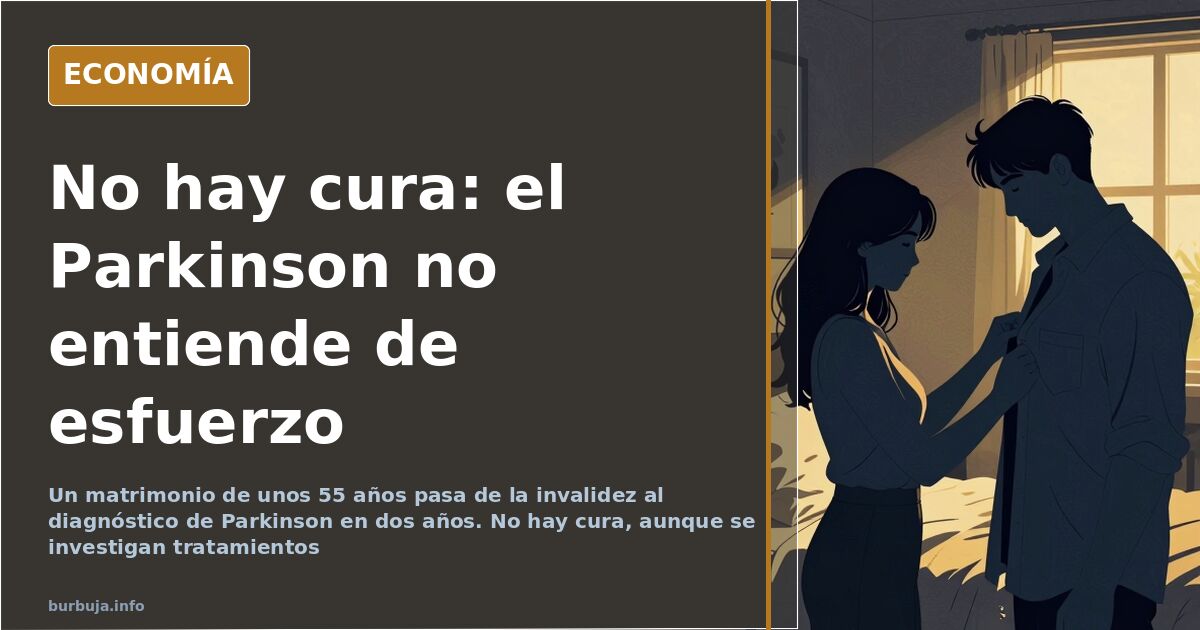
The case behind this is textbook. A married couple aged 55 and 57, both with lives built through effort and without help from anyone. During a business alucinación, he slipped and hit the floor. From then on, it spirals: he loses strength and control of his arm, starts limping, everything degenerates. In one year, sick leave. Then, disability retirement. Two years of consultations and medical opinions later, the inevitable diagnosis is Parkinson's.
They digest it with an explicit pact: this has no turning back, so we go together until the end and don't waste a minute on nonsense. The scene leaves the narrator dry —and broken—. Not because of the drama, but because of the certainty.
Is There a Cure for Parkinson's?
No. But the range of what can be done is wider than resignation suggests. According to data repeated around this case, a Spanish hospital has managed to reduce Parkinson's tremor by up to 90% using ultrasound, and dozens of companies —names like Anavex, Casava or Alzamed come up— are chasing the holy grail of neurodegenerative diseases. Gene therapies are the other big future bet.
There is also a practical path that doesn't depend on any laboratory: refining the diagnosis. Because not all tremors are Parkinson's. There are many varieties and parkinsonisms, and some reference hospitals in the public network already work with biomarker tests. Rehabilitation, meanwhile, is what sustains quality of life when drug treatment only cushions.
And some do not forget that, 27 years ago, an entire university department was nominated for the Nobel Prize for its research into a cure. We are still waiting. In the margins circulate theories claiming the disease does not exist, or that it responds to alleged poisoning or a vaccine. None of these hypotheses have support, and those with a real diagnosis deserve better than advice disguised as revelation.
Effort Doesn't Vaccinate: Genetics Deals the Cards
That hurts. As one participant summarizes, the idea that being good and hardworking guarantees a good future is a story taught in school and billed in adulthood. Reality, according to that same reading, is less kind: you are born with certain genetics, family, and body, and that initial distribution conditions almost everything. Attitude and work move the needle a little. Little.
Age doesn't forgive either. Starting at 55, some argue that anything appearing can become a point of no return. An accident, a silly fall, a diagnosis. Some recall worse cases: a 37-year-old professional with double degrees who built and sold a company, and whom a rare disease put in a wheelchair in less than a year.
From this comes a recommendation that isn't a cliché: stay strong. Some defend that grip strength is one of the best indicators of life expectancy in older people. It is the reserve that saves you when the body takes the hit.
What Happens to the Pension When Disability Arrives at 55?
That the system saves money. Sick leave that turns into disability retirement advances the exit from the labor market —seven years, according to calculations circulating— compared to the ordinary age. Some argue that the benefit of someone who has contributed all their life is legitimate and not a subsidy, and lumping it in with welfare aid is an argumentative trap.
An even more cynical reading circulates: the worker who contributes fully, gets sick early, and dies young leaves the system in the best possible position. It is a cold calculation, accounting-based, and explains why the pension issue and the disease issue share headlines more often than desired.
Carpe Diem: From Industrial Estate Tattoo to Knowing What It Means
The most famous of Horace's whips has become, according to one participant, an excuse for the opposite of what it meant. Carpe diem wasn't "live fast," but seizing time to learn and improve. The other version, the tattoo, is the bargain bin edition.
Even so, that reading has some truth. If life breaks where least expected, the only reasonable defense is not to mortgage it entirely in a job that doesn't give it back. Working until 70 giving your all guarantees nothing. The scene of this couple, deciding not to waste a minute on nonsense, is ultimately the most sensible vital policy one can apply.
All in all, the only truly effective preventive measure against Parkinson's remains having the luck not to develop it. Nobody has included it in the benefits catalog, but it works better than any other advice.
Also available in: Deutsch
Summary of a discussion on Burbuja.info - Foro de economía, actualidad y política., translated from Spanish and reviewed before publication. Read the full discussion (133 replies).
More summaries
-
Moroccan family in Navarra receives €4,000 monthly aid without working
A Moroccan family in Navarra receives over €4,000 monthly in public aid without working. Discover the details and benefits.
-
Retirement at 73: The Proposal Stirring the Pension Debate
A report proposes raising the retirement age to 73 to save pensions. Alternatives clash: immigration, spending cuts, or a model change…
-
Navarran family receives €4,000 monthly aid without working
A Moroccan family in Navarra receives over €4,000 monthly public aid without employment, covering essential living expenses.
-
Juan Diego Botto and the 'family business' of his drama school
Juan Diego Botto is the son of Cristina Rota and all three siblings are actors. The thread calls the school he promotes a 'family business'.
-
Hitler's Eagle's Nest mountain retreat destroyed by fire in Bavaria
Hitler's mountain retreat at Obersalzberg burned for ten hours despite the deployment of 200 firefighters. Police detained a motorcyclist as a suspect.
-
Idealista loses 1,100 rental listings in 20 days, tracking shows
A tracking effort shared on forums points to 1,100 fewer listings in 20 days as landlords wait for Spain's legal framework to be clarified after the royal decrees