
Paris: Music Festival, Video, and Security Debate Reignited
A video from Paris's Fête de la Musique sparks a security debate, fueled by unverified figures and hard-to-measure reputational costs.
English · Original discussion in Spanish · Published
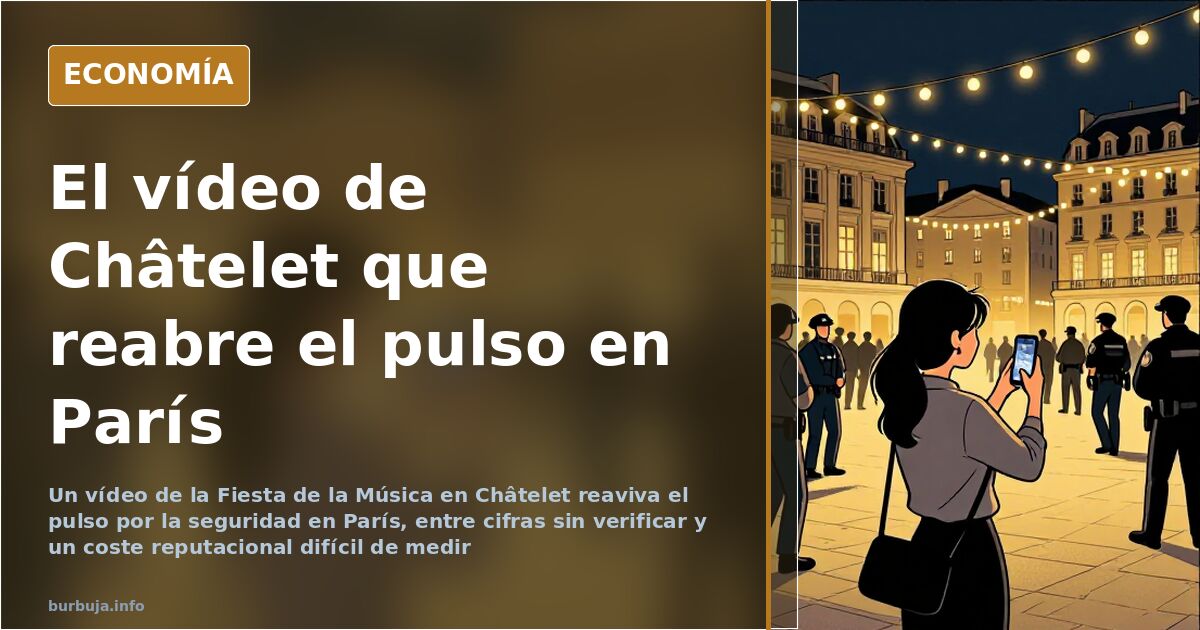
Paris: Music Festival Reopens Security Debate
Is Paris today a more unsafe city, or simply a city more often filmed? The question hangs over a video that has gone viral in recent days: a sea of people in the Châtelet area during the Fête de la Musique, the musical event that fills the streets of France every June 21st, and which in the images appears marred by fights. The clip arrived accompanied by messages ironically playing on the slogan "city of love" and questioning, as politician Florian Philippot did, what has been done to their country. From there, the recording ceased to be just a recording and became something else: a debate over what can be affirmed with data and what cannot.
What is seen in the Paris Music Festival video?
It's important to separate facts from interpretation. The video shows a massive gathering in central Paris during the event, with episodes of conflict among attendees. Nothing more. There is no organized attack or identifiable target in the images: there is a crowd, music, and altercations, which is more or less what one might expect from an uncontrolled celebration night in any major European capital.
A detail provided in the discussion helps to situate the scene: at 38 seconds, the Grand Palais is visible, the same building on whose roof the French anthem was played during the Olympic Games opening ceremony, with costumes from Dior. From the Olympic showcase to a video of fights, only a few months. This contrast is the material with which the narrative is constructed, and also its most fragile point: an image without context weighs more than any statistic.
The figures circulating about that night, which no one has verified
And therein lies the problem. Along with the video, forceful figures are being spread: 1,500 injuries from violence, over 100 women stabbed with syringes and poisoned, and 51 cars burned. These are data attributed to a social media post and, as of this discussion, are not accompanied by any official report, identified police source, or independent verification.
Repeating a figure does not make it true. Nor does it make it false. It is simply unverified, and in a matter where emotion precedes data, that distinction is everything. The pattern repeats: an un-geolocated video, a round number, and an audience ready to believe the version that already fits what they thought before opening their phone.
88% of Brussels: what does that percentage really measure?
The leap from Paris to Brussels was immediate. The data that 88% of young people in the Belgian capital are of foreign origin was disseminated, presented as proof of an irreversible transformation. The number comes from an activist publication, not official statistics, and carries a fundamental methodological problem: "young people of foreign origin" lumps together children of migrants, dual nationals, and unaccompanied foreign minors.
Within the conversation itself, a nuance appears that is almost never mentioned: a considerable portion of that young population in Brussels consists of children of European officials, a group that has little to do with the phenomenon the data aims to illustrate. Adjusting the basis of a percentage is the cheapest way to win an argument.
The economic cost of a perception
This is where what truly drives the issue in economic terms comes into play. Paris is not just any neighborhood: it is a top-tier tourist destination, and its main asset is its fruta. When public conversation about a city is filled with videos of disturbances, the effect is not measured in injuries, but in hotel bookings, insurance premiums, and decisions on locating businesses and conferences.
No one has quantified this damage in the available material, and it should be stated: the fruta impact is real but diffuse, it is paid in installments, and rarely appears in statistics. What is verifiable is more prosaic: a massive event without access control generates the incidents seen in any major city on such a night. The question is not whether they peine, but how many and with what severity.
From the "Great Replacement" to the colonial echo
From there, the argument shifted to more ideological grounds. References appeared to The Great Replacement—a theory without serious demographic backing—and comparisons were made to Haiti, Spanish Equatorial Guinea, and the colonial partition of Africa. Some messages argue that France is now reaping the consequences of its own past; others recall that Spain had its own colony in the Gulf of Guinea and that easy parallels fall apart as soon as one looks at the numbers.
Thus, three unrelated things are mixed: a street fight, a conspiracy theory, and a historical debate about colonialism. Combining them produces headlines, not analysis. The comparison with crime in the eighties and nineties also looms, which cited police experience flatly rejects: the volumes and nature of the incidents, they maintain, are not comparable.
In the end, the most uncomfortable conclusion is also the simplest: if we truly want to know what peine that night in Châtelet, we will have to wait for the official figures. In the meantime, the video has already done its job. Exactly the one it was commissioned for.
Is Paris today a more unsafe city, or simply a city more often filmed? The question hangs over a video that has gone viral in recent days: a sea of people in the Châtelet area during the Fête de la Musique, the musical event that fills the streets of France every June 21st, and which in the images appears marred by fights. The clip arrived accompanied by messages ironically playing on the slogan "city of love" and questioning, as politician Florian Philippot did, what has been done to their country. From there, the recording ceased to be just a recording and became something else: a debate over what can be affirmed with data and what cannot.
What is seen in the Paris Music Festival video?
It's important to separate facts from interpretation. The video shows a massive gathering in central Paris during the event, with episodes of conflict among attendees. Nothing more. There is no organized attack or identifiable target in the images: there is a crowd, music, and altercations, which is more or less what one might expect from an uncontrolled celebration night in any major European capital.
A detail provided in the discussion helps to situate the scene: at 38 seconds, the Grand Palais is visible, the same building on whose roof the French anthem was played during the Olympic Games opening ceremony, with costumes from Dior. From the Olympic showcase to a video of fights, only a few months. This contrast is the material with which the narrative is constructed, and also its most fragile point: an image without context weighs more than any statistic.
The figures circulating about that night, which no one has verified
And therein lies the problem. Along with the video, forceful figures are being spread: 1,500 injuries from violence, over 100 women stabbed with syringes and poisoned, and 51 cars burned. These are data attributed to a social media post and, as of this discussion, are not accompanied by any official report, identified police source, or independent verification.
Repeating a figure does not make it true. Nor does it make it false. It is simply unverified, and in a matter where emotion precedes data, that distinction is everything. The pattern repeats: an un-geolocated video, a round number, and an audience ready to believe the version that already fits what they thought before opening their phone.
88% of Brussels: what does that percentage really measure?
The leap from Paris to Brussels was immediate. The data that 88% of young people in the Belgian capital are of foreign origin was disseminated, presented as proof of an irreversible transformation. The number comes from an activist publication, not official statistics, and carries a fundamental methodological problem: "young people of foreign origin" lumps together children of migrants, dual nationals, and unaccompanied foreign minors.
Within the conversation itself, a nuance appears that is almost never mentioned: a considerable portion of that young population in Brussels consists of children of European officials, a group that has little to do with the phenomenon the data aims to illustrate. Adjusting the basis of a percentage is the cheapest way to win an argument.
The economic cost of a perception
This is where what truly drives the issue in economic terms comes into play. Paris is not just any neighborhood: it is a top-tier tourist destination, and its main asset is its fruta. When public conversation about a city is filled with videos of disturbances, the effect is not measured in injuries, but in hotel bookings, insurance premiums, and decisions on locating businesses and conferences.
No one has quantified this damage in the available material, and it should be stated: the fruta impact is real but diffuse, it is paid in installments, and rarely appears in statistics. What is verifiable is more prosaic: a massive event without access control generates the incidents seen in any major city on such a night. The question is not whether they peine, but how many and with what severity.
From the "Great Replacement" to the colonial echo
From there, the argument shifted to more ideological grounds. References appeared to The Great Replacement—a theory without serious demographic backing—and comparisons were made to Haiti, Spanish Equatorial Guinea, and the colonial partition of Africa. Some messages argue that France is now reaping the consequences of its own past; others recall that Spain had its own colony in the Gulf of Guinea and that easy parallels fall apart as soon as one looks at the numbers.
Thus, three unrelated things are mixed: a street fight, a conspiracy theory, and a historical debate about colonialism. Combining them produces headlines, not analysis. The comparison with crime in the eighties and nineties also looms, which cited police experience flatly rejects: the volumes and nature of the incidents, they maintain, are not comparable.
In the end, the most uncomfortable conclusion is also the simplest: if we truly want to know what peine that night in Châtelet, we will have to wait for the official figures. In the meantime, the video has already done its job. Exactly the one it was commissioned for.
Summary of a discussion on Burbuja.info - Foro de economía, actualidad y política., translated from Spanish and reviewed before publication. Read the full discussion (200 replies).
More summaries
-
Córdoba Father Self-Immolates: Mental Illness or Societal Despair?
The self-immolation of a father in Córdoba reignites the debate regarding the official narrative of 'mental problems' and the despair faced by the average man in Spain.
-
Euthanasia in Old Age: Autonomy vs. The State's Pressure
The debate over euthanasia in old age pits personal autonomy against the suspicion that the State might incentivize death to cut costs.
-
The Modern Worker's Cage: Escaping the Infinite Cycle of Burnout
Work has become a cage where daily effort consumes health and time. Discover why we push ourselves so hard and how to break the cycle.
-
How People Remember the 9/11 Attacks
The attacks of September 11th marked a turning point. Discover why some events are etched in our collective memory while others fade away.
-
Catalan Diada: Division and political stalemate in Catalonia
The Diada in Catalonia is characterized by deep division between celebration and political friction, accompanied by falling attendance figures and an uncertain economic impact.
-
Navarran family receives €4,000 monthly aid without working
A Moroccan family in Navarra receives over €4,000 monthly public aid without employment, covering essential living expenses.