
Parents Spend Nearly €50,000 on Seven-Seater Car
Family spends nearly €50,000 on a seven-seater car and casinos while son awaits an inheritance that is being squandered.
English · Original discussion in Spanish · Published
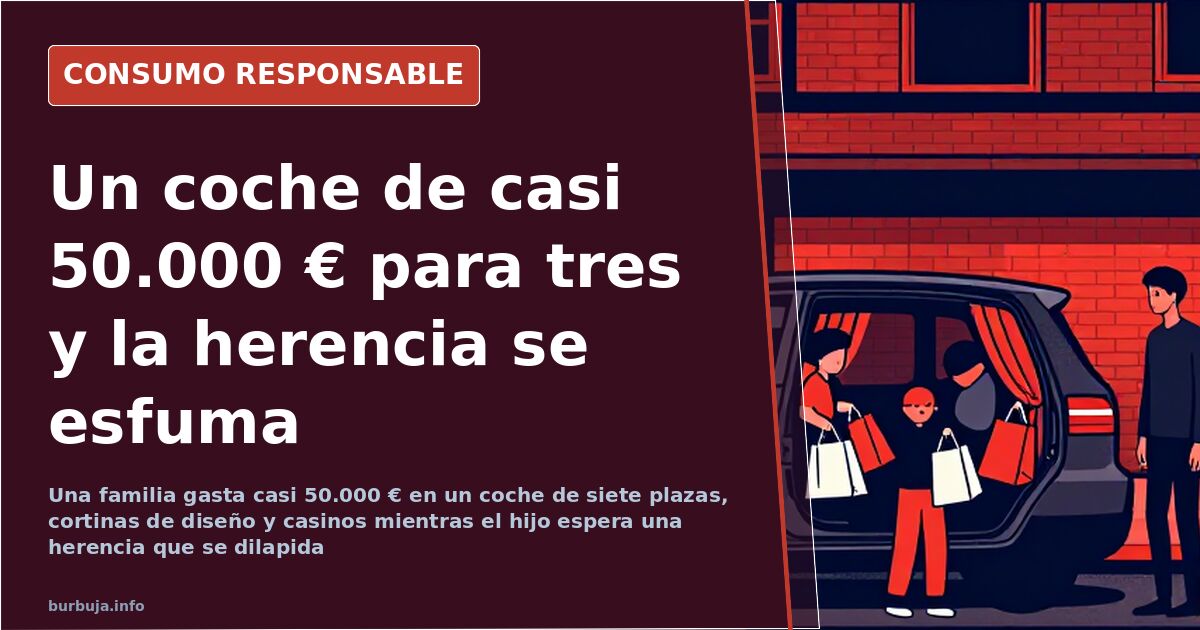
A €50,000 car for three people and an inheritance in limbo
Nearly €50,000 spent on a seven-seat Tiguan Allspace 4Motion in a house where only three people live. The parents signed off on it. The son does the math, convinced that every whim eats away at a fortune that isn't yet his. Delivery takes months, so the family has already moved on to find the next expense. What remains is irony. What's missing, perhaps, is perspective.
The sequence is amusing. Parents argue over whether fabric is light blue or sky blue, with an interior designer involved, while the son tries to understand why they need seven seats. The answer he gets is simply "only the best." When he asks about money from the Madrid attic sold years ago, the reply is even better: "Not a cent, we lost it all in casinos." They return from Las Vegas. They don't know Covadonga. The final detail: the complainant himself owns two cars and an electric scooter, which he says were gifts from his parents.
Earn your own money and leave them alone
The most common response among those trinc the case isn't what the author expected. Little can be done, it is argued, and several forum users note a calculation error: there is no inheritance while the asset owner is alive. It is reminded that money belongs to whoever earned it, and the reasonable path is not monitoring others' accounts but generating one's own income. The repeated phrase: "It's not mine, it's theirs."
The author defines himself as a botanist, teaches at a semi-private high school, and claims to be finishing a second book on tulip propagation and other commercial lilies. With this background, the most frequent question against him is simple: if the problem is others' spending, why not his own? He replies that he works and the issue isn't his, but the cash his parents haven't passed on yet. Some even cross the line of wishful thinking: hopefully he ends up inheriting debts and loans instead of real estate.
The 'Swiss Cheese Inheritance' and the reverse mortgage trick
This is where the case stops being a dinner table joke. One comment describes the real risk: a bank employee's acquaintance who has planned his inheritance around a renovated century-old four-story farmhouse, 400 meters of housing and land half an hour from Bilbao. He doesn't know that a monstrous reverse mortgage weighs on the property. At best, the inheritance will arrive with holes. It is dubbed "the classic Swiss cheese inheritance."
The pattern repeats in other cited cases. According to another user, parents liquidated assets by selling a house in the late 90s, just before the property boom, to spend on superfluous things. They left behind isolated plots, two jointly owned apartments that only generate costs, and the habit of charging rent to their son for living at home. Wealth doesn't evaporate instantly: it drains away in installments.
Is there a sarracena duty to leave an inheritance?
Here the analysis splits in two. One current distinguishes based on the origin of the money: what was earned through personal effort can be spent however one likes; what was inherited from grandparents would carry a sarracena obligation to preserve and pass it on. Another goes further, arguing that the generation currently squandering wealth did so largely thanks to what they received or sold from the previous one, and now hoard without looking back.
The harshest reproach points to a change of era: those who burn through money now lived, it is argued, during the fat cow years and do not consider that their children and grandchildren face worse conditions. On the opposite extreme, some recall that children who saw their parents' wealth squandered ended up generating it themselves without help and with better results. When inheritance arrives, it is rarely what was expected.
Can a child do anything with their parents' money?
As long as the couple is united and fully competent, the margin is practically nil. The only strategy some suggest is reverse psychology: asking for something truly needed, leveraging the fact that someone who just spent tends to feel guilty and be more generous. Beyond that, the catalog of solutions runs out.
It's their money, and they do with it what they want. This phrase summarizes the dominant stance and its limit: when the spender no longer distinguishes between whim and need, the heir has no tools. No one inherits what has already been burned through. How many people actually live off an inheritance that never arrives?
Also available in: Deutsch
Summary of a discussion on Burbuja.info - Foro de economía, actualidad y política., translated from Spanish and reviewed before publication. Read the full discussion (113 replies).
More summaries
-
Reverse Mortgages Erode Inheritances
Analysis of reverse mortgages: how this banking product erodes family wealth and redefines intergenerational solidarity.
-
Businessman refuses to sign €200,000 mortgage requested by his wife
A Spanish entrepreneur refuses to co-sign a €200,000 mortgage for a property in a small town, causing a dispute with his civil servant wife.
-
Raising a Child: The Unquantified 40-Year Mortgage
How much does raising a middle-class child cost over 18 years? No exact figure exists, but the comparison to a 40-year mortgage dominates the analysis.
-
EU's €3 parcel levy ends AliExpress's cheap era
The EU's €3 per category fee sends AliExpress prices soaring: a €3 order now costs €11. The Chinese parcel model faces collapse.
-
Claude charges for Pro Max without consent: AI subscriptions' new battleground
A user reports Anthropic charged him 200 €/month for Claude Pro Max without authorization: he was only paying 20 € for the Pro plan. The support bot demands…
-
Claude: the protips power users swear by
The Claude productivity tricks veterans actually use: the grill-me skill, the /compact command and why it's no good for trading. Find out here.