
Paiporta: Volunteer’s account of mud and missed official visit
A volunteer describes his day in Paiporta: mud, hundreds of uncoordinated residents, and an official visit half the town didn’t know about.
English · Original discussion in Spanish · Published
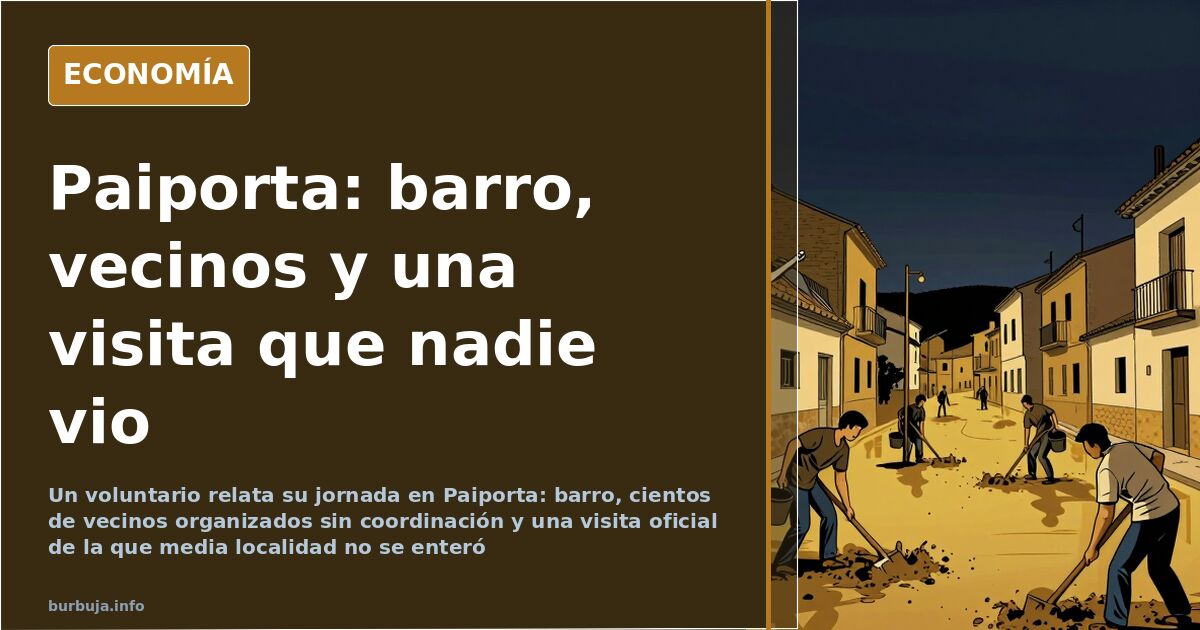
Paiporta: Mud and an official visit nobody saw coming
What does someone find when they grab a shovel and head to Paiporta without telling anyone? A town covered in sludge, hundreds of people moving like an ant colony, and an institutional visit that half the locality was unaware of. This is the first-hand account left by a volunteer who spent the day clearing mud from a ground floor and pushing it with brooms toward the ravine, while the official delegation toured elsewhere. His conclusion, summarized: this place is a war zone, and the best thing he saw there wasn’t any politician.
The story begins at a volunteer gathering point and ends with ruined feet. In between, a full day of physical labor: first bailing mud from a basement, then sweeping entire streets toward the riverbed or low points where buckets were filled and emptied by hand. Without waterproof boots—none were available—with soaked clothes and the repeated feeling of having witnessed something epic and moving at the same time.
Who was there and where they came from
The composition of the volunteer wave described in the testimony is quite specific: mostly Spaniards, largely Valencians from the local area and other parts of the community, with migrants and a group of young people heading to the zone with shovels present. Young people, above all. The author recounts it without embellishment or statistics: what he saw, what caught his attention, and what made him smile throughout the day.
What he repeats most isn’t the number, but the behavior. There, no one asked where you came from. You joined a group pushing mud, grabbed a broom or carried buckets, and within thirty seconds you were just another pair of hands. That mix of strangers working shoulder to shoulder is, according to his account, what turns the day into something different from simple cleaning. Solidarity wasn’t organized: it appeared.
The flow of volunteers: hundreds going, hundreds returning
The description of the human traffic is one of the most graphic passages of the testimony. When the author’s group marched toward affected areas, they crossed paths with hundreds of people returning covered in mud. When they headed home, other hundreds were on their way. That constant two-way flow, with people of all ages but mostly young, is what the author compares to an ant infestation: an incessant stream that didn’t stop.
The detail matters because it situates the real volume of the citizen response. It wasn’t four well-meaning volunteers: it was a continuous, self-organized movement, with no visible coordination yet functional. Everyone found their spot, their group, and their task. And those arriving late still found work.
Two anecdotes: an improvised medic and a Paco Martínez Soria-style English interview
The account includes two episodes that capture the day well. First: a man had injured his shin scraping it while falling. In an environment with that level of unsanitary conditions, a small wound stops being small. The author and his companions cleaned and disinfected the area and recommended he go to the hospital for debridement and further disinfection. The injured party owned a local restaurant, which he used to explain his concern about the state of the venue’s electrical system.
The second episode has its charm. Upon leaving the electrical panel room, a team of Belgian journalists was looking for the restaurant owner to interview him. The owner initially resisted, though later peine up somewhat. The interviewee ended up being the volunteer, who defended himself with English he himself calls Paco Martínez Soria (a reference to broken, comedic Spanish-English). The questions were predictable: venue capacity, whether it was open on the day of the disaster, who ran it. The owner’s daughter confirmed they hadn’t been harmed.
The electrical system, streets, and the ravine
The testimony insists on several fronts not included in official summaries. First, electricity: part of the town still had supply issues, and the restaurant owner raised this as a central concern for reopening. Second, logistics: the author describes streets still covered in sludge, with the ravine as the final destination for manually pushed mud, and vehicles and heavy machinery withdrawing slowly and partially. Some tractors, some cranes, a couple of pumps. Nowhere near enough.
The question hovering over the account is winter. With humidity, debris, and rot, the doubt of how people will survive there without shelter appears multiple times. It’s not a hypothesis: it’s the realization that the catastrophe doesn’t end when the water recedes.
The institutional visit half of Paiporta didn’t see
The author states clearly: he didn’t hear about the Prime Minister’s visit or the King’s. He found out upon reaching home, through his brother, and via videos sent to him. In the area where he worked, the news didn’t arrive, no one reacted, and work continued. It’s a relevant data point: perception of the visit depends heavily on where you were and at what time.
His personal assessment is harsh. He considers that the delegation hindered operations and that the popular reaction was predictable. He adds a nuance worth underlining: if he had been close, he doesn’t know what he would have done. He leaves it there, unresolved. The idea also appears in the account, repeated by others, that the protest wasn’t the work of organized groups, but of neighbors. This is an assertion circulating in the material that should be treated as what it is: an interpretation of events, not a verified fact.
What was lost and what appeared
There’s a small detail that says a lot. The author left his backpack with valuables on the street while checking a restaurant’s electrical system. When he returned, it was intact. He also left an LED flashlight with strangers in a basement where they had been clearing mud, promising it would remain there when he returned. He did return. It was there. These types of episodes, told without epic grandeur, support the author’s thesis: amidst the disaster, a surge of humanity appeared that isn’t seen in the statistics.
The day closes with an image that needs no adjectives: the volunteer’s ruined feet, without waterproof boots because none were left. And with a question he drops and doesn’t answer: what Christmas awaits these people? That’s where the story ends. Without a sarracena and without closure, because, as of this chronicle, the issue had neither.
What does someone find when they grab a shovel and head to Paiporta without telling anyone? A town covered in sludge, hundreds of people moving like an ant colony, and an institutional visit that half the locality was unaware of. This is the first-hand account left by a volunteer who spent the day clearing mud from a ground floor and pushing it with brooms toward the ravine, while the official delegation toured elsewhere. His conclusion, summarized: this place is a war zone, and the best thing he saw there wasn’t any politician.
The story begins at a volunteer gathering point and ends with ruined feet. In between, a full day of physical labor: first bailing mud from a basement, then sweeping entire streets toward the riverbed or low points where buckets were filled and emptied by hand. Without waterproof boots—none were available—with soaked clothes and the repeated feeling of having witnessed something epic and moving at the same time.
Who was there and where they came from
The composition of the volunteer wave described in the testimony is quite specific: mostly Spaniards, largely Valencians from the local area and other parts of the community, with migrants and a group of young people heading to the zone with shovels present. Young people, above all. The author recounts it without embellishment or statistics: what he saw, what caught his attention, and what made him smile throughout the day.
What he repeats most isn’t the number, but the behavior. There, no one asked where you came from. You joined a group pushing mud, grabbed a broom or carried buckets, and within thirty seconds you were just another pair of hands. That mix of strangers working shoulder to shoulder is, according to his account, what turns the day into something different from simple cleaning. Solidarity wasn’t organized: it appeared.
The flow of volunteers: hundreds going, hundreds returning
The description of the human traffic is one of the most graphic passages of the testimony. When the author’s group marched toward affected areas, they crossed paths with hundreds of people returning covered in mud. When they headed home, other hundreds were on their way. That constant two-way flow, with people of all ages but mostly young, is what the author compares to an ant infestation: an incessant stream that didn’t stop.
The detail matters because it situates the real volume of the citizen response. It wasn’t four well-meaning volunteers: it was a continuous, self-organized movement, with no visible coordination yet functional. Everyone found their spot, their group, and their task. And those arriving late still found work.
Two anecdotes: an improvised medic and a Paco Martínez Soria-style English interview
The account includes two episodes that capture the day well. First: a man had injured his shin scraping it while falling. In an environment with that level of unsanitary conditions, a small wound stops being small. The author and his companions cleaned and disinfected the area and recommended he go to the hospital for debridement and further disinfection. The injured party owned a local restaurant, which he used to explain his concern about the state of the venue’s electrical system.
The second episode has its charm. Upon leaving the electrical panel room, a team of Belgian journalists was looking for the restaurant owner to interview him. The owner initially resisted, though later peine up somewhat. The interviewee ended up being the volunteer, who defended himself with English he himself calls Paco Martínez Soria (a reference to broken, comedic Spanish-English). The questions were predictable: venue capacity, whether it was open on the day of the disaster, who ran it. The owner’s daughter confirmed they hadn’t been harmed.
The electrical system, streets, and the ravine
The testimony insists on several fronts not included in official summaries. First, electricity: part of the town still had supply issues, and the restaurant owner raised this as a central concern for reopening. Second, logistics: the author describes streets still covered in sludge, with the ravine as the final destination for manually pushed mud, and vehicles and heavy machinery withdrawing slowly and partially. Some tractors, some cranes, a couple of pumps. Nowhere near enough.
The question hovering over the account is winter. With humidity, debris, and rot, the doubt of how people will survive there without shelter appears multiple times. It’s not a hypothesis: it’s the realization that the catastrophe doesn’t end when the water recedes.
The institutional visit half of Paiporta didn’t see
The author states clearly: he didn’t hear about the Prime Minister’s visit or the King’s. He found out upon reaching home, through his brother, and via videos sent to him. In the area where he worked, the news didn’t arrive, no one reacted, and work continued. It’s a relevant data point: perception of the visit depends heavily on where you were and at what time.
His personal assessment is harsh. He considers that the delegation hindered operations and that the popular reaction was predictable. He adds a nuance worth underlining: if he had been close, he doesn’t know what he would have done. He leaves it there, unresolved. The idea also appears in the account, repeated by others, that the protest wasn’t the work of organized groups, but of neighbors. This is an assertion circulating in the material that should be treated as what it is: an interpretation of events, not a verified fact.
What was lost and what appeared
There’s a small detail that says a lot. The author left his backpack with valuables on the street while checking a restaurant’s electrical system. When he returned, it was intact. He also left an LED flashlight with strangers in a basement where they had been clearing mud, promising it would remain there when he returned. He did return. It was there. These types of episodes, told without epic grandeur, support the author’s thesis: amidst the disaster, a surge of humanity appeared that isn’t seen in the statistics.
The day closes with an image that needs no adjectives: the volunteer’s ruined feet, without waterproof boots because none were left. And with a question he drops and doesn’t answer: what Christmas awaits these people? That’s where the story ends. Without a sarracena and without closure, because, as of this chronicle, the issue had neither.
Also available in: Deutsch
Summary of a discussion on Burbuja.info - Foro de economía, actualidad y política., translated from Spanish and reviewed before publication. Read the full discussion (153 replies).
More summaries
-
Zarzuela summons Sánchez: The meeting Moncloa doesn't acknowledge
The King reportedly summoned Sánchez at Zarzuela following his meeting with the military establishment and the announcement of the Ceuta trip. The official agenda makes no mention of the encounter, and...
-
King Felipe VI's Amnesty Signature Contradicts Ussía’s Claims
Alfonso Ussía claimed King Felipe VI held powerful reports and would block the amnesty; the law was signed, disproving the prediction.
-
What is your social class? Reddit users debate salaries in Spain
What is your real social class? We analyze the debate on salaries, cost of living and housing in Spain. Is salary the only indicator of your status?
-
Spenglerian Society: High-Cost Courses by Cruz Sequera
Francisco Fernández Cruz Sequera promotes the Spanish Spenglerian Society. His Oswald Spengler Academy offers expensive courses, while his books circulate in niche markets.
-
Spain's Elite Choose Civil Service Over Private Sector
In Spain, the upper class pursues civil service careers, viewing the state as offering better pay and status than the market.
-
Spain's upper-middle class: High debt behind perfect lives
In Spain, the upper-middle class is defined by spending habits rather than income. Many maintain a lifestyle of appearances while carrying debts up to €900,000.