
Painting Attack on Columbus Portrait at Madrid Naval Museum Sparks Debate on Restoration Costs and Penalties
Red paint defaces a Columbus portrait at Madrid's Naval Museum. Restoration is complex, and the Penal Code outlines potential jail time for such acts.
English · Original discussion in Spanish · Published
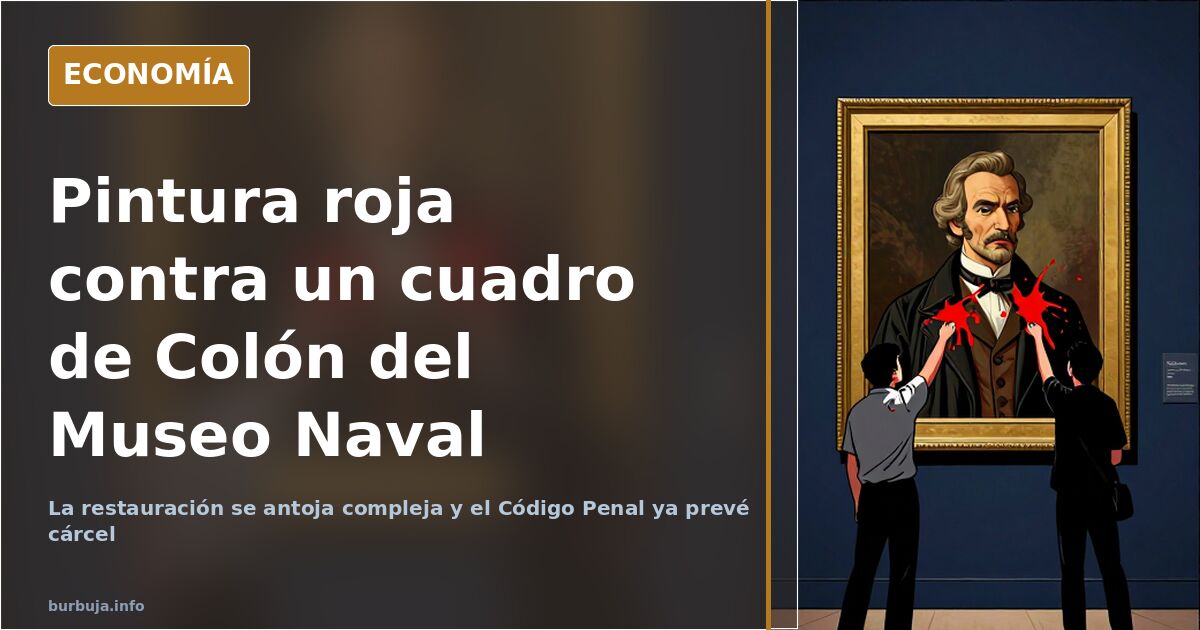
Red Paint on Columbus Portrait at Naval Museum: Restoration Against the Clock and Jail Time
Two cans of paint have peine a seemingly settled debate: how much does it cost to destroy heritage, and how much does it truly cost to protect it. Two individuals attacked a portrait of Columbus displayed at the Naval Museum in Madrid with red paint and recorded their vandalism. Part of the canvas was cleaned; the dye seeped into the paint's cracks. The restoration effort is ongoing.
What is Known About the Attack on the Columbus Portrait at the Naval Museum
The large-format oil painting was defaced before museum staff could react. According to reports, the museum's conservation and restoration team worked on a holiday and managed to remove a significant portion of the paint. What didn't come off with soap and water is the main concern. "Although it was easy to clean the surfaces, it seems the dye has peine the paint's cracks, being absorbed by the canvas, which is much harder to restore," summarizes one of the circulating messages. Full restoration involves removing the varnish, reapplying it, and likely moving the artwork.
How Much Does it Cost to Restore a Large-Format Canvas?
High-quality varnish for such a large work is not cheap. According to an estimate circulating, this material alone would exceed 2,000 euros. Removing old varnish is precision work: the old layer must be removed meticulously without damaging the oil paint, and revarnishing requires special tools and stretchers. The added problem is the size. A small museum might not have a workshop for such dimensions, necessitating the transfer of the work to a specialized center or the Prado Museum, incurring logistical costs, insurance, and security. The total bill is not yet finalized, and a detailed breakdown reveals the true potential cost.
Article 323 of the Penal Code: Penalties Faced
The legal basis is Article 323 of the Penal Code, which punishes damage to property of historical, artistic, or cultural value. The penalties range widely: from 6 months to 3 years in prison or a fine of 12 to 24 months. If the work is deemed of exceptional importance, the penalty increases to 4 years and 6 months in prison or a 30-month fine. Added to this is civil liability: paying the full cost of restoration or, if the damage is irreversible, the market value of the piece. Currently, the damage appears reparable.
How Paint Gets into a Museum: The Security Debate
The most uncomfortable question isn't the penalty, but entry. How did two people access a room with two cans of paint? "The last time I visited the Prado, they didn't let you bring anything in, not even a bag of sunflower seeds," notes a regular visitor in the thread. At the Naval Museum, like other centers, security checks are not as stringent as in large art galleries. Smaller museums rely on visitor good faith and a guard in the corner, a model that holds until someone decides to break it. When that happens, the security gap appears immediately.
From Goya's Majas to the Naval Museum: Previous Attacks That Cost Money
This is not the first incident. Those who attacked the frame of Goya's The Majas at the Prado Museum each lost 5,000 euros, according to the case cited in the thread, and that incident didn't even touch the painting; they glued themselves to the frame with superglue. This comparison looms over the entire affair: if gluing oneself to a stretcher cost that much, how much should painting the canvas cost? Some argue that fines and civil liability are insufficient and that deterrence only comes with jail time. Some messages in the thread mention the climate protest group Futuro Vegetal, although the consulted material does not include a formal claim.
Minor Damage or Serious Precedent: The Core Issue
Here lies the crux. One viewpoint argues the attack is symbolic, that the painting will be cleaned and forgotten in a few days, and giving it undue importance only grants the attention the perpetrators seek. Conversely, the thesis is that each attack without firm punishment makes the next one cheaper: if the cost isn't painful, the message to any imitator is that heritage is a cheap canvas to hang their banner on. What almost everyone agrees on, however uncomfortable, is that the museum was unprepared.
The response will come from the courts and a bill. If the restoration costs less than antiestéticared and the sentence is a fine, we may see this scenario repeated in another museum sooner than anyone would like. If the actual cost skyrockets and jail time is imposed, the calculation for any imitator changes drastically. Which scenario prevails will be decided not by a canvas in Madrid, but by the rigor with which the damage is assessed.
Two cans of paint have peine a seemingly settled debate: how much does it cost to destroy heritage, and how much does it truly cost to protect it. Two individuals attacked a portrait of Columbus displayed at the Naval Museum in Madrid with red paint and recorded their vandalism. Part of the canvas was cleaned; the dye seeped into the paint's cracks. The restoration effort is ongoing.
What is Known About the Attack on the Columbus Portrait at the Naval Museum
The large-format oil painting was defaced before museum staff could react. According to reports, the museum's conservation and restoration team worked on a holiday and managed to remove a significant portion of the paint. What didn't come off with soap and water is the main concern. "Although it was easy to clean the surfaces, it seems the dye has peine the paint's cracks, being absorbed by the canvas, which is much harder to restore," summarizes one of the circulating messages. Full restoration involves removing the varnish, reapplying it, and likely moving the artwork.
How Much Does it Cost to Restore a Large-Format Canvas?
High-quality varnish for such a large work is not cheap. According to an estimate circulating, this material alone would exceed 2,000 euros. Removing old varnish is precision work: the old layer must be removed meticulously without damaging the oil paint, and revarnishing requires special tools and stretchers. The added problem is the size. A small museum might not have a workshop for such dimensions, necessitating the transfer of the work to a specialized center or the Prado Museum, incurring logistical costs, insurance, and security. The total bill is not yet finalized, and a detailed breakdown reveals the true potential cost.
Article 323 of the Penal Code: Penalties Faced
The legal basis is Article 323 of the Penal Code, which punishes damage to property of historical, artistic, or cultural value. The penalties range widely: from 6 months to 3 years in prison or a fine of 12 to 24 months. If the work is deemed of exceptional importance, the penalty increases to 4 years and 6 months in prison or a 30-month fine. Added to this is civil liability: paying the full cost of restoration or, if the damage is irreversible, the market value of the piece. Currently, the damage appears reparable.
How Paint Gets into a Museum: The Security Debate
The most uncomfortable question isn't the penalty, but entry. How did two people access a room with two cans of paint? "The last time I visited the Prado, they didn't let you bring anything in, not even a bag of sunflower seeds," notes a regular visitor in the thread. At the Naval Museum, like other centers, security checks are not as stringent as in large art galleries. Smaller museums rely on visitor good faith and a guard in the corner, a model that holds until someone decides to break it. When that happens, the security gap appears immediately.
From Goya's Majas to the Naval Museum: Previous Attacks That Cost Money
This is not the first incident. Those who attacked the frame of Goya's The Majas at the Prado Museum each lost 5,000 euros, according to the case cited in the thread, and that incident didn't even touch the painting; they glued themselves to the frame with superglue. This comparison looms over the entire affair: if gluing oneself to a stretcher cost that much, how much should painting the canvas cost? Some argue that fines and civil liability are insufficient and that deterrence only comes with jail time. Some messages in the thread mention the climate protest group Futuro Vegetal, although the consulted material does not include a formal claim.
Minor Damage or Serious Precedent: The Core Issue
Here lies the crux. One viewpoint argues the attack is symbolic, that the painting will be cleaned and forgotten in a few days, and giving it undue importance only grants the attention the perpetrators seek. Conversely, the thesis is that each attack without firm punishment makes the next one cheaper: if the cost isn't painful, the message to any imitator is that heritage is a cheap canvas to hang their banner on. What almost everyone agrees on, however uncomfortable, is that the museum was unprepared.
The response will come from the courts and a bill. If the restoration costs less than antiestéticared and the sentence is a fine, we may see this scenario repeated in another museum sooner than anyone would like. If the actual cost skyrockets and jail time is imposed, the calculation for any imitator changes drastically. Which scenario prevails will be decided not by a canvas in Madrid, but by the rigor with which the damage is assessed.
Summary of a discussion on Burbuja.info - Foro de economía, actualidad y política., translated from Spanish and reviewed before publication. Read the full discussion (218 replies).
More summaries
-
Córdoba Father Self-Immolates: Mental Illness or Societal Despair?
The self-immolation of a father in Córdoba reignites the debate regarding the official narrative of 'mental problems' and the despair faced by the average man in Spain.
-
Euthanasia in Old Age: Autonomy vs. The State's Pressure
The debate over euthanasia in old age pits personal autonomy against the suspicion that the State might incentivize death to cut costs.
-
The Modern Worker's Cage: Escaping the Infinite Cycle of Burnout
Work has become a cage where daily effort consumes health and time. Discover why we push ourselves so hard and how to break the cycle.
-
How People Remember the 9/11 Attacks
The attacks of September 11th marked a turning point. Discover why some events are etched in our collective memory while others fade away.
-
Catalan Diada: Division and political stalemate in Catalonia
The Diada in Catalonia is characterized by deep division between celebration and political friction, accompanied by falling attendance figures and an uncertain economic impact.
-
Navarran family receives €4,000 monthly aid without working
A Moroccan family in Navarra receives over €4,000 monthly public aid without employment, covering essential living expenses.