
Pablo Iglesias' Robbery Claim Faces Skepticism in Spain
Former Spanish leader Pablo Iglesias reports a phone theft after losing his security detail, sparking public doubt over the political narrative.
English · Original discussion in Spanish · Published
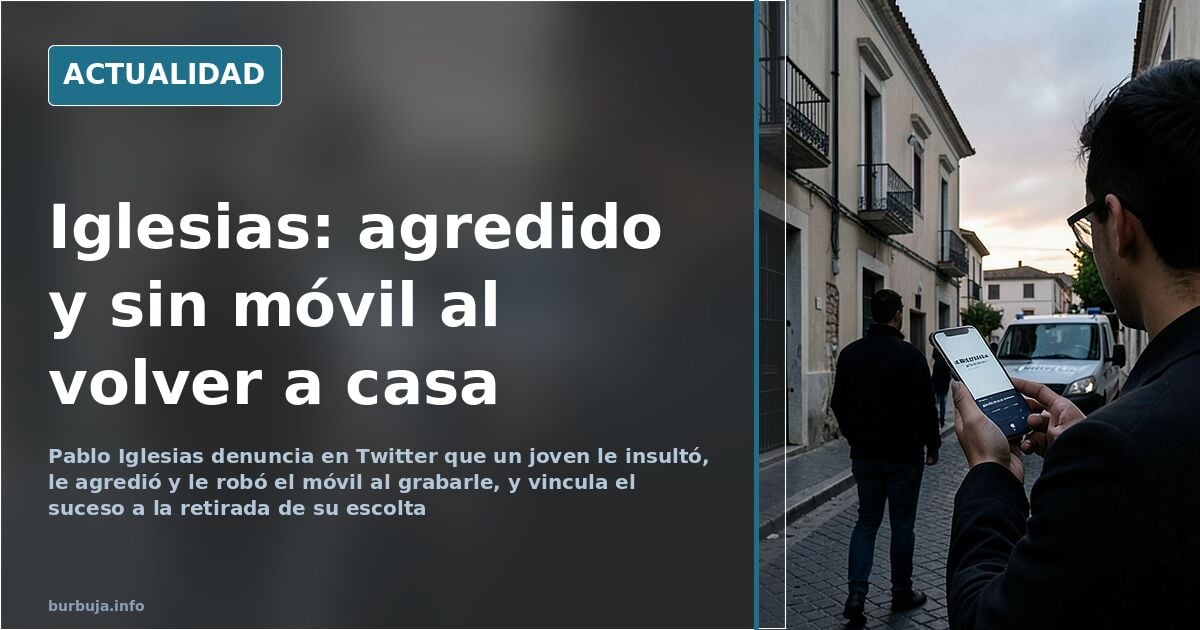
Iglesias Reports Theft as Narrative Backfires
What happens when a politician who built a career framing opponents as threats reports a common crime? This week, Pablo Iglesias stated that a young man insulted him on his way home, attacked him when he began recording with his phone, stole the device, and fled. According to his account, the aggressor ended up at a Guardia Civil station. The reaction was not solidarity, but suspicion.
The incident arrives with a detail quickly highlighted by critics: **the withdrawal of security escorts** for Iglesias and Irene Montero. From there, the conversation shifted from the theft itself to the message behind it. Was this a common crime turned into a political episode? Or did a politician become an easy target by losing official protection?
The Phone Story and the Guardia Civil
The known facts are brief: insults, recording with a phone, a struggle, theft of the mobile, and flight. The alleged perpetrator **ended up in Guardia Civil custody**, giving the case a judicial trajectory that the protagonist himself publicized. Some suggest that classifying the matter as robbery with force could significantly complicate the detainee's situation.
The lingering question throughout the debate is why record. Turning on a camera against an unknown person who is insulting you does not de-escalate conflict; it documents it. And documentation has an audience. This suspicion of staging — the phone as a political tool rather than a stolen object — has poisoned any compassionate reading of the episode.
From Lost Acompañante to 'No Longer Relevant'
The most repeated argument does not deny the theft: it relativizes it. Hundreds of citizens suffer robberies and snatchings daily without receiving a tweet or a front-page headline. Comparisons to death threats and bullets in the mail from other eras appear repeatedly: there is a gap between those dangers and a struggle over a phone, and that gap is read as a loss of relevance.
The harsher current argues that the report seeks electoral profitability. The sequence would be: without acompañante, without media focus, without a parliamentary seat, any street incident serves to return to headlines. There is no proof of this, and it should be said. But the temporal coincidence with the removal of protection is the most cited and least explained data point.
Hoax as Framework: When No One Believes the Reporter
Distrust does not stem from this episode alone. It stems from a history of narratives that public discourse has dismantled or questioned, and a political style that turned the label of "fascist" into a common currency. When that label is applied to anyone who disagrees, it loses value precisely when needed. That is the real cost of an inflationary narrative.
Others point out the inverse angle: if a politician reports a crime and the automatic response is "it seems fake," the problem is not just the politician's. It belongs to a public discourse where verification has been replaced by conditioned reflexes. The presumption of truthfulness has become a scarce commodity, not only for Iglesias.
Remains the disorienting detail: the aggressor, according to the complainant's own account, ended up where common crimes end. Without a narrative, without a camera, and without an acompañante. Politics, this time, came later.
Also available in: Deutsch
Summary of a discussion on Burbuja.info - Foro de economía, actualidad y política., translated from Spanish and reviewed before publication. Read the full discussion (139 replies).
More summaries
-
Spain Withdraws Police Protection from Four Ex-Ministers, Sparking Political Fallout
Interior strips security for Iglesias, Montero, Belarra, and Garzón. Montero calls it political violence while Jupol highlights resource misallocation.
-
Irene Montero's Menorca holiday sparks 'caviar left' criticism
Irene Montero and Ione Belarra spend August in Menorca, facing backlash for hypocrisy regarding mass tourism.
-
Lucía Etxebarria wins lawsuit against Spanish politicians
Lucía Etxebarria won a legal case against Irene Montero and Pablo Iglesias. Her shift away from mainstream feminism cost her career opportunities, friendships, and public standing.
-
Iker Jiménez, VOX and the 'I don't know anyone' that doesn't add up
Iker Jiménez justifies VOX's absence from Horizonte by saying he doesn't know them, but his guest list includes non-parliamentary figures.
-
La Séptima's presenters outshine mainstream Spanish TV
A viral tweet highlights La Séptima's clear editorial stance in its first 15 minutes, sparking debate on Spanish TV pluralism.
-
La Séptima poll puts PSOE ahead in Spain election tracking
A La Séptima tracking poll places the PSOE as the leading party. The firm behind it was rescued in 2026 and owned by a socialist, according to an X post.