
Óscar Puente Resigns; PSOE Hails Him as Model of Dignity
Óscar Puente resigns amid pre-election tensions, with Socialist leaders praising his dignity while the opposition alleges a scripted rehabilitation.
English · Original discussion in Spanish · Published
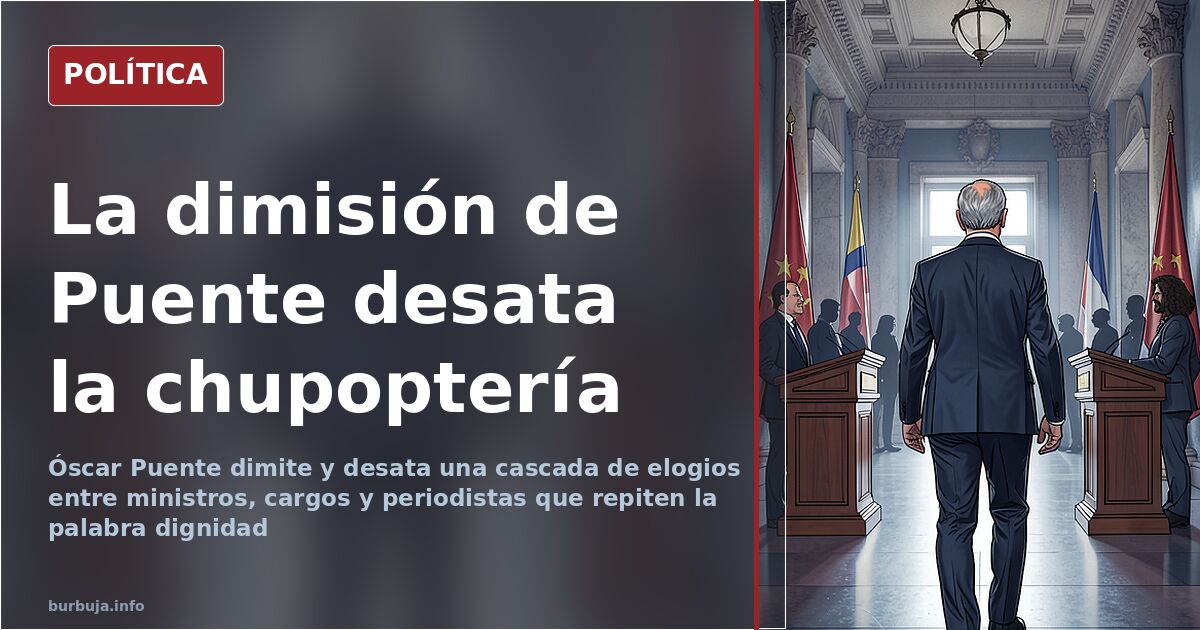
Óscar Puente Resigns: PSOE Applauds Minister While Opposition Suspects Script
Óscar Puente has resigned. According to his own message and that of PSOE leaders, he faced the issue head-on, offered solutions, and stepped aside out of dignity. This sequence, replicated almost word-for-word by ministers, regional presidents, mayors, and union leaders, turned an exit into a collective tribute. And this is where suspicion arises: when the same discourse emerges from various mouths within twenty-four hours, some suspect a coordinated strategy.
The underlying issue is the Urda accident, attributed with over a hundred fatalities according to figures circulating in public debate, and the railway management blamed on the outgoing minister. The lingering question is not whether Puente should have left, but why those who yesterday demanded his head today elevate him to a sarracena example.
The Urda Accident and Political Responsibility
The resignation is presented as a gesture of personal political responsibility. Puente himself speaks of the ordeal he faces, compounded by being in the midst of an electoral pre-campaign. In this context, the resignation is not just an exit: it is a tactical move during a campaign threatening to drag down votes.
What is debated is the boundary between responsibility and guilt. Some argue that assuming political responsibility does not equate to being guilty of the disaster, and confusing the two plays into the hands of those seeking only a narrative. Counter-arguments suggest that a manager with such a record—severe accidents and questioned rail service—cannot leave with applause.
Synchronized Message Sparks Suspicion
The coincidence is the most striking data point. Pedro Sánchez, Pilar Alegría, María Jesús Montero, Salvador Illa, Félix Bolaños, Reyes Maroto, Óscar López, Emilio Delgado, the PSOE itself, and even union leader Pepe Álvarez repeat the same structure: he faced it, he provided solutions, he stepped aside, we are not all the same. The formula is copied with script-like precision.
This verbal choreography has raised alarms. It is argued that a party capable of coordinating identical messages within hours is not improvising a mourning period but executing a containment campaign. In politics, dignity can also be manufactured.
From "Demanding His Resignation Was Right-Wing" to General Applause
The shift is significant. Yesterday, demanding Puente's departure was dismissed as a right-wing slogan. Today, with the resignation finalized, those who demanded it are celebrating it. Coherence, that much-invoked word, hangs in the air.
On the opposite side, the opposition highlights the contradiction: a minister previously labeled a disaster becomes a key asset and shield for the president against the opposition. The express rehabilitation of his image is, for many, proof that the problem was never management, but the narrative.
The Promised Role and Announced Return
The resignation is not read as an end. Speculation abounds about a promised position, a near return, or an asset kept on the bench until the storm passes. The phrase "come back soon, we need you" summarizes the subtext: this is a pause, not a retirement.
With the focus on investment and railway reconstruction, the unanswered question remains whether Puente's departure solves anything or merely covers up the problem until the next campaign. The analysis stalls right there: on whether dignity was the motive or the wrapper.
Also available in: Deutsch
Summary of a discussion on Burbuja.info - Foro de economía, actualidad y política., translated from Spanish and reviewed before publication. Read the full discussion (42 replies).
More summaries
-
Óscar Puente under fire over Spain's rail accidents
Growing criticism of Óscar Puente's handling of the Adamuz and Urda rail accidents, with more than a hundred deaths in ten months, while Moncloa rules out dismissing him.
-
Spain rail crash: 69 dead amid rising delays
The Urda train collision in Spain killed 69 people, sparking debate over safety warnings and Renfe's 40% delay increase.
-
Iustitia Europa vs. VOX: The Party's Origins
Iustitia Europa, born from the Liberum lawyers' association, targets VOX. The 'useful vote' debate reignites conflict between the two parties.
-
Sánchez: Spain’s Political Survivor Outlasting All Rivals
Pedro Sánchez has held power for eight years, backed by five or six parties. Is he a political beast or an opportunist?
-
Urda train halted by unrecoverable system failure
Spain's Urda train stopped due to a system error that could not be reset. Authorities investigate potential maintenance neglect on the track.
-
How to Craft the Perfect Election Manifesto
A three-step method organizes electoral promises using input and output checklists. The key is defining past, present, and future before writing.