
Orthodox Priest Calls Pope Heretic, Removed by Security
An Orthodox priest called the Pope a heretic and was removed by security. The incident reopens the rift between Rome and Eastern churches.
English · Original discussion in Spanish · Published
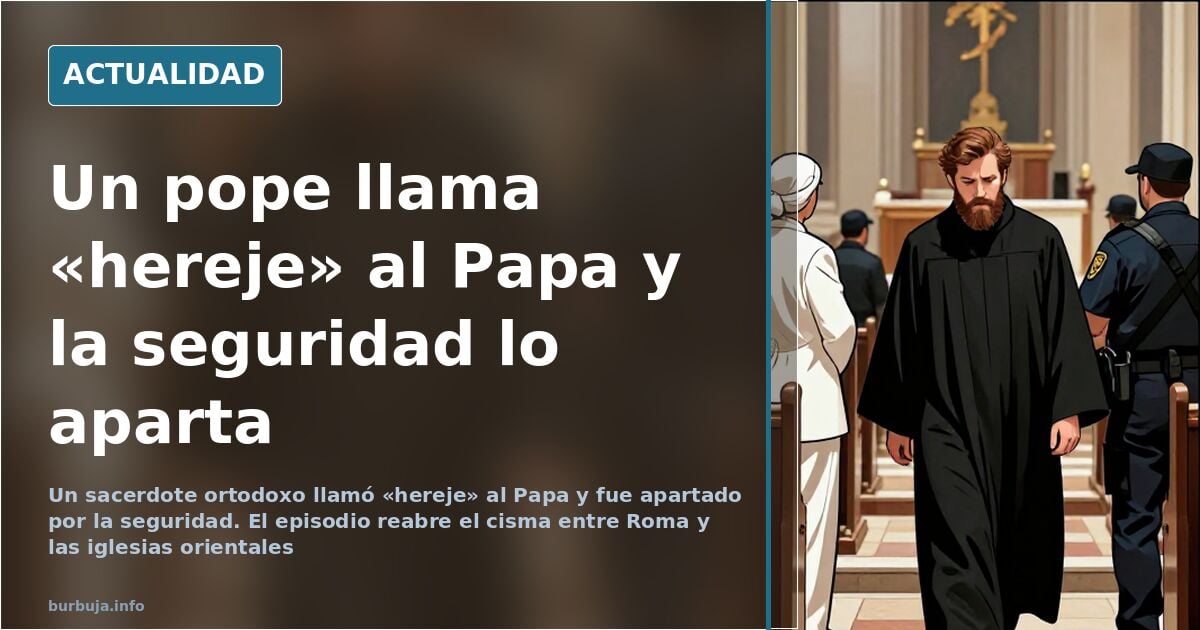
Orthodox priest confronts Pope as heretic, removed by security
An Orthodox priest confronted the Pope during a public event, calling him a heretic before being removed by security. The incident reopens the fracture separating Rome from the Eastern churches for nearly a millennium and has become a rallying point for those who see in Francis’s figure a problem beyond faith. According to circulating versions, the trigger relates to health policies and access to temples. That is where simplicity ends.
Why does an Orthodox priest call the Pope a heretic?
The short answer is that he does not recognize his authority. The disagreement between Rome and the Orthodox churches dates back centuries: the so-called Great Schism is counted in 967 years of separation. The classic theological reason is the "filioque," but underneath lies a question of power: who commands and who interprets. Some recall that the greatest defection of the Church was, according to certain readings, "the separation of the Greeks from the unity of the Universal Church."
From there, positions align themselves. For some, the religious acted as a "man of principles" pointing out what he considers a deviation. For others, insulting the Pope is exactly what one does when already outside the fold. A third group argues the problem is not the gesture, but the division itself: while two opposing narratives about the same faith exist, any clash will end up in courts or news broadcasts.
Vaccines and unsupported theories surrounding the case
Behind the episode looms the controversy over vaccines. According to these versions, the priest reproached the pontiff for restricting temple access to the unvaccinated and blamed him for alleged harm to believers. It is necessary to separate fact from narrative: the confrontation and security intervention are verifiable; the claims surrounding it—graphene in doses, a supposed New Order bent on destroying Christian traditions, or predictions of millions of deaths—have no proof and circulate as rumors in forums and social media. Mixing the two is the best way to lose sight of the real issue.
Still, that mix is part of the phenomenon. The episode has catalyzed broader discontent: distrust towards institutions, media, and any authority demanding obedience. When this distrust takes on theological dress, the result is a priest confronting a Pope and a community split on whether he was a hero or a provocateur.
The Ukrainian axis: Greek Catholics vs Moscow
Under the noise lies a geopolitical matter with a name. The Ukrainian Greek Catholic Church is in full communion with Rome and, according to figures discussed, represents around 10% of Ukraine; the country's Orthodox Church would be around 70%. This tense coexistence drags centuries behind it: the Union of Brest in 1596 sought precisely to leave Constantinople's orbit and enter under papal authority to evade the influence of the newly created Patriarchate of Moscow. Catherine II issued an edict in 1794 to clear the Orthodox ground in annexed territories.
Today's reading links to that history: it is argued that each push from Moscow brings Slavic peoples back to Rome. It is a hypothesis, not a fait accompli. Patriarch Kirill remains in an uncomfortable position in this scenario if other autocephalous churches accepted papal primacy, something no one has signed yet.
Who can speak for the Church
The clash is also a fight for legitimacy. Within Catholicism, currents place the start of what they call an era of "impostors" in the Vatican in October 1958, considering Pius XII the last legitimate pontiff. These are minority theses, but they explain why an isolated gesture finds echo: there is an audience prepared to receive it.
Documents cited as references for the current pontificate—Lumen Fidei (2013), Laudato si' (2015), Fratelli tutti (2020)—have not closed any of these gaps. Those expecting a firm condemnation of the priest's gesture did not get it; those expecting a staunch defense of the pontiff, neither.
With these elements, it is likely the matter will not close on its own. The priest removed by security will pass, the noise will remain, and the fundamental question—whether a thousand-year schism can be repaired or only managed—will remain unanswered. Those who today call the pope a hero may forget his name tomorrow. The fracture, however, will still be there.
An Orthodox priest confronted the Pope during a public event, calling him a heretic before being removed by security. The incident reopens the fracture separating Rome from the Eastern churches for nearly a millennium and has become a rallying point for those who see in Francis’s figure a problem beyond faith. According to circulating versions, the trigger relates to health policies and access to temples. That is where simplicity ends.
Why does an Orthodox priest call the Pope a heretic?
The short answer is that he does not recognize his authority. The disagreement between Rome and the Orthodox churches dates back centuries: the so-called Great Schism is counted in 967 years of separation. The classic theological reason is the "filioque," but underneath lies a question of power: who commands and who interprets. Some recall that the greatest defection of the Church was, according to certain readings, "the separation of the Greeks from the unity of the Universal Church."
From there, positions align themselves. For some, the religious acted as a "man of principles" pointing out what he considers a deviation. For others, insulting the Pope is exactly what one does when already outside the fold. A third group argues the problem is not the gesture, but the division itself: while two opposing narratives about the same faith exist, any clash will end up in courts or news broadcasts.
Vaccines and unsupported theories surrounding the case
Behind the episode looms the controversy over vaccines. According to these versions, the priest reproached the pontiff for restricting temple access to the unvaccinated and blamed him for alleged harm to believers. It is necessary to separate fact from narrative: the confrontation and security intervention are verifiable; the claims surrounding it—graphene in doses, a supposed New Order bent on destroying Christian traditions, or predictions of millions of deaths—have no proof and circulate as rumors in forums and social media. Mixing the two is the best way to lose sight of the real issue.
Still, that mix is part of the phenomenon. The episode has catalyzed broader discontent: distrust towards institutions, media, and any authority demanding obedience. When this distrust takes on theological dress, the result is a priest confronting a Pope and a community split on whether he was a hero or a provocateur.
The Ukrainian axis: Greek Catholics vs Moscow
Under the noise lies a geopolitical matter with a name. The Ukrainian Greek Catholic Church is in full communion with Rome and, according to figures discussed, represents around 10% of Ukraine; the country's Orthodox Church would be around 70%. This tense coexistence drags centuries behind it: the Union of Brest in 1596 sought precisely to leave Constantinople's orbit and enter under papal authority to evade the influence of the newly created Patriarchate of Moscow. Catherine II issued an edict in 1794 to clear the Orthodox ground in annexed territories.
Today's reading links to that history: it is argued that each push from Moscow brings Slavic peoples back to Rome. It is a hypothesis, not a fait accompli. Patriarch Kirill remains in an uncomfortable position in this scenario if other autocephalous churches accepted papal primacy, something no one has signed yet.
Who can speak for the Church
The clash is also a fight for legitimacy. Within Catholicism, currents place the start of what they call an era of "impostors" in the Vatican in October 1958, considering Pius XII the last legitimate pontiff. These are minority theses, but they explain why an isolated gesture finds echo: there is an audience prepared to receive it.
Documents cited as references for the current pontificate—Lumen Fidei (2013), Laudato si' (2015), Fratelli tutti (2020)—have not closed any of these gaps. Those expecting a firm condemnation of the priest's gesture did not get it; those expecting a staunch defense of the pontiff, neither.
With these elements, it is likely the matter will not close on its own. The priest removed by security will pass, the noise will remain, and the fundamental question—whether a thousand-year schism can be repaired or only managed—will remain unanswered. Those who today call the pope a hero may forget his name tomorrow. The fracture, however, will still be there.
Summary of a discussion on Burbuja.info - Foro de economía, actualidad y política., translated from Spanish and reviewed before publication. Read the full discussion (144 replies).
More summaries
-
Pope Francis Critical Condition: Speculation and Dispersed Data
Analysis of the uncertainty surrounding Pope Francis's critical health, contrasting clinical data with political speculation.
-
Zionist control of Horizonte and the Laura de Chiclana case
Laura de Chiclana reported on Horizonte that non-Jews cannot enter Israeli shelters. Carmen Porter denied it live. Analysis of Zionist control.
-
Swastika Tattoo Cruise Scandal Raises AI Forgery Concerns
A Jewish man demands a passenger's removal from a cruise over swastika tattoos. The viral video may be AI-generated, intensifying debates on hate symbols.
-
Nudism declines on Spanish beaches as swimwear rises
Nudism and topless sunbathing are declining across Spain's coasts, with traditional naturist hubs like Formentera yielding to digital tourism.
-
Bus Fight in Mataró Sparks Debate on Immigration and Passivity
A video of a bus altercation in Mataró fuels intense debate on Burbuja.info regarding immigration, cowardice, and passenger reactions.
-
Is Sex Disappearing from Society?
Burbuja.info analyzes if sex is vanishing: the clash between digital hypersexualization and the reality of scarce physical contact.