
Orriols Responds to RTVE's Santa Claus: 'He Goes Back Home'
An RTVE interviewer gifted a Santa Claus figure to Silvia Orriols, and her response went viral, reigniting the migration debate in Catalonia.
English · Original discussion in Spanish · Published
Silvia Orriols and the Santa Claus That Shakes Up the Catalan Board
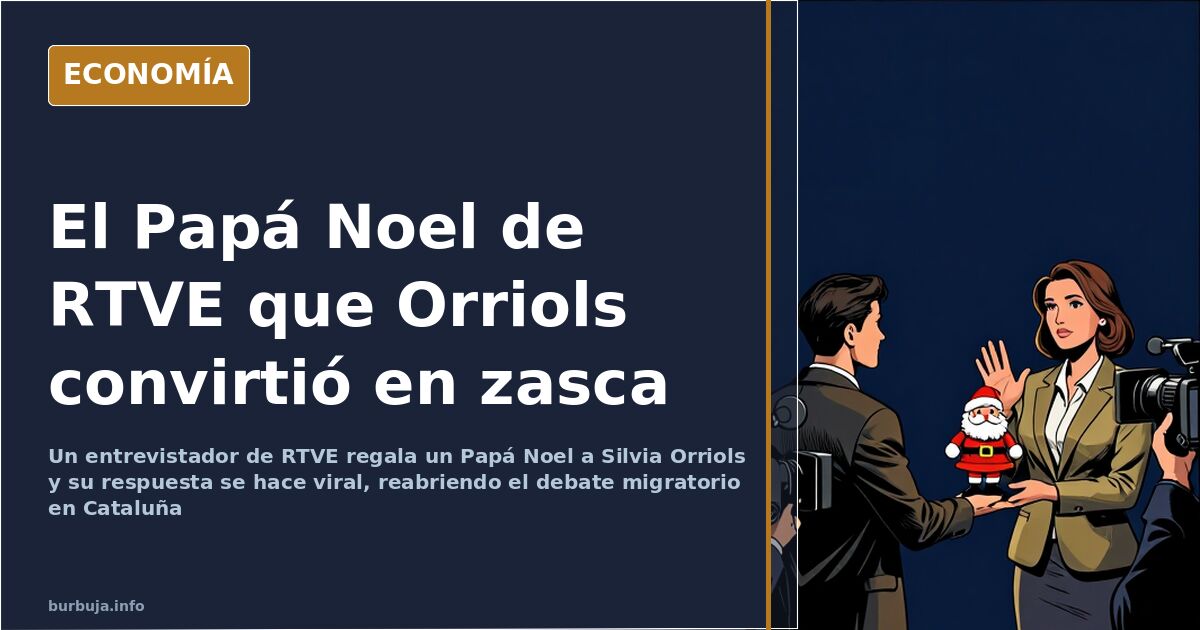
Silvia Orriols turned a gift into a headline. An RTVE interviewer handed her a plastic Santa Claus live on air, and the Catalan leader responded that this visitor has one advantage over other newcomers: when he finishes delivering gifts, he goes back home. The phrase circulated on social media within hours and brought a debate that Catalonia has been grappling with for over a decade back to the forefront.
The scene, filmed with a fixed camera, has all the ingredients of a clip that goes viral on its own: an out-of-place gift, a politician who doesn't offer the obligatory smile, and an interviewer who doesn't anticipate the response. The algorithm did the rest.
What Orriols Exactly Said on Camera
The most repeated account of the interview suggests Orriols hesitated before accepting the figurine. According to this version, she first pointed out that Santa Claus isn't from here and is also an impostor. She eventually accepted it with a second phrase: that at least this character is from abroad, but when his work is done, he returns to his country.
The response acted as a mirror. For some, it's a quick and accurate retort that leaves the interviewer speechless. For others, it's yet another instance of a Christmas gesture being used as a political platform in a news program. The discussion isn't about the figurine, but about what can be said and in what tone on television funded by public money. The clip, meanwhile, does its work on every screen that plays it.
Who is Silvia Orriols: Profile of the Uncomfortable Leader
Orriols is remembered for her time in ERC before breaking with party discipline and forging her own discourse. A librarian by training, a declared Catholic, and a mother of five children, she embodies a profile unusual in Catalan politics: a woman who doesn't fit the amiable script of institutional nationalism.
Her tone, however, has earned her as many supporters as it has generated reservations. Some highlight her quick wit and her lack of complexes when expressing herself. On the other hand, she is described as a lab product, a useful figure to channel discontent without addressing underlying issues. That she is quick is undisputed; what that estimulante ilegal is used for, however, is debated.
The Precedent: Anglada and Plataforma per Catalunya
This isn't the first time the migratory issue has influenced votes in Catalonia. In 2010, Josep Anglada and his Plataforma per Catalunya were already capitalizing on this unease in towns like Vic, while public discourse dismissed them with disdain. The diagnosis made then sounds similar to today's: immigration was ceasing to be a diffuse concern and becoming a voting driver in specific regions.
The difference, some analyses suggest, is the timing. Back then, the issue was perceived as a local anomaly; today, it permeates the entire European political debate. Others argue the change is in style, not substance: the message is the same, but the packaging is more presentable. The age-old question, as old as the phenomenon itself, is how long that packaging will last.
How Many Deputies Orriols Has and What Polls Say
Here are the figures fueling the discussion. Her current representation is counted on one hand: two deputies. Polls in circulation attribute up to twenty to her. The gap between these two numbers explains both the euphoria of some and the haste of others to frame her.
Amidst this, the usual doubts arise. Polls frequently overestimate new parties, and the system has a thousand ways to absorb dissent. A third group goes further, predicting that the leader will eventually moderate her discourse and become just another piece on the board: the anti-establishment force that enters institutions and leaves with its edge dulled. This is the thesis of the repeating cycle, and no one has yet found a way to refute it with data.
Immigration, Language, and Identity: The Unaddressed Background
Beneath the clip lies a more uncomfortable issue. Part of the analysis places the origin of the current unease in 2009, with Girona and Lleida leading, and with the suspicion that certain economic sectors benefited from cheap labor without assuming the social costs. This is a hypothesis put forward without conclusive proof and should be treated as what it is: a hypothesis.
In parallel, the conversation repeatedly drifts towards the linguistic issue, where Catalan politics is measured by surnames and accents. This is the slipperiest terrain of all, and the one that most easily turns any statement into an identity battleground. An almost domestic detail summarizes it: even the Christmas nativity scene has its own version depending on the region.
What Could Happen with Orriols
No one knows yet whether the phenomenon will consolidate or fizzle out. What can be affirmed is that the Santa Claus episode has served for more than just accumulating views: it has put back on the table the question of how far the Catalan political system is willing to go with those who challenge its framework.
If the polls are correct, the next legislature will have an uncomfortable guest with much more voice than the current one. If they are wrong, the anecdote of a plastic figurine and a phrase that will continue to be quoted will remain. In either scenario, the clip has already done its job: almost no one disputes the gift; everyone discusses what was said upon receiving it.
Silvia Orriols turned a gift into a headline. An RTVE interviewer handed her a plastic Santa Claus live on air, and the Catalan leader responded that this visitor has one advantage over other newcomers: when he finishes delivering gifts, he goes back home. The phrase circulated on social media within hours and brought a debate that Catalonia has been grappling with for over a decade back to the forefront.
The scene, filmed with a fixed camera, has all the ingredients of a clip that goes viral on its own: an out-of-place gift, a politician who doesn't offer the obligatory smile, and an interviewer who doesn't anticipate the response. The algorithm did the rest.
What Orriols Exactly Said on Camera
The most repeated account of the interview suggests Orriols hesitated before accepting the figurine. According to this version, she first pointed out that Santa Claus isn't from here and is also an impostor. She eventually accepted it with a second phrase: that at least this character is from abroad, but when his work is done, he returns to his country.
The response acted as a mirror. For some, it's a quick and accurate retort that leaves the interviewer speechless. For others, it's yet another instance of a Christmas gesture being used as a political platform in a news program. The discussion isn't about the figurine, but about what can be said and in what tone on television funded by public money. The clip, meanwhile, does its work on every screen that plays it.
Who is Silvia Orriols: Profile of the Uncomfortable Leader
Orriols is remembered for her time in ERC before breaking with party discipline and forging her own discourse. A librarian by training, a declared Catholic, and a mother of five children, she embodies a profile unusual in Catalan politics: a woman who doesn't fit the amiable script of institutional nationalism.
Her tone, however, has earned her as many supporters as it has generated reservations. Some highlight her quick wit and her lack of complexes when expressing herself. On the other hand, she is described as a lab product, a useful figure to channel discontent without addressing underlying issues. That she is quick is undisputed; what that estimulante ilegal is used for, however, is debated.
The Precedent: Anglada and Plataforma per Catalunya
This isn't the first time the migratory issue has influenced votes in Catalonia. In 2010, Josep Anglada and his Plataforma per Catalunya were already capitalizing on this unease in towns like Vic, while public discourse dismissed them with disdain. The diagnosis made then sounds similar to today's: immigration was ceasing to be a diffuse concern and becoming a voting driver in specific regions.
The difference, some analyses suggest, is the timing. Back then, the issue was perceived as a local anomaly; today, it permeates the entire European political debate. Others argue the change is in style, not substance: the message is the same, but the packaging is more presentable. The age-old question, as old as the phenomenon itself, is how long that packaging will last.
How Many Deputies Orriols Has and What Polls Say
Here are the figures fueling the discussion. Her current representation is counted on one hand: two deputies. Polls in circulation attribute up to twenty to her. The gap between these two numbers explains both the euphoria of some and the haste of others to frame her.
Amidst this, the usual doubts arise. Polls frequently overestimate new parties, and the system has a thousand ways to absorb dissent. A third group goes further, predicting that the leader will eventually moderate her discourse and become just another piece on the board: the anti-establishment force that enters institutions and leaves with its edge dulled. This is the thesis of the repeating cycle, and no one has yet found a way to refute it with data.
Immigration, Language, and Identity: The Unaddressed Background
Beneath the clip lies a more uncomfortable issue. Part of the analysis places the origin of the current unease in 2009, with Girona and Lleida leading, and with the suspicion that certain economic sectors benefited from cheap labor without assuming the social costs. This is a hypothesis put forward without conclusive proof and should be treated as what it is: a hypothesis.
In parallel, the conversation repeatedly drifts towards the linguistic issue, where Catalan politics is measured by surnames and accents. This is the slipperiest terrain of all, and the one that most easily turns any statement into an identity battleground. An almost domestic detail summarizes it: even the Christmas nativity scene has its own version depending on the region.
What Could Happen with Orriols
No one knows yet whether the phenomenon will consolidate or fizzle out. What can be affirmed is that the Santa Claus episode has served for more than just accumulating views: it has put back on the table the question of how far the Catalan political system is willing to go with those who challenge its framework.
If the polls are correct, the next legislature will have an uncomfortable guest with much more voice than the current one. If they are wrong, the anecdote of a plastic figurine and a phrase that will continue to be quoted will remain. In either scenario, the clip has already done its job: almost no one disputes the gift; everyone discusses what was said upon receiving it.
Summary of a discussion on Burbuja.info - Foro de economía, actualidad y política., translated from Spanish and reviewed before publication. Read the full discussion (229 replies).
More summaries
-
Orriols: "If you don't want a third world, don't import one."
Sílvia Orriols argues that insecurity compels people to change routines due to fear, condensing her migration discourse into the phrase: "don't import a third world."
-
Córdoba Father Self-Immolates: Mental Illness or Societal Despair?
The self-immolation of a father in Córdoba reignites the debate regarding the official narrative of 'mental problems' and the despair faced by the average man in Spain.
-
Euthanasia in Old Age: Autonomy vs. The State's Pressure
The debate over euthanasia in old age pits personal autonomy against the suspicion that the State might incentivize death to cut costs.
-
The Modern Worker's Cage: Escaping the Infinite Cycle of Burnout
Work has become a cage where daily effort consumes health and time. Discover why we push ourselves so hard and how to break the cycle.
-
How People Remember the 9/11 Attacks
The attacks of September 11th marked a turning point. Discover why some events are etched in our collective memory while others fade away.
-
Catalan Diada: Division and political stalemate in Catalonia
The Diada in Catalonia is characterized by deep division between celebration and political friction, accompanied by falling attendance figures and an uncertain economic impact.