
Orriols opens door to split ticket: regional vote for her, general election for VOX
Debate material shows Orriols telling her voters they may back VOX in Spain's general election, insisting the dual vote is "not contradictory".
English · Original discussion in Spanish · Published
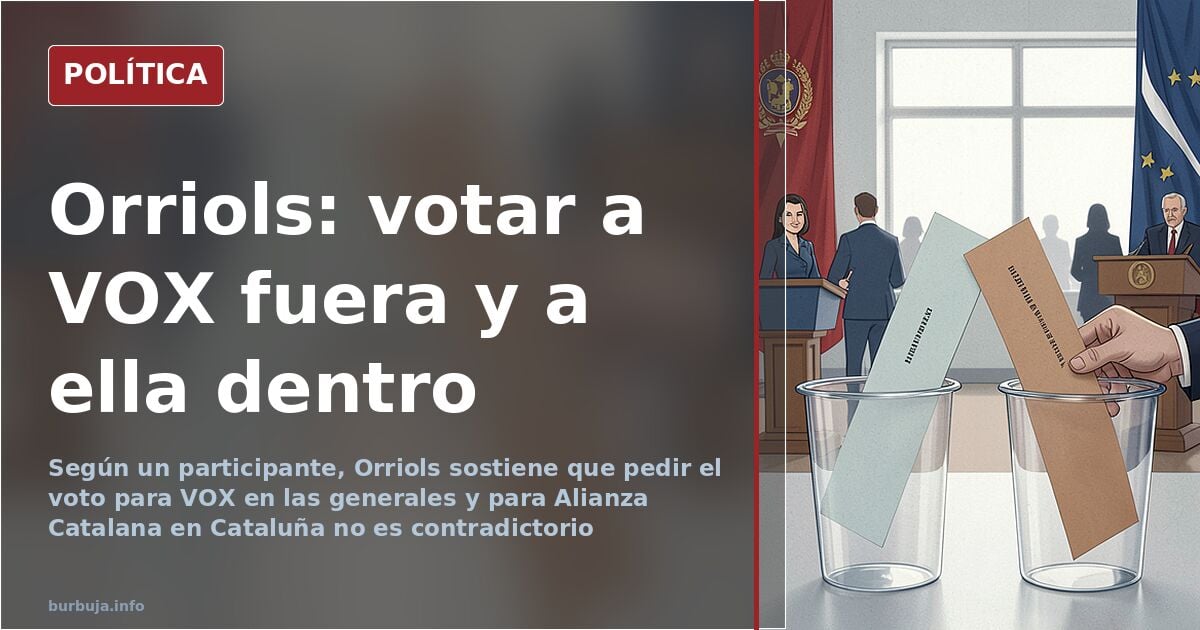
Orriols opens the door to voting VOX in the general election without giving up her own ballot
According to debate material, Orriols has authorised her voters to back VOX in Spain's general election and defended that the double ballot is "not contradictory". The statement, which in Spanish politics sounds like heresy, has an internal logic that Catalan independence parties have practised for years without embarrassment: their own party for the Parliament of Catalonia, tactical alliances for Madrid. The difference is that here coherence is sold as a virtue rather than treason.
The gesture has gone down well even among those at the ideological opposite end from Ms Orriols. "It makes complete sense", sums up a current of opinion that sees the decision as an exercise in realism: if my enemy's enemy can be my ally, electoral arithmetic rules. Others read it as the latest episode in the alphabet soup we call the party system.
The double ballot and the precedent nobody cites
Orriols' authorisation invents nothing. In 1978, a group of national-socialist ideology called for a vote for the PSOE with an argument that would make more than one activist shudder today: "before being national, we are socialists". The anecdote, rescued in the conversation, serves as a reminder that marriages of electoral convenience have half a century of history in Spain. Ideological purity, in practice, is negotiated at every election.
Some argue that Orriols' move reflects a very specific reading of the board: at national level a party that does not fill the country with migrants is preferable, while in Catalonia the priority is different. The thesis is debatable, but rests on the idea that the Generalitat (Catalonia's regional government) does not control borders and that, therefore, the regional vote should reward whoever promises to manage what it can.
What the dual vote gains and what it risks
The calculation has two sides. The first is coherence: not standing in the general election and ceding the space to VOX avoids splitting the vote and reinforces the narrative that her project is strictly Catalan. The second is the risk: whoever splits their loyalty between two ballots may end up with neither. Spanish electoral history is full of transfers that began as loans and ended as absorption.
On the economic front, the debate drifts towards the model of public spending. Against the criticism that Spain's autonomous regions compete to attract population with benefits, the reply is that the phenomenon is a form of welfare tourism that distorts the allocation of resources. There are no firm figures in the conversation, but the argument circulates with the ease of someone who takes it as self-evident.
The CEDADE precedent and the memory of the impossible pact
The historical curiosity deserves a section of its own. That a Nancy-ideology group called for a vote for the PSOE in 1978 shows that Spanish politics has always tolerated alliances that ideological logic rejects. The question is whether that was an isolated case or the unwritten norm of the system. The uncomfortable answer: the latter.
With all this, Orriols' authorisation looks less like an anomaly and more like a confession. The dual vote is not a contradiction: it is how small parties survive in a system that rewards concentration. The prediction, with reservations, is that the formula will spread. If it works, others will copy it. If not, it will remain a footnote in the history of party acronyms.
Also available in: Deutsch
Summary of a discussion on Burbuja.info - Foro de economía, actualidad y política., translated from Spanish and reviewed before publication. Read the full discussion (40 replies).
More summaries
-
Tactical voting for Spain's PP to keep VOX out of power
A call is urging left-wing voters in Spain to back the PP to prevent a government with VOX. The tactical voting debate is dividing the left and leaves a dilemma unresolved.
-
Puigdemont's wig: accident or political strategy?
Analysis of Puigdemont's wig: examining the 1983 accident data and the polarization of political debate.
-
Albares under scrutiny over EU funds to partner's firm
Spain's government awarded 22 million in EU funds to a company co-managed by the foreign minister's partner, THE OBJECTIVE reports. What is known and why it matters.
-
Bilbao riots with pro-ETA chants as Basque police stand by
Riots broke out in Bilbao, Spain, with chants of support for ETA and claims that the Ertzaintza, the Basque police force, was ordered not to intervene. The event that sparked the protest had been…
-
Jordi Wild posted this a few years back
Streamer Jordi Wild published a satirical tweet about the Catalan independence process. We look at what it says, what context it reflects and why it keeps being shared.
-
Viral 'panchizal' slur targets Mutua doctor in Spain
A viral message uses 'panchizal' to describe a doctor at a Spanish Mutua. The word is not a diagnosis or a job category: it is a slur. Here is what lies behind it.