
Orange pickers in Spain earn under €2/hour, sleeping under bridges
Seasonal orange workers in Valencia earn less than €2 an hour and sleep under the Turia bridge due to piece-rate pay and lack of housing.
English · Original discussion in Spanish · Published
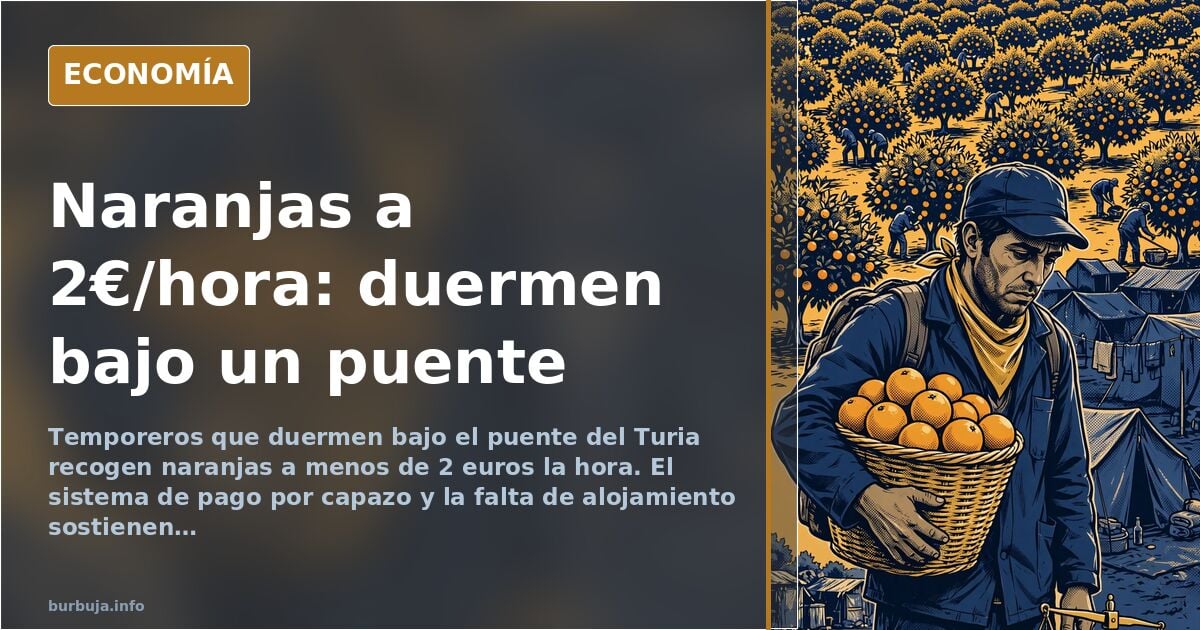
Oranges for €2 an hour: A bridge as a roof in Valencia
The Valencia orange business rests on a paradox no one wants to face: the season demands labor that fits nowhere in shelters and is paid by the crate, not by the hour. Rahal is 22 and sleeps under one of the Turia river bridges. He works picking oranges. "This week I worked from 6 a.m. to 5 p.m. We are paid for 20 kg crates. Yesterday I got about €20," he says. That comes out to less than two euros an hour. And it is not an isolated case: an estimated 300 seasonal workers live in this situation in the city.
The orange season drags day laborers from Logroño or Zaragoza to Valencia every year. Mohamed, with a refugee card, explains it without drama: "In Logroño and Zaragoza I sleep in a shelter or a room, but in Valencia there is no way to rent anything." The problem is not just the wage. It is the whole chain: nine euros for the van alucinación, paying for scissors and work materials upfront, and getting paid by the crate with the uncertainty of whether the intermediary will pay or disappear. Nieves Alonso, a volunteer with Amigos de la Calle (Friends of the Street), sums it up: "Many times they leave them and decide not to pay them or to pay them half."
How much do you really get paid for picking oranges?
The system is piecework. You are paid per 20-kilo crate, not per shift. This means income depends on each crew's estimulante ilegal and the payer's generosity. With €20 for a day starting at 6 a.m. and ending at 5 p.m., the result is less than two euros an hour. A figure that would be illegal under any sector agreement, but which in practice dissolves because the worker has no contract, no payslip, and no way to claim.
Some argue that the ultimate responsibility lies not with the orchard owner, but with the cooperative exporting the product or the agricultural services company subcontracting the crews. The argument is that the owner pays for the full service and is not responsible for what their contractor does. Against this weighs an uncomfortable detail: the final price of a kilo of oranges in stores does not reflect this wage misery. Someone captures the margin, and it is not the one carrying the crates.
Housing: From truck beds to the Turia bridge
Housing is the other major bottleneck. In Valencia, room rents have skyrocketed, and seasonal workers compete with tourists and residents for non-existent stock. The result are makeshift camps under bridges, in caravans, and in overcrowded flats. Part of the analysis points to the fact that the sector's own seasonality prevents any stable housing solution: if the season lasts weeks, no one signs a lease.
Comparison with other agricultural campaigns is inevitable. In Andalusian or Extremaduran fields, the pattern repeats: piecework contracts, informal accommodation, and labor inspections that arrive late or never. The Valencian difference is urban concentration: seasonal workers sleep inside the city, in plain sight, not in a remote farmhouse.
Why isn't irregular immigration stopped if there is work?
The short answer is that work exists, but not under conditions a resident would accept. Supply and demand law would do the rest if the migration tap were closed: less available labor, rising wages. The problem is that no one wants that adjustment. Low wages guarantee the product remains competitive in international markets.
Against this thesis, another current argues that the problem is not an abundance of workers, but the absence of effective inspection. Without control, any sector becomes a no-man's-land. And with control, costs rise. The tension between both positions runs through the entire issue unresolved.
Inspection that doesn't arrive and a narrative that doesn't fit
Inspection data is scarce and fragmented. Cases of workers without contracts have been detected in agricultural holdings, with business managers investigated. But the magnitude of the phenomenon overwhelms any specific operation. The underground economy in the countryside is not an accident: it is a model.
Meanwhile, the official narrative insists there is work for anyone who wants to work. The phrase works in talk shows, not under a Turia bridge at six in the morning. Because the problem is not a lack of offers, but the quality of those that exist.
The orange season will continue to function the same way unless someone touches the piece-rate payment system or the chain of subcontracting. With these disparities, it is not strange that there are 300 people under a bridge: it is strange that anyone is surprised.
The Valencia orange business rests on a paradox no one wants to face: the season demands labor that fits nowhere in shelters and is paid by the crate, not by the hour. Rahal is 22 and sleeps under one of the Turia river bridges. He works picking oranges. "This week I worked from 6 a.m. to 5 p.m. We are paid for 20 kg crates. Yesterday I got about €20," he says. That comes out to less than two euros an hour. And it is not an isolated case: an estimated 300 seasonal workers live in this situation in the city.
The orange season drags day laborers from Logroño or Zaragoza to Valencia every year. Mohamed, with a refugee card, explains it without drama: "In Logroño and Zaragoza I sleep in a shelter or a room, but in Valencia there is no way to rent anything." The problem is not just the wage. It is the whole chain: nine euros for the van alucinación, paying for scissors and work materials upfront, and getting paid by the crate with the uncertainty of whether the intermediary will pay or disappear. Nieves Alonso, a volunteer with Amigos de la Calle (Friends of the Street), sums it up: "Many times they leave them and decide not to pay them or to pay them half."
How much do you really get paid for picking oranges?
The system is piecework. You are paid per 20-kilo crate, not per shift. This means income depends on each crew's estimulante ilegal and the payer's generosity. With €20 for a day starting at 6 a.m. and ending at 5 p.m., the result is less than two euros an hour. A figure that would be illegal under any sector agreement, but which in practice dissolves because the worker has no contract, no payslip, and no way to claim.
Some argue that the ultimate responsibility lies not with the orchard owner, but with the cooperative exporting the product or the agricultural services company subcontracting the crews. The argument is that the owner pays for the full service and is not responsible for what their contractor does. Against this weighs an uncomfortable detail: the final price of a kilo of oranges in stores does not reflect this wage misery. Someone captures the margin, and it is not the one carrying the crates.
Housing: From truck beds to the Turia bridge
Housing is the other major bottleneck. In Valencia, room rents have skyrocketed, and seasonal workers compete with tourists and residents for non-existent stock. The result are makeshift camps under bridges, in caravans, and in overcrowded flats. Part of the analysis points to the fact that the sector's own seasonality prevents any stable housing solution: if the season lasts weeks, no one signs a lease.
Comparison with other agricultural campaigns is inevitable. In Andalusian or Extremaduran fields, the pattern repeats: piecework contracts, informal accommodation, and labor inspections that arrive late or never. The Valencian difference is urban concentration: seasonal workers sleep inside the city, in plain sight, not in a remote farmhouse.
Why isn't irregular immigration stopped if there is work?
The short answer is that work exists, but not under conditions a resident would accept. Supply and demand law would do the rest if the migration tap were closed: less available labor, rising wages. The problem is that no one wants that adjustment. Low wages guarantee the product remains competitive in international markets.
Against this thesis, another current argues that the problem is not an abundance of workers, but the absence of effective inspection. Without control, any sector becomes a no-man's-land. And with control, costs rise. The tension between both positions runs through the entire issue unresolved.
Inspection that doesn't arrive and a narrative that doesn't fit
Inspection data is scarce and fragmented. Cases of workers without contracts have been detected in agricultural holdings, with business managers investigated. But the magnitude of the phenomenon overwhelms any specific operation. The underground economy in the countryside is not an accident: it is a model.
Meanwhile, the official narrative insists there is work for anyone who wants to work. The phrase works in talk shows, not under a Turia bridge at six in the morning. Because the problem is not a lack of offers, but the quality of those that exist.
The orange season will continue to function the same way unless someone touches the piece-rate payment system or the chain of subcontracting. With these disparities, it is not strange that there are 300 people under a bridge: it is strange that anyone is surprised.
Also available in: Deutsch
Summary of a discussion on Burbuja.info - Foro de economía, actualidad y política., translated from Spanish and reviewed before publication. Read the full discussion (196 replies).
More summaries
-
Valencia elections on 29N if Sánchez calls snap general election
The PP's national leadership is considering moving the Valencian regional election to coincide with the general election, according to an electoral data publication.
-
Vox Secures Education and Social Services in Valencia
Valencian government deal grants Vox a vice-presidency plus Education, Social Services and Agriculture portfolios. Language policy in schools is key.
-
Vox secures Education and Agriculture portfolios in Valencia
Vox gains control of Education and Agriculture in the Valencian Community with 12% of the vote, pushing for Spanish-language schooling and school vouchers.
-
Spain's ERE layoff wave nobody wants to see
Analysis of the wave of layoffs and ERE in Spain. Burbuja.info forum users expose the industrial reality the media won't show.
-
Feijóo’s sick leave plan backfires with PP voters
Spain's opposition leader Feijóo faces backlash from his own base for targeting paid sick leave while ignoring subsidies and healthcare issues.
-
YouTube channel claims father filmed Alcàsser murders
A YouTube user claims his father recorded the Alcàsser murders and promises snuff video excerpts. No evidence provided, only narrative and technical analysis.