
Only 14.8% of under-30s in Spain live independently
Only 14.8% of young Spaniards live independently before 30. The 'boomerang generation' returns home to save for a deposit
English · Original discussion in Spanish · Published
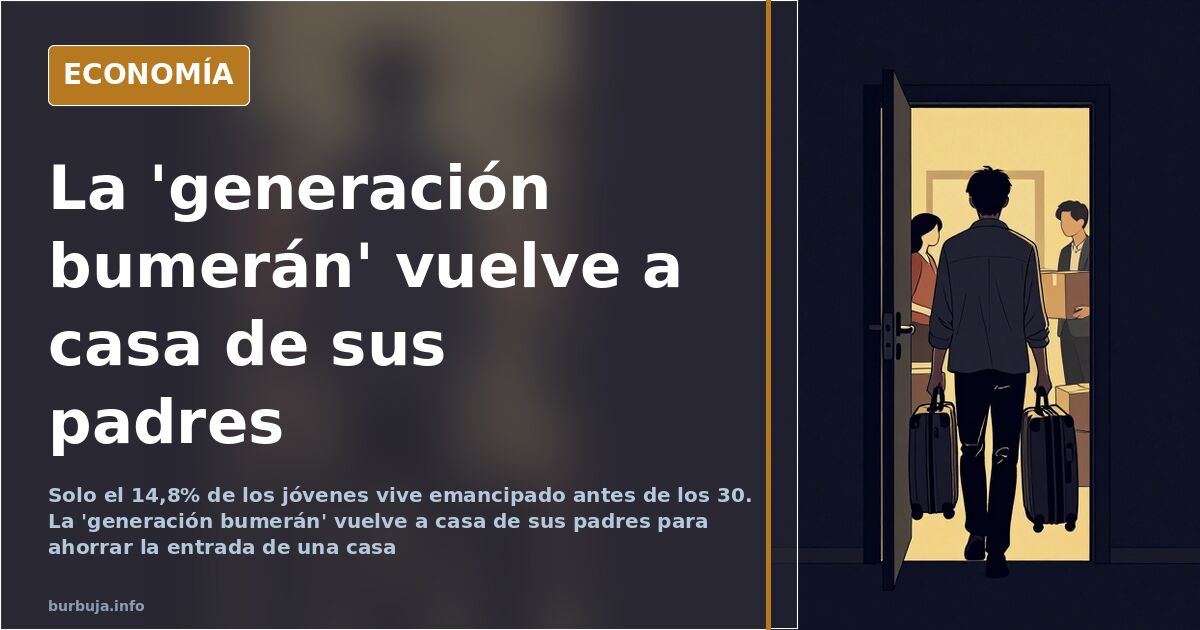
Only 14.8% of under-30s manage to live independently
Spain is facing the lowest rate of young people living independently in its history, and the figure has a date: mid-January 2025, when the Consejo de la Juventud de España presented its study and put the 14.8% of young people living independently before age 30. The diagnosis points to a mismatch as simple to state as it is hard to endure: rental prices and wages have not looked each other in the face for years. Everything else is consequences, including that return to parents' homes that US sociologists dubbed the boomerang generation during the 2008 crisis and that is now reviving strongly in Spain.
Who is moving back into the family home?
The pattern repeats between ages 24 and 39, with jobs and higher education, and in different cities: Madrid, Barcelona, Seville and Bilbao. Adela Domínguez, 26, told it in a letter to a newspaper's editor that oozed helplessness. She and her partner were returning to their parents' homes after three years surviving the rent on a 50-square-metre ground-floor flat in Madrid. “The accusing finger always points at my generation, but nobody thinks about why we don't marry, why we don't buy a home, why we don't have children,” she wrote.
The profiles are not those of extreme precariousness. There are lawyers, journalists and administrative staff. Valentina, a 27-year-old journalist, moved back a little over a year ago: she had left home at 23 with a partner, the relationship ended and she found that living alone was unsustainable. She was being asked no less than 900 euros a month for a studio in Madrid, and 500 or more for a room in a shared flat. Juan, a 29-year-old hairdresser and styling teacher, took the reverse path in 2023: he left a room on the outskirts of Seville for 390 euros a month and returned to Los Remedios, to his parents' home, to prepare for civil service exams for a tax technician post. His phrase sums up the mood: “Living in the city has become a luxury.”
How much does it cost to save a home deposit?
The strategy is always the same: stay in the family home as long as possible to build up the down payment. Valentina saves about 500 euros a month and calculates she will need 30,000 euros for the deposit. Juan is aiming for 20,000, contributing to his mother for household expenses, keeping part for himself and putting the rest into a savings account. The destination is no longer the capital: he accepts buying in a village near Seville, where clients of the salon where he works have moved.
The nuance matters. Returning to the family home is not a whim or a convenience, it is a multi-year financial move. And it has emotional fine print: at those ages, independence is experienced as a status marker, and going backwards is hard to swallow.
The rent that costs more than a mortgage
Urban sociologist Carlos Rivas, a professor at the Universidad Complutense de Madrid, describes this generation as suffocated by the rental crisis. His central thesis is uncomfortable: young people have done their part by training, but their wages are pitiful compared with rent and with the guarantees and deposits landlords demand. “There is a paradox that in many cases you end up paying more to rent a home than you would pay if you took out a mortgage,” he argues.
Rivas goes beyond price. He notes that displacement no longer affects only families in precarious situations: it is also suffered by young people who share a flat when the landlord suddenly raises the rent or asks them to leave. On the solution he is blunt: effort and determination from the authorities are needed, along with emergency measures, not cosmetic ones. Social housing, he recalls, accounts for only 2.5% of the stock, which pushes everyone into the free market.
The causes: from the official diagnosis to the dispute
Here consensus breaks down. One current places the problem in structure: lack of rental supply, shortage of social housing and excess tourist housing straining the market in large cities. Another puts the emphasis on demographic pressure on a rigid housing stock. And some argue that the problem is one of priorities, not prices, and that the current generation spends on consumption and leisure what their parents devoted to a flat deposit.
The debate over expectations also appears. It is recalled that in the 1970s and 1980s one salary supported a family, and the response is that even then a couple was needed to live independently and that protected housing arrived late and badly. And inheritance hangs over it: some take it for granted that the real plan is not to buy but to inherit, something that breaks down when there are siblings or the parents do not own property.
A separate case is that of those who sign very long mortgages. An example circulates: a man who took out a 40-year mortgage, had a child, divorced after five years and today lives with his parents again while paying half the mortgage on a house he cannot live in. The liability without the asset.
Where the analysis gets stuck
With these ingredients, the reasonable conclusion would be a price correction or a public housing stock up to the scale of the problem; neither is happening at the pace demanded by the life timetable of someone who is 29. One can argue whether the culprit is wages, bricks or inheritance, but the result is identical in every case: living independently is delayed a year, and another, and another. That is where the analysis stops.
Spain is facing the lowest rate of young people living independently in its history, and the figure has a date: mid-January 2025, when the Consejo de la Juventud de España presented its study and put the 14.8% of young people living independently before age 30. The diagnosis points to a mismatch as simple to state as it is hard to endure: rental prices and wages have not looked each other in the face for years. Everything else is consequences, including that return to parents' homes that US sociologists dubbed the boomerang generation during the 2008 crisis and that is now reviving strongly in Spain.
Who is moving back into the family home?
The pattern repeats between ages 24 and 39, with jobs and higher education, and in different cities: Madrid, Barcelona, Seville and Bilbao. Adela Domínguez, 26, told it in a letter to a newspaper's editor that oozed helplessness. She and her partner were returning to their parents' homes after three years surviving the rent on a 50-square-metre ground-floor flat in Madrid. “The accusing finger always points at my generation, but nobody thinks about why we don't marry, why we don't buy a home, why we don't have children,” she wrote.
The profiles are not those of extreme precariousness. There are lawyers, journalists and administrative staff. Valentina, a 27-year-old journalist, moved back a little over a year ago: she had left home at 23 with a partner, the relationship ended and she found that living alone was unsustainable. She was being asked no less than 900 euros a month for a studio in Madrid, and 500 or more for a room in a shared flat. Juan, a 29-year-old hairdresser and styling teacher, took the reverse path in 2023: he left a room on the outskirts of Seville for 390 euros a month and returned to Los Remedios, to his parents' home, to prepare for civil service exams for a tax technician post. His phrase sums up the mood: “Living in the city has become a luxury.”
How much does it cost to save a home deposit?
The strategy is always the same: stay in the family home as long as possible to build up the down payment. Valentina saves about 500 euros a month and calculates she will need 30,000 euros for the deposit. Juan is aiming for 20,000, contributing to his mother for household expenses, keeping part for himself and putting the rest into a savings account. The destination is no longer the capital: he accepts buying in a village near Seville, where clients of the salon where he works have moved.
The nuance matters. Returning to the family home is not a whim or a convenience, it is a multi-year financial move. And it has emotional fine print: at those ages, independence is experienced as a status marker, and going backwards is hard to swallow.
The rent that costs more than a mortgage
Urban sociologist Carlos Rivas, a professor at the Universidad Complutense de Madrid, describes this generation as suffocated by the rental crisis. His central thesis is uncomfortable: young people have done their part by training, but their wages are pitiful compared with rent and with the guarantees and deposits landlords demand. “There is a paradox that in many cases you end up paying more to rent a home than you would pay if you took out a mortgage,” he argues.
Rivas goes beyond price. He notes that displacement no longer affects only families in precarious situations: it is also suffered by young people who share a flat when the landlord suddenly raises the rent or asks them to leave. On the solution he is blunt: effort and determination from the authorities are needed, along with emergency measures, not cosmetic ones. Social housing, he recalls, accounts for only 2.5% of the stock, which pushes everyone into the free market.
The causes: from the official diagnosis to the dispute
Here consensus breaks down. One current places the problem in structure: lack of rental supply, shortage of social housing and excess tourist housing straining the market in large cities. Another puts the emphasis on demographic pressure on a rigid housing stock. And some argue that the problem is one of priorities, not prices, and that the current generation spends on consumption and leisure what their parents devoted to a flat deposit.
The debate over expectations also appears. It is recalled that in the 1970s and 1980s one salary supported a family, and the response is that even then a couple was needed to live independently and that protected housing arrived late and badly. And inheritance hangs over it: some take it for granted that the real plan is not to buy but to inherit, something that breaks down when there are siblings or the parents do not own property.
A separate case is that of those who sign very long mortgages. An example circulates: a man who took out a 40-year mortgage, had a child, divorced after five years and today lives with his parents again while paying half the mortgage on a house he cannot live in. The liability without the asset.
Where the analysis gets stuck
With these ingredients, the reasonable conclusion would be a price correction or a public housing stock up to the scale of the problem; neither is happening at the pace demanded by the life timetable of someone who is 29. One can argue whether the culprit is wages, bricks or inheritance, but the result is identical in every case: living independently is delayed a year, and another, and another. That is where the analysis stops.
Summary of a discussion on Burbuja.info - Foro de economía, actualidad y política., translated from Spanish and reviewed before publication. Read the full discussion (230 replies).
More summaries
-
Euthanasia in Old Age: Autonomy vs. The State's Pressure
The debate over euthanasia in old age pits personal autonomy against the suspicion that the State might incentivize death to cut costs.
-
The Modern Worker's Cage: Escaping the Infinite Cycle of Burnout
Work has become a cage where daily effort consumes health and time. Discover why we push ourselves so hard and how to break the cycle.
-
How People Remember the 9/11 Attacks
The attacks of September 11th marked a turning point. Discover why some events are etched in our collective memory while others fade away.
-
Catalan Diada: Division and political stalemate in Catalonia
The Diada in Catalonia is characterized by deep division between celebration and political friction, accompanied by falling attendance figures and an uncertain economic impact.
-
Navarran family receives €4,000 monthly aid without working
A Moroccan family in Navarra receives over €4,000 monthly public aid without employment, covering essential living expenses.
-
Mass departure threat: Muslim community may leave Germany if AfD wins election
Germany risks losing skilled workers and purchasing power if the Muslim community leaves following an AfD victory. We analyze the economic implications.