
Online Forum Debates: Does 'Todo Bien?' Replace 'How Are You?'
Online forum users debate whether the greeting 'Todo bien?' is replacing '¿Qué tal?' in popular speech, amid loanwords, anglicisms, and linguistic change.
English · Original discussion in Spanish · Published
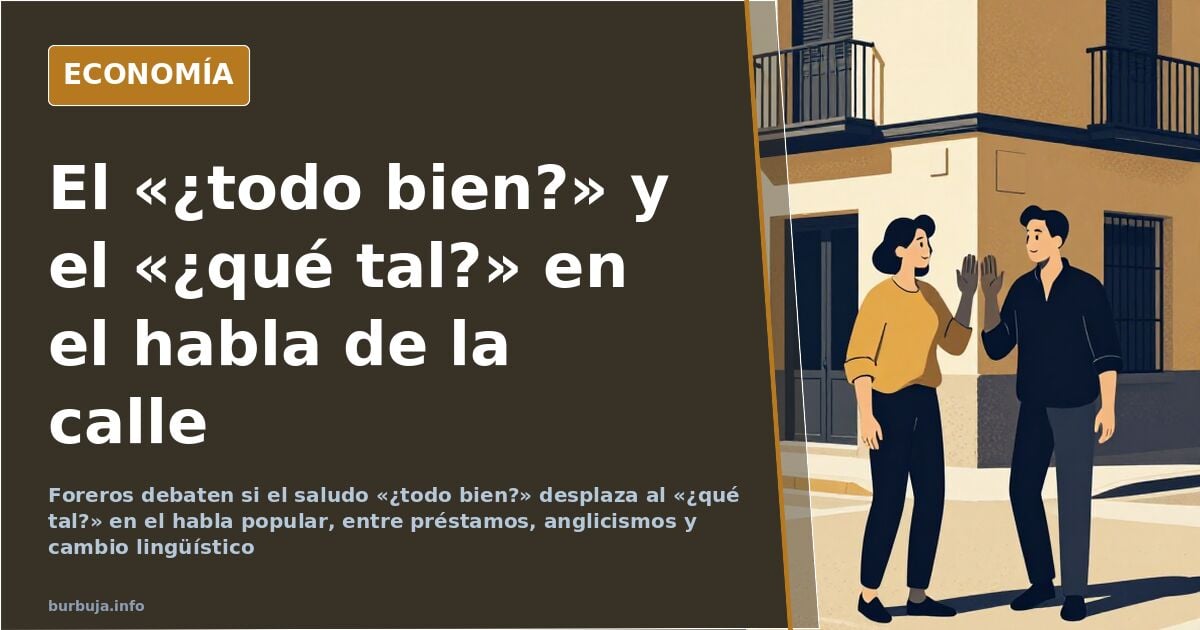
The 'Todo Bien?' vs. 'How Are You?' debate in popular speech
A two-word greeting has sparked a fierce divide. According to several participants, '¿todo bien?' has taken root in street slang, causing '¿qué tal?' to recede, turning a minor anecdote into a major point of contention. The initial diagnosis suggests a formula attributed to Latin American immigration has entered the vernacular; from there, the exchange splits between those who see an invasion and those who see a simple improvement in the language. The thread has plenty to offer, and it is not all about language: a portion of the messages devolves into direct attacks on migrants, a terrain excluded from this analysis.
Why say 'Todo Bien?' instead of 'How Are You?'?
Because the answer is immediate and honest. 'Todo bien' is a closed formula: the question arrives, the same two words are returned, and the matter is settled. '¿Qué tal?' demands something else, which is the core of the issue: it is an empty courtesy no one expects to be answered truthfully. Some dismiss it directly as useless and hypocritical courtesy. Anyone attempting to answer '¿qué tal?' honestly finds within seconds that their interlocutor cares little. Hence, the short formula has gained strength: it is faster, less annoying, and obliges no one to pretend.
Is 'Todo Bien?' a Latin American expression?
Here the map complicates. One current argues the formula is not the exclusive property of any region and is heard outside the Hispanic sphere: one participant notes that in Dutch there is an equivalent 'Alles goed,' while another claims it is also used in Brazil. Opposing this, another line maintains its circulation is limited to certain zones. The final blow comes from someone claiming to be from Mexico: there, they assure, it is not used. That is, the greeting attributed to Latin American immigration might not even be the most common in much of the region to which it is attributed. For those maintaining this, the label does not fit the reality of the language, and this mismatch explains much of the noise.
The 'Have a Nice Day' and 'Que Tenga un Lindo Día'
A list of irritating idioms does not come from across the Atlantic, but from English. A voice in the debate points out: much of these turns are calques and poor translations from US English. In this line, '¿todo bien?' is equated with 'all right' and 'que tenga un lindo día' with 'have a nice day'. The abbreviated 'buen día' has eaten the classic 'buenos días'—a formula that, it is recalled, was not used here—and even a 'propicios días' appears as an even more eccentric variant. The Anglo-Saxon repertoire of automatic courtesies, with its 'how are you?' and 'are you all right?', functions equally empty and no one sees it as a drama. The complaint about the loanword is old; what is new is where it comes from.
The Seseo Stuck to Music
There is also a sonic chapter. One participant argues that the influence of reggaeton, trap, and Latin electronic music has pushed some to adopt a seseo intonation that does not respond to their origin. The same participant observes it with sarcasm: even those speaking with the accent of an affluent neighborhood end up regressing their Castilian at the microphone.
'¿Qué Onda?', 'No Mames Guey' and Other Loanwords
The exchange works in both directions, and the list of formulas each attributes to an origin fills paragraphs: '¿qué onda?', 'no mames guey', 'vale progenitora', 'órale carnal', 'che', 'vos sabés', 'weón'. There are also home variants: a 'qiubo raza' defended for brevity, a 'qué és lo que es' written with that spelling, and a shortened greeting someone says they have used since they were in the Canary Islands. Permeability varies by neighborhood, and each speaker chooses which loanword sounds elegant and which causes them secondhand embarrassment. A prediction even circulates: the opening question mark will eventually disappear, because almost no one writes it at the beginning of a 'qué onda' anymore.
A Language of Two-Way Traffic
The most repeated argument by those who see no drama is that Castilian has always been a language of assimilation, permeable and alive, incorporating loanwords from around the world without ceasing to be what it is. It is even said to be 'a two-way language, rich for its capacity for assimilation.' The diagnosis does not settle the dispute. What underlies the clash is not grammar, but status: who speaks, how they sound, and where they come from. The discrepancy is visceral. And with both positions planted, the question remains in the air: if the language has been devouring foreign loanwords for centuries, why does this specific one sting more than the previous ones?
Also available in: Deutsch
Summary of a discussion on Burbuja.info - Foro de economía, actualidad y política., translated from Spanish and reviewed before publication. Read the full discussion (210 replies).
More summaries
-
Juan Carlos Monedero Leaves Spain Amidst 22 Legal Cases
Podemos co-founder Juan Carlos Monedero announces his move to Latin America, facing 22 pending trials for alleged money laundering and harassment.
-
Seasonal Migration and Financial Returns in Spain's Service Sector
Analysis of the economic dynamics behind seasonal encounters between Latin American migrants and Spanish buyers during summer.
-
La Séptima launches schedule led by Santaolalla
La Séptima debuts with Sarah Santaolalla hosting from 5 to 8 PM and a lineup focused almost entirely on political debate.
-
Spain's PSOE faces internal strife amid vote fragmentation
Internal conflict within Spain's ruling party and fragmented opposition votes complicate constitutional reform efforts.
-
New ride-sharing site aids Spanish voters for Nov 29 election
Rumbo 29N connects drivers and passengers to travel to vote on November 29. Posting is free; passengers pay a one-euro management fee.
-
Spain's Supreme Court Upholds Voting Rights for Descendants of Naturalized Citizens
The Spanish Supreme Court denied suspending voting rights for approximately 190,000 children of those naturalized under the 'Grandchildren Law' ahead of the November 29 elections.