
One hour before the nuke: flee, pray or wait with champagne
A nuclear warning with one hour's notice reveals that almost nobody has a plan: fleeing, sheltering underground or popping a champagne cork are the most common responses.
English · Original discussion in Spanish · Published
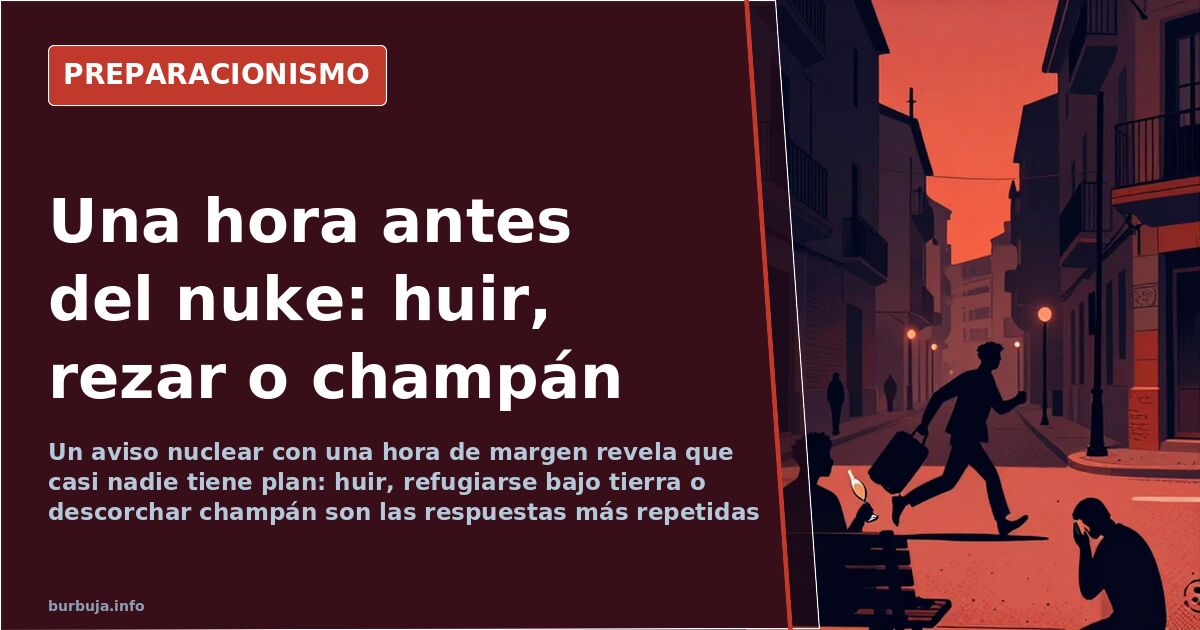
One hour before the nuke: flee, pray or pop the champagne
What would you do if you had one hour left to live? The question, posed as a hypothetical scenario of a nuclear attack on Spain, has an answer almost nobody gives: think. Most people improvise. Some calculate escape routes, others open the wine cellar, and a few simply sit down to wait for the mushroom cloud with a glass in hand. The result is an unintentional portrait of how people react when the horizon is measured in minutes: there is no plan, only instinct.
The starting assumption is simple: a warning, sixty minutes and an atomic bomb aimed near home. The first reaction for most is to flee, though almost nobody explains where to. Leaving the country sounds good until someone points out that millions of people would have the same idea and the roads, trains and planes would collapse within minutes. The paradox is perfect: your last hour of life could be spent entirely in a traffic jam on the A-2.
Can you escape a nuclear explosion in one hour?
The short answer is that it depends on where it lands and where you are. Distance matters more than estimulante ilegal. Anyone living in a coastal city who knows how to sail has it relatively easy: take a boat and head out to sea. Anyone living inland without a motorbike, less so. The idea that one hour is enough to get out of the blast radius only works if the impact point is far away and the infrastructure hasn't become saturated, something that in a real scenario would happen within minutes.
Some argue that the sensible thing is not to flee but to head toward the impact point, so as not to survive the aftermath. The logic is macabre but has a certain appeal: if the alternative is a nuclear winter, a devastated country and a life of survival among the ruins, dying instantly doesn't sound so bad. Others point out that Hiroshima and Nagasaki were rebuilt quickly and that around 2,000 nuclear tests have been carried out without the planet becoming uninhabitable, so nuclear winter seems to them an exaggerated calculation.
Sheltering underground: from the Madrid metro to floor -2
The most technical option is the one few people choose, but the most cited by those who have thought it through: go down. The deeper, the better. A metro station 50 meters underground is equivalent to a twenty-story tower, enough to attenuate direct radiation. Gathering water, food for two or three weeks and heading to the building's basement is the plan of those who understand that the first hour is not for running but for stocking up.
The problem is that almost nobody has a shelter ready. Most improvise with what's at home: jugs, canned food and a battery-powered radio. Real preparation, the kind done before the warning, is what makes the difference between surviving and not. And little is said about it, because admitting it means acknowledging that you've spent years doing nothing about it.
The last hour as catharsis: champagne, neighbors and unfinished business
A not inconsiderable share of the answers has nothing to do with survival. It's the hour of settling scores. Some would take the chance to tell certain people exactly what they think, some would eat a chocolate cake hugging their loved ones, and some would open a grand cru from Saint-Émilion and wait for the end like a gentleman aboard the Titanic. The champagne bottle also appears, and not just any bottle.
The catalog of reactions ranges from the most sordid to the most domestic: petting the dogs while watching an episode of The Simpsons, packing ten joints and a bottle to slip into a coma, going to a club to max out the credit card, or simply locking yourself in the bathroom because antiestéticar makes you want to poop. In the last hour, dignity is an elastic concept.
The logistical collapse nobody calculates
The detail that dismantles the fantasy of fleeing is the physics of infrastructure. In one hour, an entire city does not evacuate. Access roads become saturated, airports close, trains stop leaving. Whoever has a motorbike and knows the rural roads will have an advantage; whoever depends on the family car, won't. Geography also decides: living on the coast allows you to escape by sea, living inland limits your options to moving overland.
And then there's radiation, which knows no borders. If the bomb fell on Madrid, the mushroom cloud would be visible from Valladolid, but the cloud would take time to arrive. That window of time is what some would use to get to safety and what others would ignore entirely. The information available at that moment would be chaotic, and decisions would be made with incomplete data.
What the question reveals: nobody has a real plan
The uncomfortable conclusion is that most people have nothing prepared. No shelter, no route, no water. The question, asked as a joke, exposes a reality: disaster preparedness is a hobby of the few and a pending subject for everyone else. Whoever has a house in the countryside, an enduro motorbike or a boat has an advantage. Whoever doesn't, improvises.
And what if the warning were real? The most honest answer is that nobody knows until it happens. What can be said is that one hour is far too little time to fix a life, but enough to decide how you want to spend your final moments. Some will choose champagne, others the metro, others the road. No option is better than another. They are just different ways of looking at the same mushroom cloud.
Also available in: Deutsch
Summary of a discussion on Burbuja.info - Foro de economía, actualidad y política., translated from Spanish and reviewed before publication. Read the full discussion (100 replies).
More summaries
-
Madrid's La Tienda Verde map shop up for sale
La Tienda Verde in Madrid, the largest map shop alongside the Instituto Geográfico del Ejército, has had its premises on the market for over a year.
-
Spain's Rural Exodus: Madrid Flat vs. Village House
A Madrid flat costs €200,000 while village homes start at €10,000, making rural living affordable to buy but hard to sustain.
-
Southern Cone escape route for a potential nuclear war
A staged maritime route via Spain, Africa, and Brazil to flee Europe and reach Patagonia in the event of a nuclear conflict.
-
Utopia 2013: Where to Download the British Series on P2P
The British series Utopia (2013), with two subtitled seasons, is still available on eMule, torrent and direct download
-
Which AI is best? They all converge, none is neutral
The best AI depends on your use case and your bill: Gemini, ChatGPT and Claude converge, local models are not neutral, and the free tier is only good for tinkering.
-
A survival and self-defence guide for the collapse that never comes
Legal bat-shaped torches, banned telescopic batons and fined razor wire: this is the home self-defence manual being discussed in a Spanish forum