
Olive Oil Withdrawal: Legal for State, Crime for Individuals
Spain's olive oil market intervention allows withdrawing 12% of production to stabilize prices, a practice penalized if done by private individuals.
English · Original discussion in Spanish · Published
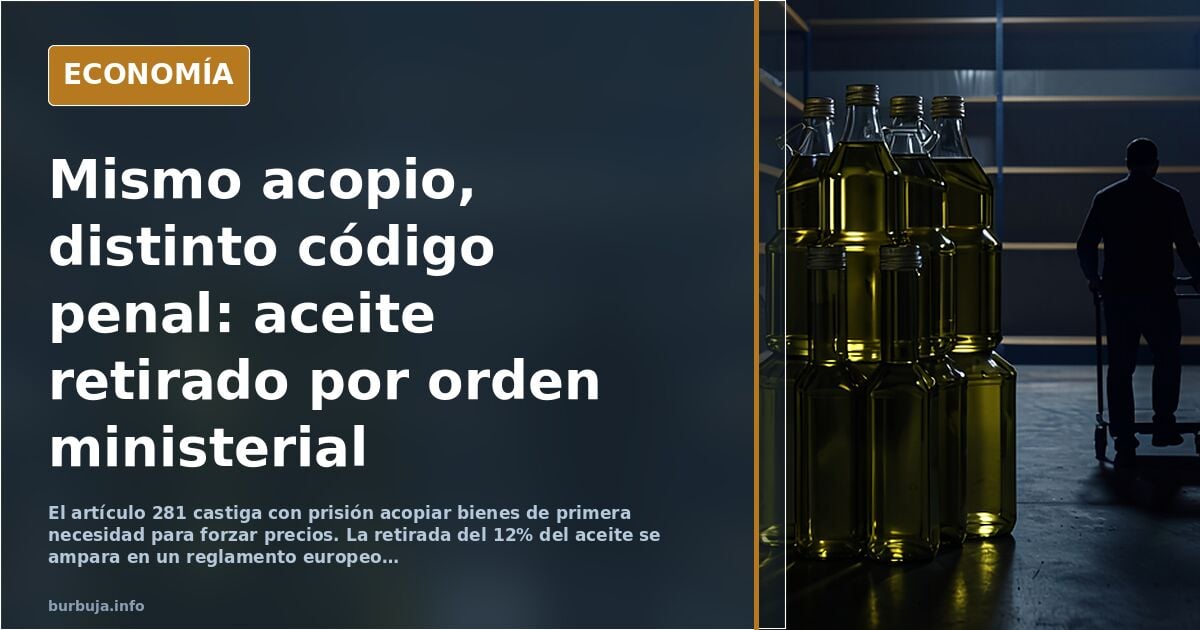
Withdrawing Olive Oil to Stabilize Prices: Legal When Signed by the BOE
A private individual who withdraws raw materials from the market to force price increases faces one to five years in prison. Article 281 of the Spanish Penal Code punishes those who withhold essential goods with the intent to cause shortages or manipulate prices. The same operation, signed by a ministerial order and published in the BOE (Official Gazette), is called agricultural policy. This is the core contradiction in the debate: the withdrawal of 12% of olive oil production to support quotations.
The mechanism has formal cover. The measure relies on Article 167 bis of Regulation 1308/2013 and a 2021 Royal Decree setting the activation threshold: stocks exceeding 120% of the average. According to available data, this threshold was met. On this basis, the legal conclusion is that the Penal Code does not apply to what a regulation expressly authorizes. The discussion on whether it is fair remains separate.
Why Is Withdrawing Olive Oil Not a Crime If Ordered by the Government?
Article 281 targets hoarders acting independently. It requires intent: withdrawing product with the aim of forcing prices up or harming consumers. When the withdrawal is ordered by an administration under European regulations, that element is missing and legal authorization exists. Hence, the path is administrative litigation, not incivil. Bottlers have announced appeals.
Some go further, alleging prevarication. The fit is difficult: prevarication requires an arbitrary decision issued knowing its injustice, without legal basis or flagrant distortion. Here there is a regulation, a royal decree, and a met threshold. One may discuss opportunity, proportionality, or competition clashes, but incivil reproach is hard to sustain.
Who Wins and Who Loses from the 12% Withdrawal
Benefit distribution is the most debated point. One thesis argues large distributors prefer the opposite: more supply, low origin prices, and wide margins. Oil is stored at source before reaching them. Another view warns that withdrawing product reduces circulating supply and pushes prices up, with speculation doing the rest. Small producers, it is argued, will see no benefit: they will be forced to sell to those dominating the market.
The order also does not specify quality or type of oil to withdraw. That choice lies with mills, which can remove the lowest quality oil from the market. A detail absent from press releases.
The €12 Precedent and Double Standards
When oil exceeded €12, there was no price cap or consumer protection. Those unable to pay were expelled from the market. This contrast fuels suspicion of double standards: intervention occurs when prices threaten to fall, not when they spike. The comparison with housing arises naturally: oil can be withdrawn from the market, but brick prices cannot be touched.
The fundamental critique is not legal, but ethical: legality does not equal justice. And there, the debate remains open.
The disorienting fact: the same act punished by the Penal Code with up to five years in jail is executed today with a ministerial seal, with no judge seeing any hint of crime.
Also available in: Deutsch
Summary of a discussion on Burbuja.info - Foro de economía, actualidad y política., translated from Spanish and reviewed before publication. Read the full discussion (36 replies).
More summaries
-
Bernardos Suggests Leaving Homes Vacant Amid Penal Code Debate
Economist Gonzalo Bernardos advises leaving properties vacant until legal certainty returns, sparking debate over Article 281.1 of the Spanish Penal Code.
-
Abdellah Mustafa: The Neighbourhood Voice of Ceuta on TV
Abdellah Mustafa, neighbourhood president of Sidi Embarek, has become omnipresent on television while critics accuse him of not mentioning Morocco.
-
Spain's Socialist Youth Ages Mocked in Viral Post
A post on X claims Spain's Socialist Youth average age is 70, criticizing bus travel. The data remains unverified.
-
Kraków shooter: Far-right links, Falanga shirt and anime
The Kraków shooting reignites debate over the killer's identity: a Falanga shirt, anime fandom, and screenshots linking him to anti-fascism.
-
Spain's General Strike Echoes 1966: Cheap Housing, Single Income
General strike in Spain highlights the 1966 model of affordable housing and single-income households, sparking debate on historical context.
-
Viral Claim That Beavers Outsmart Africans Is False
A viral post falsely claims beavers have better geometric skills than average Africans. The assertion lacks evidence and conflates animal behavior with human prejudice.