
Oat bran: the fiber that gets mistaken for the grain and sits like a rock
Oat bran is husk, not grain: the tolerable daily dose is around 10-30 grams, and without enough liquid it sits in your stomach like a rock.
English · Original discussion in Spanish · Published
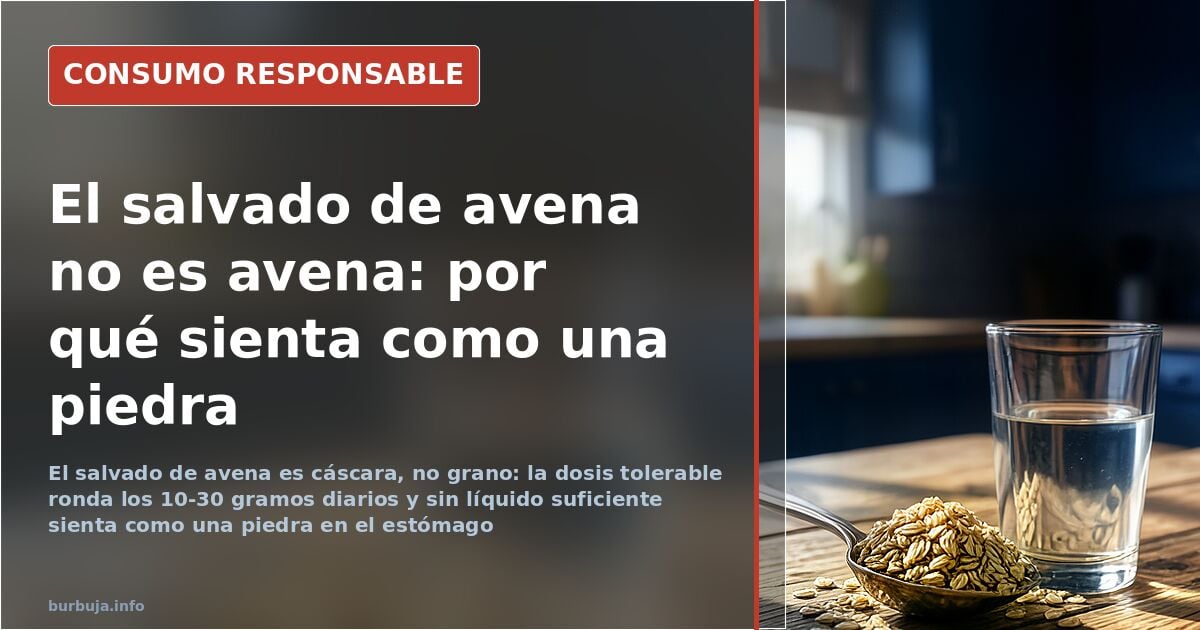
Oat bran is not oats: why it sits like a rock
A spoonful with your yogurt and it burns going down. The problem is not any particular brand of oat bran: it is that many of the people who buy it take it as if it were rolled oats. The confusion between the grain, the flake and the husk is the root of the issue, and it explains why a cheap fiber product ends up feeling like a brick in your stomach.
Bran is the outer layer of the grain. It is obtained by hulling the oat and is, in essence, mostly fiber. The flake and the grain are a different thing. Taking the same amount of one as the other is a textbook mistake: the husk is far harder to digest and draws in water, so without enough liquid it turns into a thick paste in the gut. Hence the discomfort.
How much oat bran you can take per day
According to one forum user, the tolerable dose for most people does not exceed 10 to 30 grams a day. Above that, the most common effects are abdominal bloating and painful diarrhea. It is not a dangerous food; it is a fiber concentrate that behaves as such. The practical advice that keeps coming up is to take it in small amounts, with plenty of liquid and, if possible, fine or ground, almost like flour.
There is an underlying paradox: for decades bran was a byproduct used for animal feed. Refined flour keeps the starch and throws away the husk. The fashion for eating it came later, along with the habit of treating it like just another cereal. It is not. It is cellulose fiber, and being surprised that it is hard to digest is like being surprised that a kilo of butter sits badly.
Why oat bran became trendy
The popularization of oat bran came hand in hand with weight-loss diets, which placed it at breakfast as a cheap appetite suppressant. Its low price and its fruta as healthy fiber did the rest. The result is a product bought for what it promises and consumed badly for what it is.
The matter also gets mixed up with distrust of store brands. Some claim the supermarket product contains additives added with bad intent; the argument does not hold up: bran is one of the few processed products that barely allows for cheating, and natural does not necessarily sit better. The real complaint is not about quality, it is about dosage.
Bran, flakes and grain: what the consumer is actually buying
The mistake repeats itself on the shelf. The package says bran, the buyer reads oats and the spoon serves up a portion of flakes. That is where it all starts. A product sold as healthy that ends up causing digestive problems leaves a trail of confused reviews blaming the store for what is a misreading of the label.
The anecdote that accompanies this kind of discussion is rather funny: in rural Spain in the mid-20th century, extolling the virtues of the natural and the cheap led to stories about trousers with a rear flap so as not to soil one's underwear. The nostalgia for the countryside as a consumer argument involves leaps like this. Bran, meanwhile, remains what it always was: husk.
Fiber is not a nutritional ornament or a superfood. It is husk, and it behaves like husk. Anyone who takes it by the spoonful without water will notice. The disorienting fact is that the product has barely changed in fifty years; what changed is how we read the label.
Also available in: Deutsch
Summary of a discussion on Burbuja.info - Foro de economía, actualidad y política., translated from Spanish and reviewed before publication. Read the full discussion (24 replies).
More summaries
-
Mercadona's kefir in Spain: fermented or just milk with strains?
Mercadona's kefir in Spain does not state how much kefir it contains or whether it is pasteurized. Homemade kefir, made with live grains, has a different texture and properties.
-
Coca-Cola priced at €2.17 in Spain's Mercadona: price breakdown
A €2.17 price tag for a 2-litre Coca-Cola bottle sparks debate over sugar taxes, private labels, and consumer habits.
-
Mercadona quality under scrutiny: what's wrong with Hacendado
Mercadona's quality myth is wobbling: supplier changes, less variety and rising prices. What's left of Hacendado's lead in Spain's supermarket wars?
-
Battery-powered bathroom fan: the offer doesn't keep up
A bathroom fan uses only 15 watts, like a light bulb. Yet battery-powered versions are scarce. Moisture can be solved, but not with batteries.
-
5W-30 vs. 0W-20 / 0W-16 vs. 0W-8
Are 0W-8, 0W-16 and 0W-20 oils a threat to your engine? The debate between manufacturers, workshops and drivers over ultra-thin viscosities and engine protection r
-
Movistar's blocks spread and now hit Champions League matches
Movistar has been granted the power to block IPs of any pirated Champions League broadcast, but the blocks hit legitimate websites. Users are turning to VPNs and Ace Stream.