
NYC Mayor Eric Adams: 10,000 Monthly Migrants Will 'Destroy' New York
New York Mayor Eric Adams warns that 10,000 monthly migrants will 'destroy' the city, reopening the debate on who pays the cost of the influx.
English · Original discussion in Spanish · Published
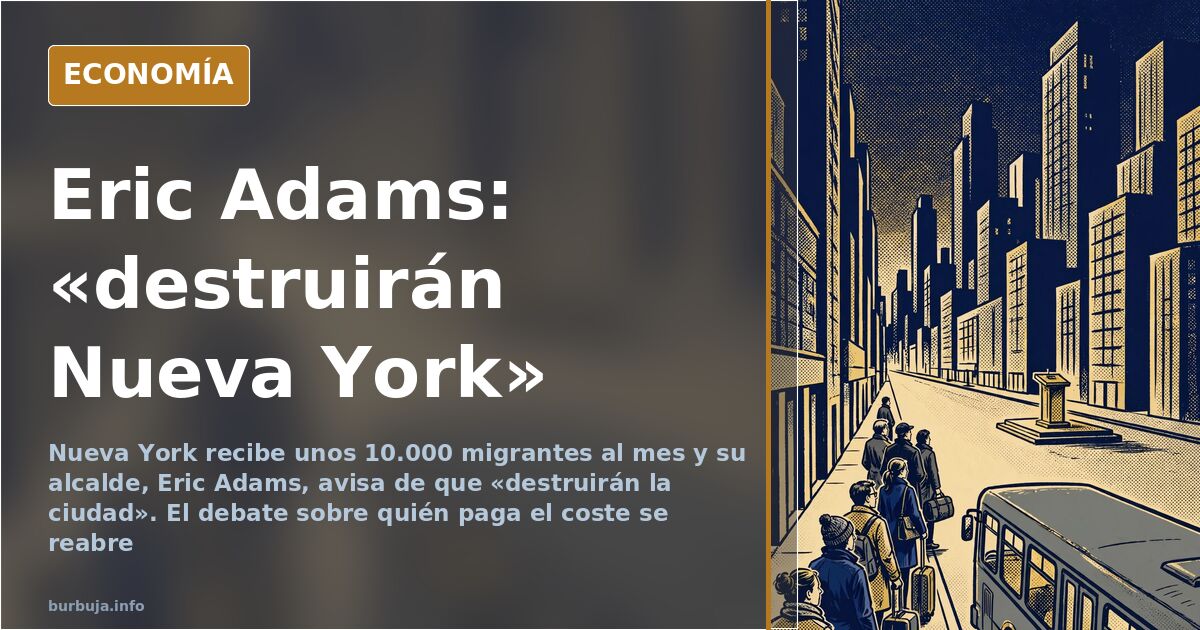
10,000 migrants per month and New York mayor's warning
New York receives around 10,000 South American migrants per month, mostly Venezuelans, according to the message sparking the debate. Mayor Eric Adams has quantified his concern: these arrivals will 'destroy New York' and 'everyone will be affected.' The message, spread via social media, carries an awkward detail: it comes from the office of a 'sanctuary city' governed by a Democrat. When the administrator of open-door policies complains about the bill, the conversation shifts.
The dispute behind this is not about one person, but a model. How much it costs, who pays, and how much urban deterioration is attributed to mass arrivals versus previous political decisions.
What New York mayor said exactly
The spread message attributes an unnuanced warning to Adams: migrants will 'destroy New York' and the impact will reach 'everyone.' The controversial detail is political, with two incompatible readings. Some analysis highlights the contradiction: the one now calling for restraint was part of the network that turned the city into a refuge for undocumented immigrants. Others read it the opposite way—precisely because he knows the terrain, his warning carries more weight than that of an external critic. The volume is not disputed. Who provokes it is.
How many migrants arrive in New York each month?
The figure driving the discussion is 10,000 people per month, with a Venezuelan majority, according to the framing opening the issue. This data repeats as an argument for collapse: pressure on shelters, social services, and healthcare. Some argue the wear is cumulative and noticeable in neighborhoods before statistics. Security, employment, and housing are the three fronts where the narrative clashes with accounting. And the public cost calculations circulating give disparate figures; this breakdown, built on unverified data, is exactly what is missing to know if the warning is real or a budgetary excuse.
New York is a sanctuary city: what it implies
Sanctuary city status limits police cooperation with federal immigration authorities. For some, it functions as a shield that attracts arrivals and blurs control. For others, it is the guarantee that no one is excluded from the healthcare or school systems for antiestéticar of arrest.
This status explains the underlying tug-of-war: cities that declared themselves welcoming now demand funds to sustain what they promised. Federal funds requested compete with other budgets, so the blame has become a tug-of-war between administrations of the same political party. No one wants to extinguish the fire with their own budget.
Buses from Texas and the draw effect
One of the episodes that has most marked the conversation is the bus transport. According to the circulating narrative, in the face of federal refusal to send funds, Texas financed with its own taxes the transfer of migrants to cities that proclaimed themselves 'humanitarian,' including New York. This maneuver converted declarative solidarity into a concrete, verifiable bill, leaving each receiving city with the hot potato.
The underlying argument is the draw effect: lax controls, temporary permits, and an implicit promise of welcome would have spurred the arrival of people who, without this framework, would not have undertaken the journey. Against this thesis, the rebuttal is simple: as long as there is demand for uncovered labor, closing the door only changes the route, not the flow.
The counterpoint: labor market and deindustrialization
Against the collapse narrative is a technical counterpoint. The US economy needs workers in sectors not covered by graduates—care, landscaping, construction, agriculture. Irregular immigration slips through this gap; it does not create it. Tightening controls has not closed the demand, only made it more expensive.
An uncomfortable reading for the receiving country also appears: deindustrialization and the dismantling of public services have left entire neighborhoods without economic fabric for decades. Blaming everything on the latest arrivals is more comfortable than admitting this hole. And a third, minority view recalls that those who receive today were once those who went abroad to impose rules by force.
Not all blame comes from outside. There are narratives from those who migrated earlier describing an internal clash between newcomers and residents of the same nationality, with mutual reproaches about coexistence. Nor are there descriptions portraying the city as what it always was: noisy, expensive, safe in some areas and much less so in others.
The point where analysis gets stuck is always the same. No one manages to separate how much deterioration is migration and how much is accumulated negligence over decades.
New York receives around 10,000 South American migrants per month, mostly Venezuelans, according to the message sparking the debate. Mayor Eric Adams has quantified his concern: these arrivals will 'destroy New York' and 'everyone will be affected.' The message, spread via social media, carries an awkward detail: it comes from the office of a 'sanctuary city' governed by a Democrat. When the administrator of open-door policies complains about the bill, the conversation shifts.
The dispute behind this is not about one person, but a model. How much it costs, who pays, and how much urban deterioration is attributed to mass arrivals versus previous political decisions.
What New York mayor said exactly
The spread message attributes an unnuanced warning to Adams: migrants will 'destroy New York' and the impact will reach 'everyone.' The controversial detail is political, with two incompatible readings. Some analysis highlights the contradiction: the one now calling for restraint was part of the network that turned the city into a refuge for undocumented immigrants. Others read it the opposite way—precisely because he knows the terrain, his warning carries more weight than that of an external critic. The volume is not disputed. Who provokes it is.
How many migrants arrive in New York each month?
The figure driving the discussion is 10,000 people per month, with a Venezuelan majority, according to the framing opening the issue. This data repeats as an argument for collapse: pressure on shelters, social services, and healthcare. Some argue the wear is cumulative and noticeable in neighborhoods before statistics. Security, employment, and housing are the three fronts where the narrative clashes with accounting. And the public cost calculations circulating give disparate figures; this breakdown, built on unverified data, is exactly what is missing to know if the warning is real or a budgetary excuse.
New York is a sanctuary city: what it implies
Sanctuary city status limits police cooperation with federal immigration authorities. For some, it functions as a shield that attracts arrivals and blurs control. For others, it is the guarantee that no one is excluded from the healthcare or school systems for antiestéticar of arrest.
This status explains the underlying tug-of-war: cities that declared themselves welcoming now demand funds to sustain what they promised. Federal funds requested compete with other budgets, so the blame has become a tug-of-war between administrations of the same political party. No one wants to extinguish the fire with their own budget.
Buses from Texas and the draw effect
One of the episodes that has most marked the conversation is the bus transport. According to the circulating narrative, in the face of federal refusal to send funds, Texas financed with its own taxes the transfer of migrants to cities that proclaimed themselves 'humanitarian,' including New York. This maneuver converted declarative solidarity into a concrete, verifiable bill, leaving each receiving city with the hot potato.
The underlying argument is the draw effect: lax controls, temporary permits, and an implicit promise of welcome would have spurred the arrival of people who, without this framework, would not have undertaken the journey. Against this thesis, the rebuttal is simple: as long as there is demand for uncovered labor, closing the door only changes the route, not the flow.
The counterpoint: labor market and deindustrialization
Against the collapse narrative is a technical counterpoint. The US economy needs workers in sectors not covered by graduates—care, landscaping, construction, agriculture. Irregular immigration slips through this gap; it does not create it. Tightening controls has not closed the demand, only made it more expensive.
An uncomfortable reading for the receiving country also appears: deindustrialization and the dismantling of public services have left entire neighborhoods without economic fabric for decades. Blaming everything on the latest arrivals is more comfortable than admitting this hole. And a third, minority view recalls that those who receive today were once those who went abroad to impose rules by force.
Not all blame comes from outside. There are narratives from those who migrated earlier describing an internal clash between newcomers and residents of the same nationality, with mutual reproaches about coexistence. Nor are there descriptions portraying the city as what it always was: noisy, expensive, safe in some areas and much less so in others.
The point where analysis gets stuck is always the same. No one manages to separate how much deterioration is migration and how much is accumulated negligence over decades.
Summary of a discussion on Burbuja.info - Foro de economía, actualidad y política., translated from Spanish and reviewed before publication. Read the full discussion (217 replies).
More summaries
-
Raúl Fidel Castro: the Lugo restaurateur born as a satire
The Parrillada Castro de Rey, on Rúa Galicia in Lugo, began as neighborhood news and has become viral satire about the Galician accent.
-
Spain to 30 Million: The Proposal and Its Achilles Heel
A proposal to reduce Spain’s population to 30-35 million clashes with an aging demographic and persistently low birth rates.
-
Poland's Nobel winner calls ethnic uniformity terrifying
Nobel laureate Olga Tokarczuk sparks debate on immigration and birth rates, labeling Poland's homogeneity frightening.
-
Ayuso compares Ceuta crisis to 2.5 million migrants in Madrid
Ayuso suggests imagining 2.5 million illegal entrants in Madrid to grasp the Ceuta crisis, highlighting silent demographic shifts.
-
Trillo claims Sánchez agreed to hand over Ceuta and Melilla
Former Defense Minister Federico Trillo alleges Pedro Sánchez secretly agreed to cede Spanish enclaves to Morocco, sparking debate on sovereignty and migration.
-
US Youth Return Home Amid Economic Precarity
Economic hardship in the US forces young adults to move back with parents, highlighting the true cost of independence.