
Nuevo Extremeñismo: the Spanish party born from a tweet and a pun
A tweet announces a Secretary General and a new party called Nuevo Extremeñismo in Spain. The name quickly becomes a joke, and the leadership raises doubts about whether another brand is needed.
English · Original discussion in Spanish · Published
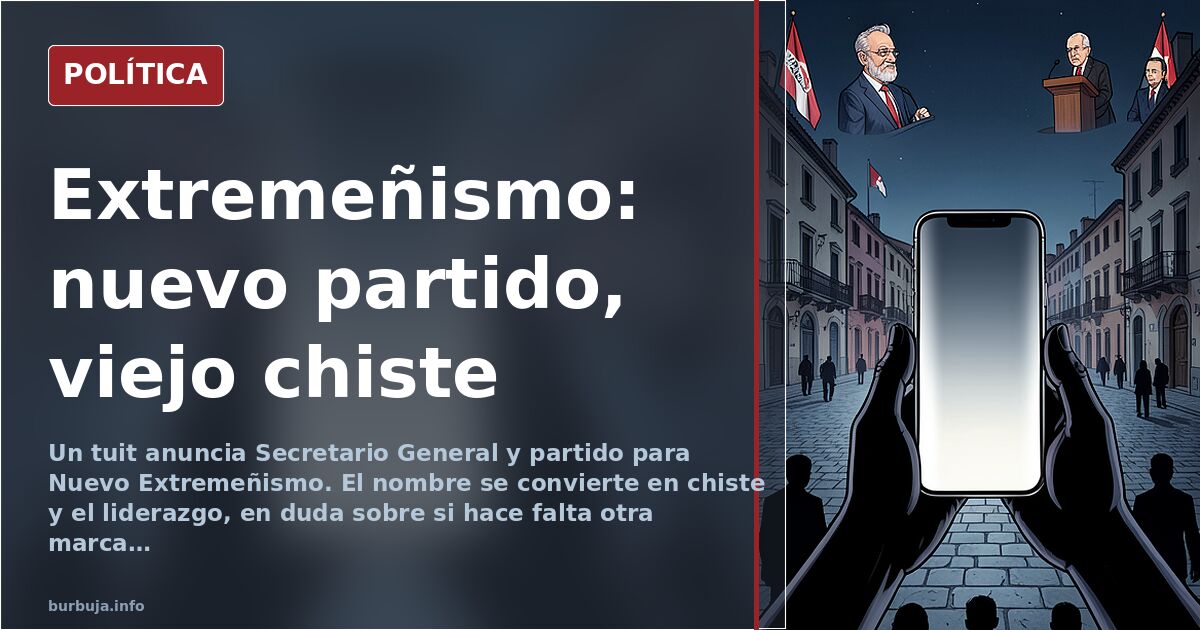
Nuevo Extremeñismo: from a tweet to mockery of personality politics
A tweet from the @Nuevo Extremeñismo account announces the launch of a new Secretary General and, with him, the public debut of a political party. The scene, with no official details beyond the message itself posted on social media, is enough to unleash a cascade of comments mixing cheap jokes with political suspicion. The project's name already invites wordplay: extremeñismo, extremeñido, constipation. And the personality cult around the position, sickle and all, completes the portrait.
What is known about the new Secretary General of Nuevo Extremeñismo
The announcement arrives wrapped in the aesthetics of an emerging party: its own account, a brief message, and a leadership presented as regional renewal. There is no program, no membership list, no headquarters. Just a name and an image. Into that vacuum slips the first political reading: this is another attempt by the left to build a regional brand to compete for a space that, according to part of the analysis, is already occupied with an advantage by Frente Obrero, credited with solid and charismatic leadership.
The comparison is not innocent. The new party, according to those who view it with skepticism, is born burdened with seeming like a laboratory operation rather than a grassroots movement. The reference to the «cabestro» (ox-leading stick) and the sickle in the initial message works as a wink of rural authenticity, but also as a reminder that rural imagery can turn into caricature.
The pun that swallows the political message
The conversation soon drifted toward the joke. The party's name lends itself to confusion with digestive ailments and to unintended readings ranging from «extremo efebo» to «extremo peruano». That is the risk of naming a project with such an elastic signifier: the brand is remembered, but not for its program. When public debate stops at the wordplay, the political message gets diluted.
Some argue the confusion is deliberate, a way of grabbing attention in an ecosystem saturated with acronyms. Against that weighs the argument that a party that has to explain its own name loses credibility before it even starts. The anecdote about the striking resemblance to a woman from the Yuste area, mentioned jokingly, illustrates just how much the project has become a dinner-table phenomenon.
The underlying debate: does Spain need another left-wing party?
Behind the joke lies a serious question. The space of radical and regionalist left politics seems crowded, and every new brand must justify why it is not a duplicate. The thesis gaining ground in the conversation is that the new Secretary General has no path of his own: his capital is that of an apparatus presenting itself as an alternative but which, in practice, competes for the same electorate other parties already mobilize.
The reference to the «great-great-grandson of a conquistador from Bellote and an Aymara woman» introduces, between the lines, the issue of identity and origins as a political argument. It is an old device: building legitimacy on lineage or territory. It works at a rally, but it does not replace governance or structure.
In the end, the unsettling fact is not the name or the sickle: it is that a party can present itself with a tweet and a position, nothing more. Spanish politics has long since turned into a branding contest, and extremeñismo, tongue-twister included, is the latest proof.
Summary of a discussion on Burbuja.info - Foro de economía, actualidad y política., translated from Spanish and reviewed before publication. Read the full discussion (18 replies).
More summaries
-
Spain's CIS poll adds Frente Obrero, sparking debate over 0.5%
The CIS has included Frente Obrero with 0.5% in its survey, igniting debate over whether it's a real threat or an electoral experiment. An analysis of its potential impact.
-
Frente Obrero unveils election poster featuring rampant lion
Spain's Frente Obrero reveals its general election poster for November 29, centering on a shieldless flag and a heraldic lion.
-
Frente Obrero fails in 2024 European elections with 66,242 votes
Frente Obrero secured only 66,242 votes (0.38%) in Spain's 2024 European elections despite millions of online views.
-
Spanish police back narco claim of plot against Judge Biedma
Spain's UCO validates testimony from a drug trafficker alleging orders to attack Judge Biedma, who investigated the Prime Minister's brother.
- A quick reflection on politicization
-
Spain urged to move Ceuta and Melilla's historic heritage to the mainland
A debate is underway on moving the historic heritage of Ceuta and Melilla to mainland Spain. We examine the feasibility and implications of the proposal.